
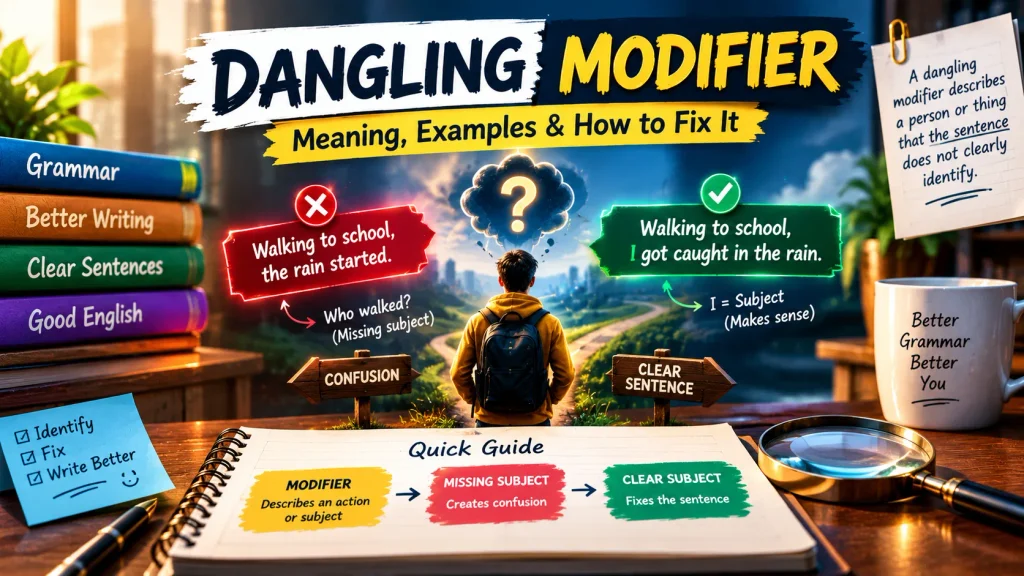
Dangling Modifier: A Dangling Modifier is a word, phrase, or clause that describes a person or thing that the sentence does not clearly identify. Dangling modifiers create confusing or illogical sentences because the intended subject is missing or does not match the modifier.
For example:
- Incorrect: Walking to school, the rain started pouring.
- Correct: Walking to school, I got caught in the rain.
In the incorrect sentence, the phrase “Walking to school” appears to describe “the rain,” but rain cannot walk. In the corrected sentence, “I” clearly identifies the person who walked to school.
Learning how to identify and correct dangling modifiers helps you write clearer sentences, improve your grammar, and avoid common writing mistakes.
What Is a Dangling Modifier?
A dangling modifier is a descriptive word, phrase, or clause that lacks a clear grammatical connection to the word it modifies. It often appears at the beginning of a sentence, followed by a subject that cannot logically perform the action described by the modifier.
Consider this example:
Incorrect: After finishing the assignment, the television was turned on.
Who finished the assignment? The sentence does not identify the person. Instead, the television appears immediately after the introductory phrase, creating an illogical connection.
Correct: After finishing the assignment, Sarah turned on the television.
Now, the subject “Sarah” logically connects to the phrase “After finishing the assignment.”
Dangling modifiers commonly occur with introductory participial phrases, infinitive phrases, and clauses that do not clearly identify their intended subjects.
Dangling Modifier Examples
Here are several examples that demonstrate how dangling modifiers create confusion and how to correct them.
| Incorrect sentence | Correct sentence |
| Driving to work, the traffic became heavy. | Driving to work, I encountered heavy traffic. |
| After reading the book, the movie seemed disappointing. | After reading the book, Maria found the movie disappointing. |
| To pass the exam, regular practice is necessary. | To pass the exam, students must practice regularly. |
| Walking through the park, the flowers looked beautiful. | Walking through the park, we admired the beautiful flowers. |
| Having finished dinner, the dishes were washed. | Having finished dinner, Jack washed the dishes. |
| While studying for the test, the phone rang. | While I was studying for the test, the phone rang. |
| Exhausted from the journey, the hotel looked welcoming. | Exhausted from the journey, we found the hotel welcoming. |
| To improve her writing, more books should be read. | To improve her writing, Emma should read more books. |
These examples show that the subject following an introductory modifier must logically match the person or thing described by that modifier.
Explore More: https://wordminto.com/misplaced-modifier/
What Causes Dangling Modifiers?
Dangling modifiers usually occur when writers omit the intended subject, place the wrong subject after an introductory phrase, or use a sentence structure that separates a modifier from its logical target.
1. Missing Subject
Writers sometimes leave out the person acting.
Incorrect: After completing the project, the report was submitted.
Correct: After completing the project, Daniel submitted the report.
The corrected sentence identifies Daniel as the person who completed the project and submitted the report.
2. Incorrect Sentence Structure
A sentence may contain the correct information but arrange it in a way that creates an illogical connection.
Incorrect: Running across the field, the ball hit the player.
Correct: Running across the field, the player was hit by the ball.
The revised sentence connects the running action to the player rather than the ball.
3. Misplaced Introductory Phrases
An introductory phrase can create a dangling modifier when the following subject does not match its meaning.
Incorrect: After working all night, the assignment was finally complete.
Correct: After working all night, Olivia finally completed the assignment.
The corrected version identifies Olivia as the person who worked all night.
4. Unclear Infinitive Phrases
Infinitive phrases beginning with “to” can dangle when the sentence does not identify who intends to act.
Incorrect: To become a successful writer, patience is essential.
Correct: To become a successful writer, you need patience.
The second sentence clearly identifies “you” as the person who wants to become a successful writer.
Explore More: https://wordminto.com/squinting-modifier/
Types of Dangling Modifiers
Dangling modifiers can occur in several grammatical structures. Understanding these patterns makes them easier to recognize and correct.
1. Dangling Participial Phrases
A participial phrase begins with a present participle ending in -ing or a past participle, such as walking, running, exhausted, or confused.
Incorrect: Looking out the window, the mountains appeared beautiful.
Correct: Looking out the window, I admired the beautiful mountains.
The phrase “Looking out the window” must describe the person looking, not the mountains.
More examples:
- Incorrect: Sitting on the sofa, the music sounded relaxing.
- Correct: Sitting on the sofa, Maya listened to relaxing music.
- Incorrect: Shocked by the news, the newspaper fell to the floor.
- Correct: Shocked by the news, David dropped the newspaper.
2. Dangling Infinitive Phrases
An infinitive phrase begins with “to” followed by the base form of a verb, such as to learn, to succeed, or to understand.
Incorrect: To win the competition, hard work is required.
Correct: To win the competition, the team must work hard.
More examples:
- Incorrect: To save money, unnecessary purchases should be avoided.
- Correct: To save money, you should avoid unnecessary purchases.
- Incorrect: To understand the lesson, additional examples were needed.
- Correct: To understand the lesson, students needed additional examples.
3. Dangling Gerund-Related Constructions
Gerunds function as nouns, so not every phrase containing an -ing word creates a dangling modifier. However, sentences involving gerund-like expressions can become unclear when the person responsible for an action remains unidentified.
Unclear: After spending hours on the project, completing it felt wonderful.
Clearer: After spending hours on the project, Liam felt wonderful when he completed it.
The revised sentence identifies Liam as the person who spent hours working on the project.
4. Dangling Absolute Phrases
An absolute phrase modifies an entire sentence and usually contains a noun or pronoun followed by a participle or another descriptive element.
Incorrect: The weather being perfect, a picnic in the park seemed ideal for us walking along the river.
This construction mixes the absolute phrase with an unclear relationship between the picnic and the people walking.
Clearer: The weather being perfect, we decided to have a picnic in the park.
The revised sentence expresses the intended relationship clearly.
5. Dangling Purpose Clauses
Purpose clauses explain why someone acts. They can become unclear when the sentence does not identify the person with that purpose.
Incorrect: In order to improve his grades, more studying was necessary.
Correct: In order to improve his grades, Kevin needed to study more.
The corrected sentence identifies Kevin as the person who wants to improve his grades.
Explore More: https://wordminto.com/setup-or-set-up/
Dangling Modifier vs Misplaced Modifier
Dangling modifiers and misplaced modifiers both create confusing sentences, but they differ importantly.
- A dangling modifier lacks an appropriate word or subject to modify.
- A misplaced modifier has an intended word to modify, but the sentence places it in the wrong position.
| Feature | Dangling Modifier | Misplaced Modifier |
| Main problem | The intended subject is missing or unclear. | The modifier appears in the wrong position. |
| Example | Walking to class, the rain started. | She almost drove her children to school every day. |
| Correction | Walking to class, I got caught in the rain. | She drove her children to school almost every day. |
| Common cause | Missing or illogical subject | Poor word or phrase placement |
In the misplaced-modifier example, “almost” changes the meaning. The original suggests that she nearly drove her children but might not have done so. The corrected sentence indicates that she drove them on most days.
Dangling Modifier vs Squinting Modifier
A squinting modifier sits between two parts of a sentence and could logically modify either one. This placement creates ambiguity rather than the missing subject that typically causes a dangling modifier.
Squinting modifier example:
Unclear: Students who study regularly often perform well.
The word “often” could refer to how frequently students study or how frequently they perform well.
Clearer: Students who study regularly tend to perform well.
Alternatively, if the intended meaning concerns study frequency:
Clearer: Students who regularly study tend to perform well.
A dangling modifier has a different problem:
Incorrect: Studying regularly, good grades become easier to achieve.
Correct: Studying regularly, students find it easier to achieve good grades.
The second sentence identifies the students as the people doing the studying.
Explore More: https://wordminto.com/adapt-vs-adopt/
How to Identify a Dangling Modifier
You can identify dangling modifiers by examining the relationship between a descriptive phrase and the subject of the main clause.
Follow these steps.
Step 1: Find the Modifier
Look for a descriptive phrase, especially one at the beginning of a sentence.
Example: “After finishing the meal, the dishes were placed in the sink.”
The modifier is “After finishing the meal.”
Step 2: Identify the Action
Ask who performed the action described by the modifier.
Who finished the meal? A person did, but the sentence does not name that person.
Step 3: Check the Main Subject
Find the subject of the main clause.
In the example, the subject is “the dishes.” Dishes do not eat meals, so the modifier dangles.
Step 4: Rewrite the Sentence
Add the intended subject or restructure the sentence.
Correct: After finishing the meal, Emma placed the dishes in the sink.
This version connects the introductory phrase to the person who acted.
Step 5: Read the Sentence Again
Check whether the sentence communicates your intended meaning without confusion.
Ask yourself:
- Does the modifier describe the correct person or thing?
- Does the sentence identify the person acting?
- Does the sentence sound logical when read aloud?
If the answers are yes, you have likely corrected the dangling modifier.
Explore More: https://wordminto.com/can-vs-could/
Rules for Correcting Dangling Modifiers
Follow these practical rules to make your sentences grammatically clear.
Rule 1: Place the Intended Subject After the Introductory Modifier
Incorrect: Walking into the room, the lights were bright.
Correct: Walking into the room, I noticed the bright lights.
The subject “I” is walking into the room.
Rule 2: Add the Missing Subject
Incorrect: To complete the task on time, careful planning was required.
Correct: To complete the task on time, the manager needed careful planning.
The corrected sentence names the person responsible for completing the task.
Rule 3: Rewrite the Sentence When Necessary
Sometimes changing the sentence structure produces a more natural result.
Incorrect: Having been delayed by traffic, the meeting started late.
Correct: Because traffic delayed the attendees, the meeting started late.
This version removes the unclear connection between the attendees and the meeting.
Rule 4: Use a Complete Clause
When an introductory phrase creates confusion, a complete clause can clarify the relationship.
Incorrect: While preparing dinner, the doorbell rang.
Correct: While I was preparing dinner, the doorbell rang.
The complete clause identifies the person preparing dinner.
Rule 5: Make the Intended Meaning Explicit
Avoid relying on readers to guess who acted.
Incorrect: To get a better result, the instructions were followed carefully.
Correct: To get a better result, the researchers followed the instructions carefully.
The revised sentence clearly identifies the people following the instructions.
Dangling Modifier Examples in Everyday Writing
Dangling modifiers appear in school assignments, workplace communication, emails, essays, and everyday conversation.
Academic Writing
Incorrect: After analyzing the results, several errors were discovered.
Correct: After analyzing the results, the researchers discovered several errors.
The corrected sentence identifies the researchers as the people who analyzed the results.
Business Writing
Incorrect: To increase sales, a new marketing strategy was developed.
Correct: To increase sales, the marketing team developed a new strategy.
The corrected version identifies the team responsible for the action.
Email Writing
Incorrect: After reviewing your application, an interview was scheduled.
Correct: After reviewing your application, we scheduled an interview.
The revised sentence identifies the person or group that reviewed the application and scheduled the interview.
Creative Writing
Incorrect: Entering the dark forest, strange sounds could be heard.
Correct: Entering the dark forest, Leo heard strange sounds.
The corrected version connects the action of entering the forest to Leo.
News Writing
Incorrect: Investigating the incident, several witnesses were interviewed by the reporter.
Correct: While investigating the incident, the reporter interviewed several witnesses.
The revised sentence directly identifies the reporter as the person conducting the investigation.
Common Mistakes to Avoid
Writers often make the following mistakes when dealing with dangling modifiers.
1. Assuming Every Introductory Phrase Is Incorrect
Introductory phrases are perfectly acceptable when they logically connect to the subject.
Correct: Walking through the garden, Sarah smelled the roses.
The phrase “Walking through the garden” correctly describes Sarah.
2. Correcting Only the Punctuation
Adding a comma does not fix a dangling modifier.
Incorrect: Walking through the garden, the roses smelled wonderful.
Still incorrect: Walking through the garden; the roses smelled wonderful.
Correct: Walking through the garden, Sarah noticed that the roses smelled wonderful.
The problem concerns the grammatical relationship, not punctuation alone.
3. Replacing the Subject Without Checking the Meaning
A correction must preserve the intended message.
Incorrect: Hoping to pass the exam, the textbook was studied all night.
Possible correction: Hoping to pass the exam, Daniel studied the textbook all night.
The correction identifies Daniel as the person who hopes to pass the exam and studies the textbook.
4. Using Unclear Pronouns
Pronouns can make a modifier’s target unclear when readers cannot identify the intended person.
Unclear: After reviewing the document, it seemed inaccurate.
Clearer: After reviewing the document, Priya decided that it contained inaccurate information.
The revised sentence identifies Priya as the person reviewing the document and making the judgment.
5. Ignoring the Logical Meaning
A sentence may look grammatically structured but still connect a modifier to the wrong subject.
Incorrect: Covered in chocolate, the children enjoyed the strawberries.
This sentence suggests that the children were covered in chocolate.
Correct: Covered in chocolate, the strawberries delighted the children.
The modifier now describes the strawberries.
Why Are Dangling Modifiers Important?
Dangling modifiers matter because they affect clarity, accuracy, and readability.
- Clarity: They help readers understand who acts.
- Grammar: Correct modifier placement strengthens sentence structure.
- Professional writing: Clear sentences make reports, applications, and business documents easier to understand.
- Academic writing: Correct modifiers help students communicate research findings precisely.
- Reader experience: Logical sentences reduce confusion and improve the flow of a paragraph.
Although readers can often infer the intended meaning, dangling modifiers may create unintended humor or change how a sentence sounds. Correcting them makes your writing more precise and professional.
Practice Exercises: Identify and Correct Dangling Modifiers
Test your understanding by identifying the dangling modifier in each sentence and rewriting it to make the meaning clear.
Exercise 1: Choose the Correct Sentence
1. Which sentence contains a dangling modifier?
A. Walking to the store, I saw my friend.
B. Walking to the store, the rain soaked my clothes.
C. I walked to the store and bought some milk.
2. Which sentence correctly fixes the modifier?
A. After finishing the homework, the television was watched.
B. After finishing the homework, the student watched television.
C. After finishing the homework, the television looked interesting.
3. Which sentence contains a dangling infinitive phrase?
A. To improve her vocabulary, Mia reads every day.
B. To improve her vocabulary, regular reading is helpful.
C. Mia reads every day to improve her vocabulary.
Exercise 2: Correct the Sentences
Rewrite each sentence so that the modifier clearly describes the intended person or thing.
- Running down the street, the backpack fell off.
- After completing the assignment, the computer was shut down.
- To get a promotion, hard work is necessary.
- Walking into the kitchen, the smell of fresh bread was wonderful.
- Having studied all night, the exam seemed easy.
Answers to the Practice Exercises
Exercise 1: Multiple-Choice Answers
- B. Walking to the store, the rain soaked my clothes. The phrase appears to describe the rain as walking.
- B. After finishing the homework, the student watched television. The student performs both actions.
- B. To improve her vocabulary, regular reading is helpful. The sentence does not explicitly identify who wants to improve her vocabulary, and “her” has no clear referent.
Exercise 2: Suggested Corrections
- Correct: Running down the street, Jack felt his backpack fall off.
- Correct: After completing the assignment, Maria shut down the computer.
- Correct: To get a promotion, employees must work hard.
- Correct: Walking into the kitchen, I noticed the wonderful smell of fresh bread.
- Correct: Having studied all night, James found the exam easy.
Other corrections may also work if they preserve the intended meaning and clearly connect each modifier to its subject.
People Also Ask
A dangling modifier is a descriptive phrase that does not clearly describe the intended person or thing in a sentence.
Example: Running to school, the bus arrived.
Correction: Running to school, Jake saw the bus arrive.
Identify the descriptive phrase, determine who or what should act, and make that person or thing the clear subject of the sentence. You can also rewrite the sentence as a complete clause.
Incorrect: After eating lunch, the dishes were washed.
Correct: After eating lunch, Anna washed the dishes.
The corrected sentence identifies Anna as the person who ate lunch and washed the dishes.
A dangling modifier lacks a clear or logical word to modify, while a misplaced modifier sits in the wrong position and creates confusion about which word it describes.
Yes. Dangling modifiers can occur in different sentence positions, although they often appear at the beginning.
Example: The report was submitted to meet the deadline, hoping to avoid a penalty.
The phrase “hoping to avoid a penalty” does not clearly identify who has that hope.
Correction: Hoping to avoid a penalty, the employee submitted the report before the deadline.
Conclusion
A Dangling Modifier occurs when a descriptive phrase lacks a clear or logical connection to the word it should modify. These errors often involve introductory participial phrases, infinitive phrases, and missing subjects.
To correct a dangling modifier, identify the intended subject, connect the modifier to that subject, and rewrite the sentence if necessary. For example, change “Walking to school, the rain started” to “Walking to school, I got caught in the rain.”
With regular practice, you can recognize dangling modifiers, correct common grammatical mistakes, and write clearer, more effective English sentences.











3 thoughts on “Dangling Modifier: Meaning, Rules, Examples, and How to Fix It”