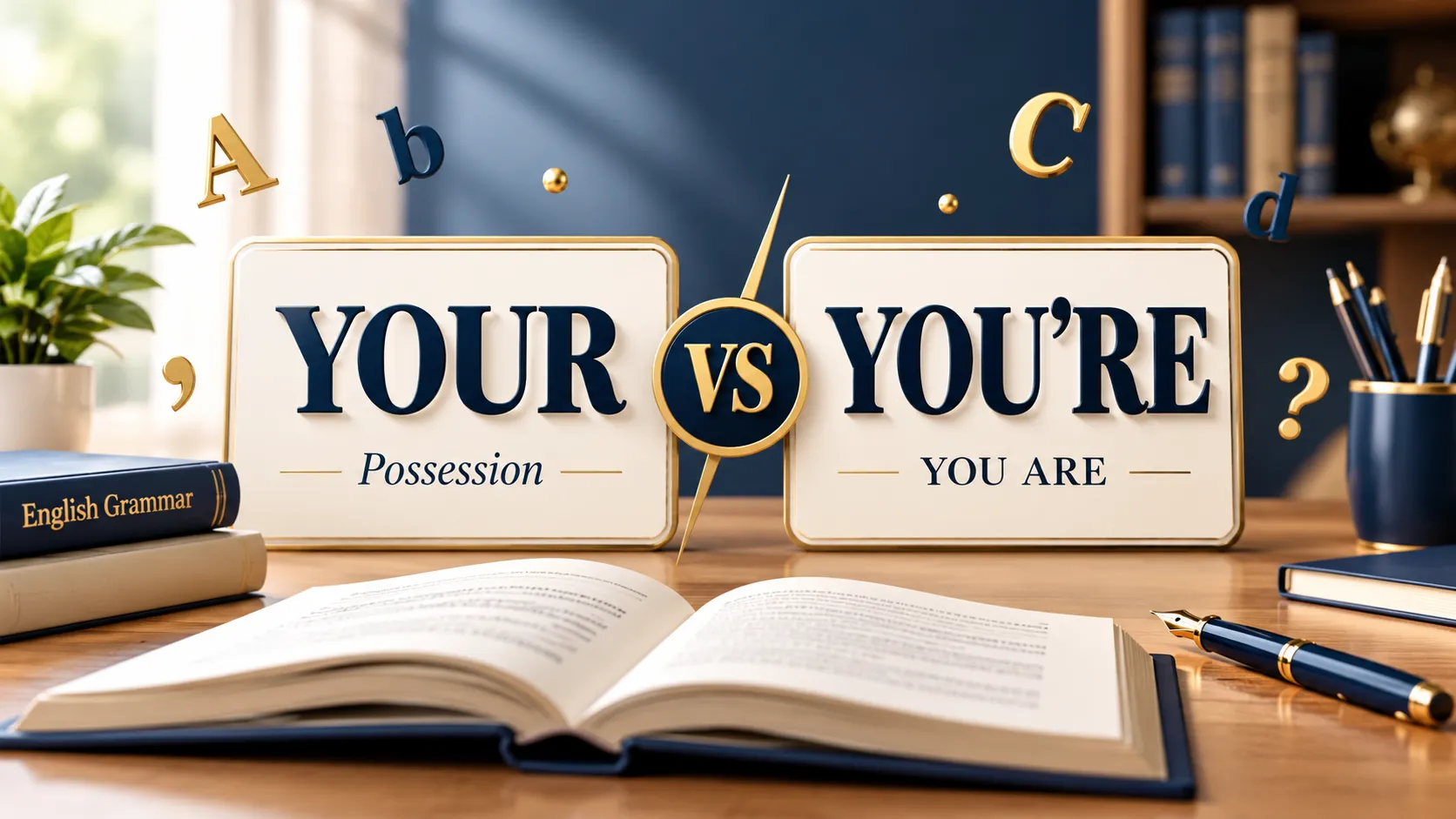
Your vs You’re: Your and you’re are two commonly confused English words. They sound similar in many varieties of English, but they have completely different grammatical functions and meanings.
The easiest way to remember the difference is:
- Your = shows possession or connection to someone.
- You’re = short for you are.
For example:
- Your phone is ringing.
- You’re late for class.
A simple substitution test can help: if you can replace you’re with you are, use you’re. If that does not work and the word is describing something belonging or relating to you, use your.
Your vs You’re: Quick Answer
| Word | Meaning | Grammar | Example |
| Your | Belonging or relating to you | Possessive determiner | I like your new car. |
| You’re | You are | Contraction | You’re very kind. |
The easiest rule
Your = belonging to you
Is this your book?
You’re = you are
You’re reading a book.
If you can expand you’re to you are, it is correct.
You’re ready. → You are ready. ✓
But:
I like your idea. → I like you are idea. ✗
Therefore, your is correct.
What Does “Your” Mean?
Your is a possessive determiner used to show that something belongs to, relates to, or is associated with the person or people being addressed. Cambridge identifies your as a determiner that is used before a noun.
Examples of “your”
- Where is your phone?
- I like your jacket.
- What is your name?
- Please bring your passport.
- Have you finished your homework?
- Is this your seat?
- I appreciate your help.
- How was your trip?
In each sentence, your connects the person being addressed with a noun.
Your + noun
A useful grammatical pattern is:
your + noun
Examples:
- your car
- your house
- your friend
- your idea
- your job
- your name
- your family
- your answer
Cambridge explains that possessive determiners such as your are used before nouns.
What Does “You’re” Mean?
You’re is a contraction of you are. Cambridge defines it directly as the short form of you are.
The apostrophe represents letters omitted from you are.
You are → You’re
Examples of “you’re”
- You’re very talented.
- You’re late.
- You’re my best friend.
- You’re doing a great job.
- You’re going to love this movie.
- You’re responsible for the project.
- You’re welcome here.
- You’re probably right.
Try expanding each sentence:
You’re very talented.
→ You are very talented.
You’re late.
→ You are late.
Because you’re can be replaced by you are, it is the correct form.
Your vs. You’re: The Main Difference
The biggest difference is grammatical.
Your expresses possession or association.
I like your shoes.
You’re means you are.
You’re wearing new shoes.
Compare these:
| Your | You’re |
| Your dog is cute. | You’re a good dog owner. |
| I like your idea. | You’re very creative. |
| Where is your phone? | You’re using my phone. |
| Your answer is correct. | You’re correct. |
| I found your keys. | You’re lucky I found them. |
| Is that your bag? | You’re carrying a heavy bag. |
The trick is to look at what comes after the word and what the sentence means.
When Should You Use “Your”?
Use your when you are talking about something belonging to or connected with the person you are addressing.
1. To show possession
Where is your car?
I borrowed your pen.
Did you bring your passport?
2. To show a relationship
How is your brother?
I met your teacher yesterday.
Is your mother at home?
3. To describe something associated with someone
I understand your concern.
I respect your opinion.
Thank you for your help.
4. Before a noun
Your normally appears directly before a noun or noun phrase.
your house
.
your new house
.
your favorite book
.
your best friend
.
your English teacher
Examples:
I love your new dress.
Please check your email.
What is your favorite movie?
When Should You Use “You’re”?
Use you’re when you mean you are.
1. Before an adjective
You’re happy.
.
You’re intelligent.
.
You’re tired.
.
You’re ready.
Here:
You’re = You are
2. Before a present participle (-ing form)
You’re working hard.
.
You’re learning quickly.
.
You’re making progress.
.
You’re driving too fast.
Expanded:
You’re working hard.
→ You are working hard.
3. Before a noun or noun phrase
You’re a great teacher.
.
You’re my best friend.
.
You’re the person I was looking for.
4. Before other complements
You’re in the right place.
.
You’re at the wrong address.
.
You’re on the correct page.
In all these examples, you’re means you are.
Your or You’re: The Replacement Test
The fastest way to choose between your and you’re is the “you are” test.
Step 1: Read the sentence
I think you’re right.
Step 2: Replace “you’re” with “you are”
I think you are right.
The sentence still works, so you’re is correct.
Now try:
I like your idea.
Replace your with you are:
I like you are idea. ✗
That does not work, so your is correct.
More examples
___ very funny.
→ You are very funny. ✓
Answer: You’re
I like ___ new haircut.
→ I like you are new haircut. ✗
Answer: Your
___ going to enjoy this.
→ You are going to enjoy this. ✓
Answer: You’re
Where is ___ notebook?
→ Where is you are notebook? ✗
Answer: Your
Your vs. You’re Examples
Here are more examples to make the difference clear.
Correct use of “your”
- I like your new shoes.
- Where is your brother?
- Did you finish your homework?
- Please bring your laptop.
- What is your favorite color?
- I agree with your opinion.
- Your house looks beautiful.
- I found your wallet.
- Please check your email.
- How was your vacation?
Correct use of “you’re”
- You’re very kind.
- You’re doing well.
- You’re late again.
- You’re going to love it.
- You’re absolutely right.
- You’re working too hard.
- You’re a talented writer.
- You’re invited to the party.
- You’re making good progress.
- You’re welcome.
Common Your and You’re Mistakes
Because the two words are pronounced similarly, they are frequently confused in writing. Grammarly lists your/you’re among common English homophone pairs.
Mistake 1
❌ Your going to love this movie.
Correct:
✅ You’re going to love this movie.
Why?
You’re = You are
You are going to love this movie.
Mistake 2
❌ I like you’re new car.
Correct:
✅ I like your new car.
Why?
The sentence refers to a car belonging to you.
your + car
Mistake 3
❌ Your very helpful.
Correct:
✅ You’re very helpful.
Why?
You’re = You are
You are very helpful.
Mistake 4
❌ I like you’re idea.
Correct:
✅ I like your idea.
Why?
Your modifies the noun idea.
Mistake 5
❌ I hope your ready.
Correct:
✅ I hope you’re ready.
Why?
I hope you are ready.
Your vs. You’re in Questions
The same rule applies in questions.
Your
Is this your phone?
What is your name?
Where is your car?
Have you finished your work?
You’re
Are you’re ready? ❌
Notice something important here: after Are, you normally use you, not you’re.
Correct:
Are you ready? ✓
But in a statement:
You’re ready. ✓
Other examples:
Are you coming with us?
You’re coming with us.
This distinction is important because you’re already contains the verb are.
Your vs. You’re in Negative Sentences
You’re can also be used in negative constructions:
You’re not wrong.
.
You’re not alone.
.
You’re not listening.
.
You’re not responsible for this.
Here:
You’re not = You are not
However, your does not mean “you are.”
Your not ready. ❌
Correct:
You’re not ready. ✓
Your vs. You’re in Formal Writing
Both words are grammatically correct, but they have different functions.
Your is used normally in both formal and informal writing:
Please submit your application by Friday.
You’re is also grammatically correct, but it is a contraction. In highly formal writing, some writers may prefer the expanded form you are depending on the style and context.
For example:
You are required to submit the form.
Instead of:
You’re required to submit the form.
The important point is that you’re is not an incorrect or informal version of your. They are different words with different grammatical functions.
Your, You’re, and Yours
Another common source of confusion is yours.
These three forms are different:
| Word | Meaning | Example |
| Your | Belonging or relating to you; used before a noun | Is this your book? |
| You’re | You are | You’re very helpful. |
| Yours | Belonging to you; used independently | This book is yours. |
Cambridge describes your as a possessive determiner and yours as a possessive pronoun.
Compare:
This is your book.
This book is yours.
But:
You’re reading the book.
Here, you’re means you are.
Your vs. You’re vs. You
Do not confuse you with your or you’re.
You
You is a personal pronoun referring to the person or people being addressed.
.
You are my friend.
Your
Your indicates possession or connection.
This is your book.
You’re
You’re means you are.
.
You’re my friend.
Compare:
You are using your phone because you’re waiting for a call.
Each word has a different function.
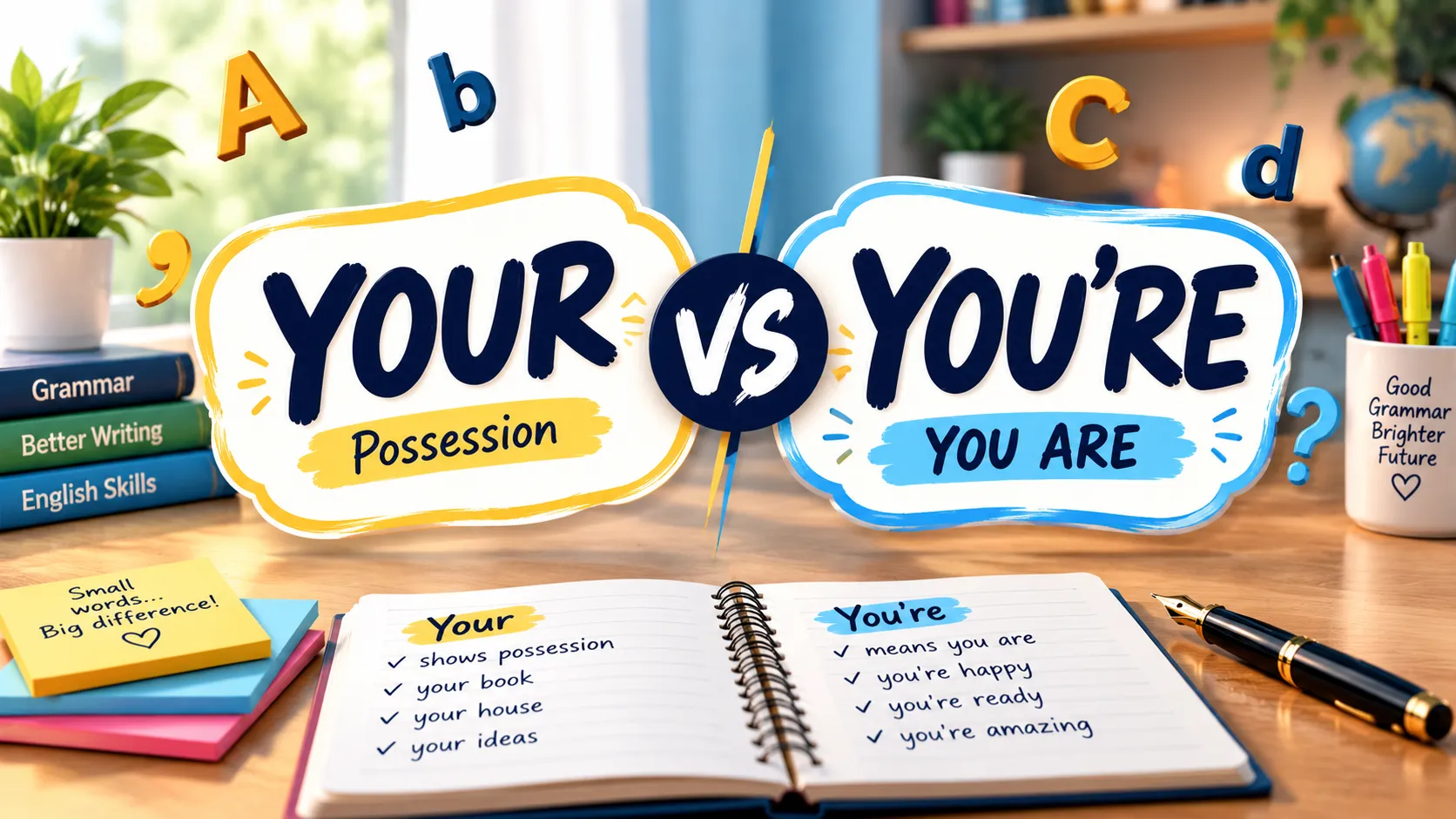
A Simple Memory Trick for Your vs. You’re
Remember:
YOUR = YOUR thing
If something belongs or relates to you, use your.
your phone
your house
your opinion
your family
YOU’RE = YOU ARE
If you can say you are, use you’re.
You’re happy.
→ You are happy.
.
You’re learning.
→ You are learning.
.
You’re a student.
→ You are a student.
The apostrophe clue
The apostrophe in you’re signals that letters have been omitted:
you are → you’re
So when you see you’re, think:
YOU + ARE
Your or You’re: A Quick Decision Tree
When you are unsure, ask:
Does the sentence mean “you are”?
- Yes → You’re
- No → Your
Then ask:
Is it showing that something belongs to or relates to you?
- Yes → Your
Examples:
___ very funny.
“You are very funny.”
→ You’re
I like ___ sense of humor.
“You are sense of humor” does not work.
→ Your
___ going to win.
“You are going to win.”
→ You’re
I like ___ chances.
“You are chances” does not work.
→ Your
Explore More: https://wordminto.com/principal-or-principle/
Your or You’re: Common Expressions
Expressions with “your”
- your best
- your own
- your choice
- your turn
- your way
- your fault
- your responsibility
- your opinion
- your decision
- your future
- your life
- your time
- your name
- your family
- your friend
Examples:
It is your choice.
Take your time.
That is your decision.
Expressions with “you’re”
- you’re right
- you’re wrong
- you’re welcome
- you’re welcome to…
- you’re going to…
- you’re supposed to…
- you’re allowed to…
- you’re responsible for…
- you’re ready
- you’re late
- you’re invited
- you’re doing well
Examples:
You’re right about that.
.
You’re welcome to join us.
.
You’re supposed to be here at nine.
Is “Your” a Contraction?
No.
Your is not a contraction. It is a possessive determiner.
You’re is a contraction because it is shortened from you are.
| Form | Full form | Type |
| your | — | Possessive determiner |
| you’re | you are | Contraction |
The apostrophe in you’re is therefore meaningful: it indicates the omitted letters in the contraction.
Is “You’re” Possessive?
No.
You’re does not show possession.
It means:
you are
For possession, use:
your
Example:
Your phone is ringing.
Not:
You’re phone is ringing. ❌
The second sentence would effectively mean:
You are phone is ringing.
That grammatical structure does not work.
Why Do People Confuse Your and You’re?
The main reason is pronunciation.
Depending on accent and context, your and you’re can sound the same or very similar. Grammarly identifies them as a commonly confused homophone pair.
Speech does not always reveal which spelling is intended, so writers must determine the correct form from grammar and meaning.
For example:
I like your idea.
and
You’re very creative.
The words may sound similar, but their grammatical roles are different.
Your or You’re: Comparison Examples
| Incorrect | Correct | Reason |
| Your going home. | You’re going home. | You are going home. |
| I like you’re house. | I like your house. | Possession. |
| Your very kind. | You’re very kind. | You are very kind. |
| Is that you’re bag? | Is that your bag? | The bag belongs to you. |
| I think your right. | I think you’re right. | You are right. |
| Check you’re email. | Check your email. | The email is associated with you. |
| Your invited. | You’re invited. | You are invited. |
| I love you’re style. | I love your style. | Your style. |
| Your making progress. | You’re making progress. | You are making progress. |
| Take you’re time. | Take your time. | Your time. |
Your or You’re: Practice Exercise
Choose your or you’re in each sentence.
- I really like ___ new shoes.
- ___ going to be late.
- Is this ___ backpack?
- I think ___ absolutely right.
- Please bring ___ notebook.
- ___ very good at English.
- What is ___ favorite movie?
- I hope ___ feeling better.
- Where did you park ___ car?
- ___ invited to the party.
- Please check ___ email.
- ___ doing an excellent job.
- I like ___ idea.
- ___ my best friend.
- Don’t forget ___ keys.
Answers
- your
- you’re
- your
- you’re
- your
- you’re
- your
- you’re
- your
- you’re
- your
- you’re
- your
- you’re
- your
Why?
A quick way to verify each answer is to use the substitution test.
You’re my best friend.
→ You are my best friend. ✓
But:
I like your idea.
→ I like you are idea. ✗
Therefore, your is correct.
Your or You’re: Fill-in-the-Blank Challenge
Try these without looking at the answers.
- ___ the person I was waiting for.
- What happened to ___ phone?
- I think ___ making a mistake.
- Is this ___ seat?
- ___ always welcome here.
- Don’t forget ___ homework.
- ___ going to enjoy this book.
- I really like ___ new hairstyle.
- ___ responsible for the project.
- Please take ___ time.
Answers
- You’re
- your
- you’re
- your
- You’re
- your
- You’re
- your
- You’re
- your
People Also Ask
Both are correct words, but they have different meanings. Your shows possession or connection, while you’re is the contraction of you are.
Replace you’re with you are. If the sentence still makes sense, use you’re. Otherwise, your may be correct when the sentence expresses possession or connection.
Yes. You’re is the contraction of you are.
Yes. Your is a possessive determiner used to show that something belongs to or relates to the person or people being addressed.
No. Your does not mean you are.
You’re means you are.
No. Use your to show possession or association.
Your car is outside.
Final Rule: Your or You’re?
The distinction is simple once you focus on grammar rather than pronunciation.
Use YOUR for possession or connection
Your house
Your car
Your name
Your opinion
Your family
Use YOU’RE for “you are”
You’re happy.
.
You’re ready.
.
You’re right.
.
You’re learning.
.
You’re invited.
Remember this:
YOUR = belongs/relates to you
YOU’RE = YOU ARE
If you remember only one test, make it the “you are” test:
Can I replace the word with “you are”?
- Yes → you’re
- No, and it shows possession/connection → your
Once you apply this test consistently, the difference between your and you’re becomes much easier to recognize in both everyday writing and formal English.







4 thoughts on “Your vs You’re: Meaning, Difference & Examples”