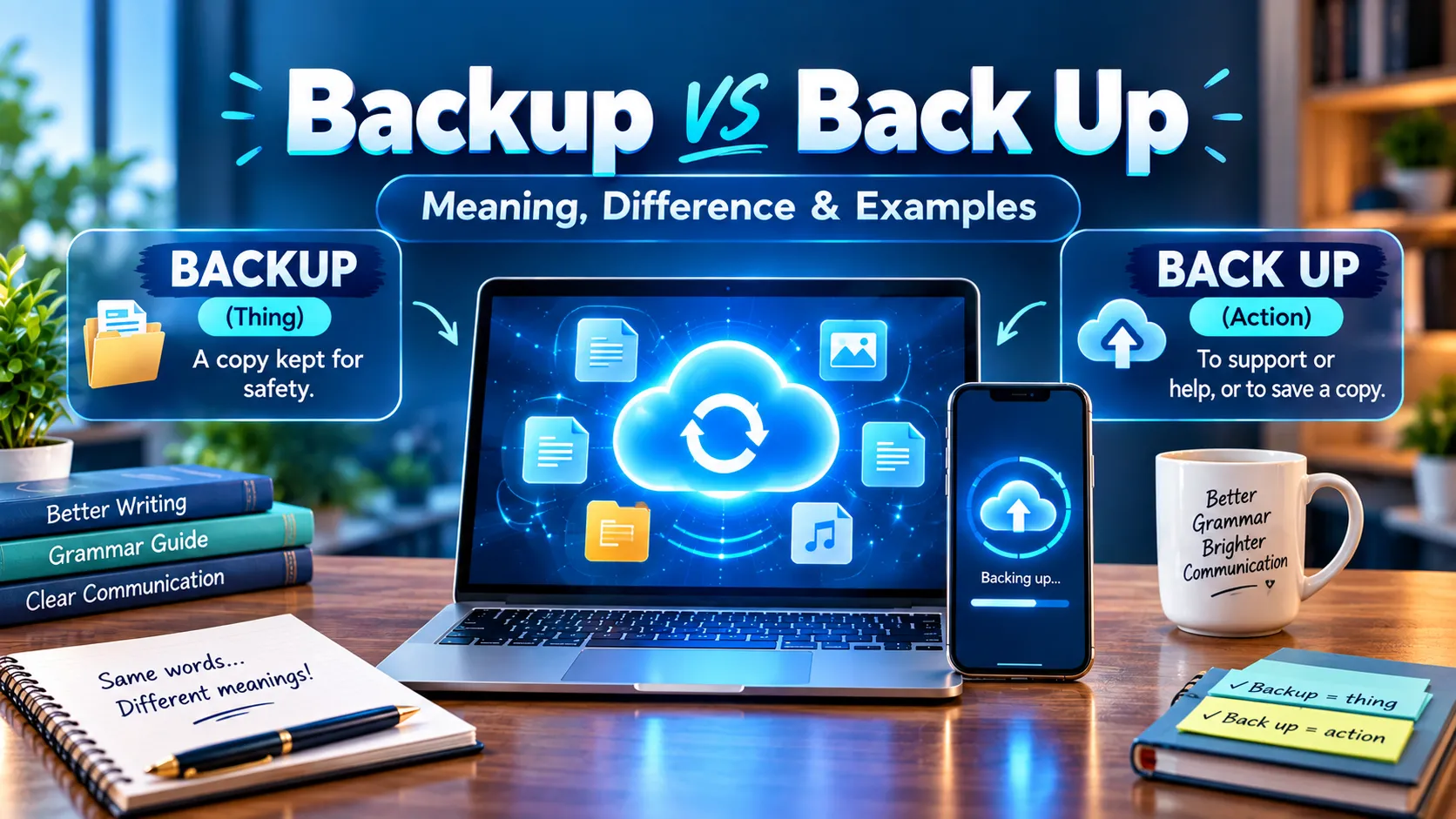
Backup vs Back Up: Backup and back up are both correct, but they are used differently. The main difference is grammatical:
- Backup is usually a noun or adjective.
- Back up is a phrasal verb.
For example:
I made a backup of my files. ✅
Please back up your files. ✅
When talking about computers and data, this distinction is especially important: make a backup, but back up your files. Cambridge Dictionary defines backup as a noun for an extra copy of computer information, while back up can mean to make that extra copy.
Backup or Back Up: Which Is Correct?
Both backup and back up are correct English forms, but they perform different grammatical functions.
| Form | Part of Speech | Main Meaning | Example |
| backup | Noun | An extra copy, support, or substitute | I made a backup. |
| backup | Adjective | Supporting or additional | We need a backup plan. |
| back up | Phrasal verb | To make a copy, support, or move backward | Please back up your files. |
Compare:
I need a backup of this document. ✅
Here, backup is a noun.
I need to back up this document. ✅
Here, back up is a verb.
The words sound essentially the same, but the space changes the grammatical role.
What Does Backup Mean?
Backup is primarily a noun. It can refer to an extra copy of information, additional support, a substitute, or something kept available in case the main option fails.
Examples:
- I keep a backup of all my important files.
- We need a backup plan.
- The police called for backup.
- Keep a backup of your passport information.
- Our team has a reliable backup system.
- I always carry a backup battery.
In computing, a backup is an extra copy of information stored separately from the original.
What Does Back Up Mean?
Back up is a phrasal verb. Its meaning depends on the context.
It can mean:
- To make an extra copy of computer data
- To support someone
- To provide evidence for a claim
- To move backward
- To cause traffic or something else to accumulate
Cambridge Dictionary lists these uses for back up.
Examples:
Please back up your files.
My colleagues backed me up during the meeting.
The evidence backs up his claim.
Could you back up the car?
Traffic is backing up on the highway.
Backup vs. Back Up: The Easy Rule
A simple rule will help you choose between them:
If you can put “a” or “the” before it, use “backup.”
For example:
I need a backup. ✅
We have a backup plan. ✅
The backup is stored safely. ✅
But:
I need to back up my files. ✅
Please back up your computer. ✅
You should back up this folder. ✅
Remember:
Backup = thing
Back up = action
Backup as a Noun
When backup refers to a thing, person, plan, or copy, it is generally written as one word.
1. Computer copy
I made a backup of my photos.
2. Extra support
The team needs additional backup.
3. Alternative plan
We have a backup in case the original plan fails.
4. Replacement
The coach sent in the backup player.
5. Emergency support
The officer called for backup.
Cambridge lists backup as a noun meaning support or help, as well as an extra copy of computer information.
Backup as an Adjective
Backup can also function as an adjective, especially in American English, when it describes something that provides additional or alternative support.
Examples include:
- backup plan
- backup generator
- backup battery
- backup system
- backup player
- backup singer
- backup equipment
- backup power
Examples:
We need a backup plan.
The hospital has a backup generator.
Keep a backup battery in your bag.
The company installed a backup system.
Cambridge lists backup as an adjective used before a noun in American English, including examples such as “backup vocals.”
Back Up as a Verb
Use back up when you are describing an action.
Computer example
You should back up your files regularly.
Here, back up means to make an additional copy of computer information.
Support example
Can you back me up during the meeting?
Here, back up means to support someone.
Evidence example
The research backs up her argument.
Here, backs up means supports or provides evidence for the argument.
Moving backward
Please back up a little.
Here, back up means move backward.
Backup or Back Up for Computer Files?
This is one of the most common areas of confusion.
Both forms are correct, depending on the sentence.
Use “backup” when referring to the copy:
I made a backup of my files.
Where is the latest backup?
The backup is stored on an external drive.
We have several backups of the database.
Use “back up” when referring to the action:
I need to back up my files.
Please back up your computer.
Remember to back up your photos.
We backed up the database yesterday.
Easy comparison:
Make a backup.
Back up your files.
Cambridge specifically gives make a backup as the noun construction and back up your files as the verb construction.
Backup vs. Back Up Examples
Examples of Backup
- I created a backup of my documents.
- Always keep a backup of important files.
- We need a backup plan.
- The computer has an automatic backup system.
- The officer called for backup.
- I keep a backup phone at home.
- The company maintains several data backups.
- We installed a backup generator.
- She is the team’s backup player.
- Keep a backup copy in a safe location.
Examples of Back Up
- Please back up your files.
- You should back up your phone regularly.
- I backed up all my photos.
- Can you back up the database?
- My colleague will back me up.
- The evidence backs up his statement.
- Please back up the car.
- Traffic is starting to back up.
- Make sure you back up your computer.
- We backed up the files before updating the system.
Backup or Back Up in a Sentence
One useful way to understand the difference is to compare sentences containing both forms.
Example 1
I made a backup before I backed up the new files.
The first backup is a noun.
The second backed up is the past-tense form of the verb back up.
Example 2
The backup is ready, so you can back up the remaining files.
Again:
- backup = noun
- back up = verb
Example 3
We have a backup plan if the original plan fails.
Here, backup describes the alternative plan.
Is “Back-Up” Also Correct?
You may sometimes see back-up with a hyphen.
For example:
a back-up plan
However, modern dictionaries commonly list backup as the standard closed form, particularly as a noun and adjective. Cambridge’s main entry uses backup, although its Business English material also records back-up as a variant.
For consistent modern writing, especially when writing about computers, backup is usually the clearest choice.
Preferred:
backup
Verb:
back up
Variant you may encounter:
back-up
Explore More: https://wordminto.com/your-vs-youre/
Backup or Back Up in American and British English
The distinction between backup and back up is used in both American and British English.
However, there can be some differences in specific compounds and stylistic preferences.
For example, Cambridge lists backup as a noun in both its British and American entries.
The important grammatical distinction remains:
backup = noun/adjective
back up = verb
So:
Make a backup. ✅
Back up your files. ✅
Backup vs. Back Up Pronunciation
Both forms are pronounced very similarly.
Backup:
/ˈbæk.ʌp/
Back up:
/ˈbæk ʌp/
Cambridge gives backup as /ˈbæk.ʌp/ and back up as a phrasal verb pronounced with the same basic sound sequence.
Because they sound alike, the difference is primarily visible in writing and grammar, not pronunciation.
Common Mistakes With Backup and Back Up
Mistake 1: Using “back up” as a noun
❌ I made a back up of my files.
✅ I made a backup of my files.
Because you’re referring to the copy itself, use the noun backup.
Mistake 2: Using “backup” as a verb
❌ Please backup your files.
✅ Please back up your files.
Here, back up is the verb.
Mistake 3: Confusing “backup plan” and “back up the plan”
These have different structures.
We need a backup plan. ✅
Here, backup describes the alternative plan.
But:
Please back up your plan with evidence. ✅
Here, back up means support or provide evidence for something.
Mistake 4: Writing “make a back up”
❌ Make a back up of the document.
✅ Make a backup of the document.
Mistake 5: Writing “I will backup my files”
In standard edited writing, when back up is used as a verb, keep the words separate:
❌ I will backup my files.
✅ I will back up my files.
Back Up vs. Backed Up vs. Backup
These three forms are easy to confuse.
Back up
Present-tense phrasal verb:
Please back up your files.
Backed up
Past tense or past participle:
I backed up my files yesterday.
The files are backed up securely.
Backup
Noun/adjective:
I made a backup yesterday.
The backup files are stored separately.
Backup vs. Back Up: Grammar Test
Try inserting to before the expression.
If to back up makes sense, you’re probably dealing with the verb.
I need to back up my files. ✅
But:
I need to backup my files. ❌
For the noun, you can often use an article:
I need a backup. ✅
This quick grammatical test can help you distinguish the two forms.
What Is a Backup Plan?
A backup plan is an alternative plan prepared in case the primary plan does not work.
Examples:
We have a backup plan in case it rains.
Always have a backup plan for important events.
The team developed a backup plan before starting the project.
Here, backup is functioning as an adjective modifying plan.
What Is a Backup File?
A backup file is a copy of information kept separately so that the information can potentially be recovered if the original is lost, damaged, or deleted.
Examples:
Keep your backup files on a separate drive.
The software creates automatic backup files.
I deleted the original but still had a backup file.
A backup is useful because it provides another copy of important information. Cambridge defines a computer backup as an extra copy stored separately from the computer.
Backup vs. Backup Copy
The expression backup copy is also used.
Keep a backup copy of your documents.
Here, backup modifies copy.
You can also simply say:
Keep a backup of your documents.
Both communicate the idea of an additional copy.
Back Up Your Data: Why the Space Matters
Consider these two sentences:
Back up your data.
Keep a backup of your data.
They communicate closely related ideas, but the grammar is different.
Back up tells someone to perform an action.
Backup names the resulting copy or arrangement.
This distinction applies beyond computers:
Back up your argument with evidence.
The research provides backup for the argument.
The first uses the verb; the second uses the noun.
Synonyms for Backup
Depending on context, backup can mean:
- support
- assistance
- reserve
- substitute
- alternative
- extra copy
- contingency
- reinforcement
For computer contexts:
- copy
- duplicate
- data copy
- saved copy
- recovery copy
The best synonym depends on the sentence.
Explore More: https://wordminto.com/definitely-or-definately/
Synonyms for Back Up
Depending on its meaning, back up can mean:
When talking about data:
- copy
- save
- duplicate
- archive
When talking about support:
- support
- assist
- reinforce
- confirm
- substantiate
Talking about movement:
- reverse
- retreat
- move backward
For example:
The evidence backs up his claim.
can be rewritten as:
The evidence supports his claim.
Backup or Back Up: Quick Comparison
| Feature | Backup | Back Up |
| Grammar | Noun/adjective | Phrasal verb |
| Meaning | Extra copy/support/alternative | Make a copy/support/move backward |
| Computer example | I made a backup. | I backed up my files. |
| Plan example | We need a backup plan. | — |
| Support example | We need backup. | Please back me up. |
| Correct as a verb? | ❌ | ✅ |
| Correct as noun? | ✅ | ❌ |
Easy Memory Trick
Use this simple formula:
Backup = thing
Back up = action
Think about your computer:
Make a backup. 📁
Back up your files. 💻
Or remember:
One word = the backup itself.
Two words = the action of backing up.
This rule will solve most backup vs. back up questions.
Practice: Choose Backup or Back Up
Fill in each blank with backup or back up.
- Please ________ your computer before installing the software.
- I made a ________ of all my photographs.
- We need a ________ plan in case the event is canceled.
- Remember to ________ your important documents.
- The company keeps a daily ________ of its database.
- Can you ________ my files before we restart the computer?
- The police called for ________.
- We have a ________ generator in case the power fails.
- I always ________ my phone before updating it.
- Where is the latest ________?
Answers
- back up
- backup
- backup
- back up
- backup
- back up
- backup
- backup
- back up
- backup
People Also Ask
Both are correct, but they have different grammatical functions. Backup is generally a noun or adjective, while back up is a phrasal verb.
The standard form is:
Back up your files. ✅
Because back up is functioning as a verb.
The standard form is:
Make a backup. ✅
Here, backup is a noun referring to the extra copy.
As a noun or adjective, backup is generally one word. As a phrasal verb, back up is two words.
Backup refers to an extra copy, support, substitute, or alternative. Back up is the verb meaning to make an extra copy, support someone or something, or move backward.
Final Verdict: Backup vs Back Up?
Both backup and back up are correct—the choice depends on how you use the word.
Use backup for a noun or adjective:
I made a backup of my files.
We need a backup plan.
The police called for backup.
Use back up for a verb:
Please back up your files.
I need to back up my computer.
The evidence backs up his claim.
The easiest rule to remember is:
Backup = thing
Back up = action
So, when you’re talking about the copy, support, or alternative, use backup. When you’re telling someone to make the copy, provide support, or move backward, use back up.
In short:
Make a backup. ✅
Back up your files. ✅
Use a backup plan. ✅
Back up your argument with evidence. ✅











1 thought on “Backup vs Back Up: Meaning, Difference & Examples”