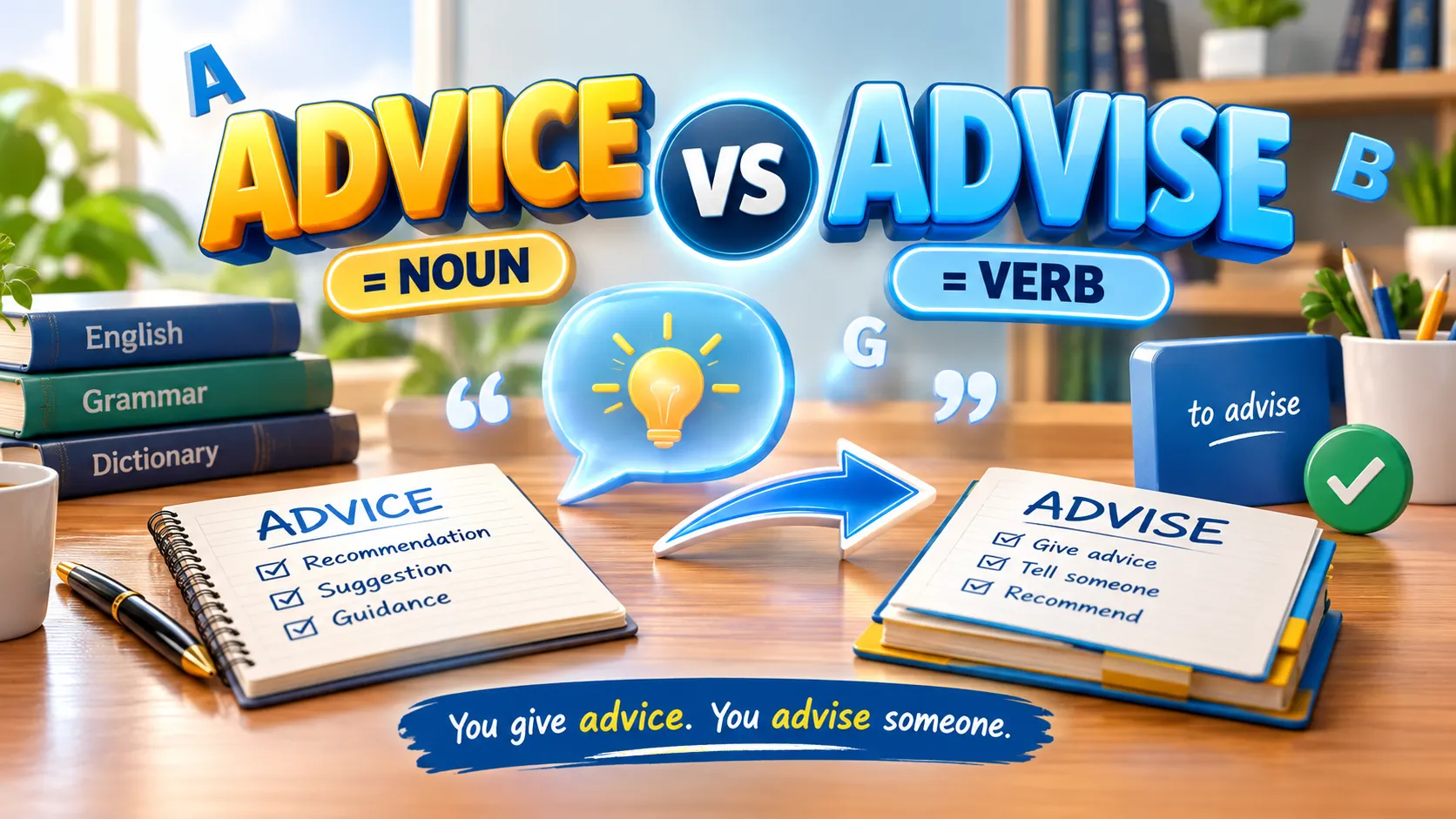
Advice or Advise: Advice and advise are two commonly confused English words. They look almost identical and have closely related meanings, but they have different grammatical roles.
The easiest rule is:
Advice is a noun. Advise is a verb.
You give advice, but you advise someone.
For example:
- She gave me useful advice.
- She advised me to wait.
There is also an important pronunciation difference. Advice ends with an /s/ sound, while advise ends with a /z/ sound. Also normally an uncountable noun, which explains why expressions such as some advice and a piece of advice are correct.
Advice or Advise: Quick Answer
Use advice when you mean a suggestion, recommendation, or guidance.
Use advise when you mean the action of giving a suggestion, recommendation, guidance, or information.
| Word | Part of Speech | Meaning | Example |
| advice | Noun | Guidance or recommendation | Thank you for your advice. |
| advise | Verb | To give guidance or a recommendation | I advise you to wait. |
The easiest way to remember it
Advice = the thing.
Advise = the action.
You can:
- give advice
- ask for advice
- receive advice
- take advice
- follow advice
- offer advice
But you:
- advise someone
- advise someone to do something
- advise someone against something
- advise someone on something
- advise someone of something
A sentence containing both words makes the difference especially clear:
My teacher gave me some advice, and I advised my friend to follow it.

Advice vs. Advise at a Glance
| Feature | Advice | Advise |
| Part of speech | Noun | Verb |
| Basic meaning | Guidance or recommendation | To give guidance or recommendation |
| Pronunciation | /ədˈvaɪs/ | /ədˈvaɪz/ |
| Ending sound | /s/ | /z/ |
| Countability | Normally uncountable | Verb |
| Common pattern | give/receive/take advice | advise someone to do something |
| Example | I need your advice. | Please advise me. |
The key distinction is grammatical: advice names the guidance, while advise describes the act of giving guidance.
What Does Advice Mean?
Advice is a noun meaning an opinion, suggestion, recommendation, or guidance about what someone should do.
Examples
- I need some advice.
- She gave me good advice.
- His advice was helpful.
- We followed our teacher’s advice.
- I asked my parents for advice.
- You should get professional advice.
In each sentence, advice refers to the guidance or recommendation itself.
Advice in Sentences
Example 1:
I need some advice about my career.
Here, advice is the guidance being requested.
Example 2:
Her advice helped me make a decision.
Here, advice names the recommendation.
Example 3:
Thank you for your advice.
Again, advice is the thing being received.
Common Expressions With Advice
These combinations are extremely common:
- give advice
- offer advice
- ask for advice
- receive advice
- seek advice
- follow advice
- take advice
- ignore advice
- accept advice
For example:
My father gave me some useful advice.
She asked her teacher for advice.
He decided to follow his lawyer’s advice.
What Does Advise Mean?
Advise is a verb. It means to give someone advice, recommend something, or tell someone what you think they should do.
Examples
- I advise you to wait.
- She advised me to apply early.
- The doctor advised him to rest.
- We advise customers to read the instructions.
- I would advise against making a quick decision.
The verb advise can also be used formally to mean giving someone information.
Advise in Sentences
The teacher advised us to study harder.
I would advise you to check your work.
The lawyer advised her to read the contract carefully.
We advise against driving in severe weather.
Please advise us when you are available.
Notice that advise describes what someone does.
Advice Is a Noun; Advise Is a Verb
This is the central rule you should remember.
Advice = Noun
I need your advice.
The word advice names the recommendation.
Advise = Verb
Please advise me.
The word advise describes the action of giving guidance.
Compare these sentences:
She gave me advice.
She advised me to wait.
The first sentence uses the noun advice. The second uses the verb advised.
A Simple Substitution Test
If you can replace the word with recommendation, you probably need advice.
I need your advice.
→ I need your recommendation.
If you can replace the word with recommend, you probably need advice.
I advise you to wait.
→ I recommend that you wait.
This is a useful proofreading trick, although sentence structure should always be considered as well.
How to Pronounce Advice and Advise
The words advice and advise are not pronounced the same.
Advice
.
Advice ends with an /s/ sound:
.
advice → /ədˈvaɪs/
The ending sounds similar to the s in ice.
Advise
.
Advise ends with a /z/ sound:
.
advise → /ədˈvaɪz/
The ending sounds similar to the z sound in wise.
Easy Pronunciation Memory Trick
Advice → ice → /s/
Advise → wise → /z/
So:
advice = /s/
advise = /z/
This pronunciation distinction is useful when speaking because the words can otherwise sound very similar.
Why Is Advice an Uncountable Noun?
One of the most important grammar points about advice is that it is normally an uncountable noun.
That means you generally do not say:
- ❌ an advice
- ❌ two advices
- ❌ three advices
Instead, use:
- ✅ some advice
- ✅ a piece of advice
- ✅ two pieces of advice
- ✅ a lot of advice
- ✅ some useful advice
Correct Examples
She gave me some advice.
He gave me a piece of advice.
My teacher gave us two pieces of advice.
We received a lot of advice.
Why?
English treats advice similarly to other commonly uncountable nouns such as:
- information
- furniture
- equipment
- knowledge
When you want to count individual recommendations, use an appropriate counting expression.
For example:
I received three pieces of advice.
Not:
❌ I received three advices.
Is “An Advice” Correct?
In standard English, an advice is normally incorrect when advice means a suggestion or recommendation.
Use:
✅ some advice
or:
✅ a piece of advice
Incorrect
❌ Can you give me an advice?
Correct
✅ Can you give me some advice?
✅ Can you give me a piece of advice?
If you want to count several recommendations, use pieces of advice:
❌ I have three advices for you.
✅ I have three pieces of advice for you.
Is “Advices” Correct?
For the ordinary meaning of guidance or recommendations, advice is not the standard plural form.
Use:
pieces of advice
For example:
❌ My teacher gave me several advices.
✅ My teacher gave me several pieces of advice.
And:
❌ She offered two advices.
✅ She offered two pieces of advice.
This is a particularly common error among English learners because many countable nouns form their plural with -s. Advice does not normally work that way.
Please Advise or Please Advice?
The correct expression is:
Please advise.
Not:
❌ Please advice.
Why?
Because advise is the verb needed in this sentence.
Please advise means that you are asking someone to provide information, guidance, or a response.
Correct Examples
Please advise me on what to do next.
.
Please advise us of any changes.
.
Please advise when you are available.
.
Please advise whether the documents are complete.
In Professional Emails
Please advise is especially common in business and professional correspondence.
For example:
Dear Ms. Ahmed,
We have attached the revised documents. Please advise if any additional information is required.
The important point is simple:
Please advise = correct
Please advice = incorrect
When you intend the common verb construction.
Can You Say “Advise Me”?
Yes.
Advise me is grammatically correct because advise is functioning as a verb.
Examples:
Can you advise me on this matter?
Please advise me on what I should do.
Could you advise me about the application process?
My manager advised me to wait.
But:
❌ Can you advice me?
is incorrect.
Compare:
✅ Can you advise me?
with:
✅ Can you give me some advice?
The grammar changes because the sentence structures are different.
Advice or Advise in Different Sentence Patterns
Learning common patterns can be more useful than memorizing definitions.
1. Give + advice
My father gave me some advice.
2. Ask for + advice
I asked my teacher for advice.
3. Take + advice
She decided to take his advice.
4. Follow + advice
He followed his doctor’s advice.
5. Need + advice
I need some advice.
6. Advise + someone
The lawyer advised me.
7. Advise + someone + to + verb
The lawyer advised me to wait.
8. Advise + against + noun/-ing
The doctor advised against smoking.
9. Advise + someone + on + topic
She advises clients on financial matters.
10. Advise + someone + of + information
The company advised customers of the change.
These patterns show why simply memorizing “noun versus verb” is not enough. Knowing the structures helps you use each word naturally.
Common Mistakes With Advice and Advise
Mistake 1: Using “advise” as a noun
❌ Thank you for your advise.
✅ Thank you for your advice.
Mistake 2: Using “advice” as a verb
❌ I advice you to wait.
✅ I advise you to wait.
Mistake 3: Writing “advices”
❌ She gave me several advices.
✅ She gave me several pieces of advice.
Mistake 4: Writing “an advice”
❌ He gave me an advice.
✅ He gave me some advice.
✅ He gave me a piece of advice.
Mistake 5: Writing “please advice”
❌ Please advice me.
✅ Please advise me.
Mistake 6: Writing “adviced”
❌ She adviced me to wait.
✅ She advised me to wait.
The past tense and past participle of advise are advised, not adviced.

Advice, Advise, Advised, Advising, Adviser, and Advisor
These words belong to the same word family, but they have different grammatical functions.
| Word | Function | Example |
| advice | Noun | I need your advice. |
| advise | Verb | I advise you to wait. |
| advised | Past tense/past participle | She advised me to stay. |
| advising | Present participle/gerund | He is advising the company. |
| adviser | Noun for a person | She is my academic adviser. |
| advisor | Noun for a person | He is a financial advisor. |
| advisable | Adjective | It is advisable to wait. |
| advisory | Adjective/noun | The government issued an advisory. |
Adviser vs. Advisor
Both adviser and advisor are established English spellings.
Examples:
She works as a financial advisor.
He is a university adviser.
The preferred spelling can depend on regional or organizational style.
Explore More: https://wordminto.com/scarey-or-scary/
Advice vs. Advise in American and British English
The basic distinction between advice and advise remains the same in both American and British English.
In both varieties:
- advice = noun
- advise = verb
The pronunciation distinction between /s/ and /z/ also remains important.
Therefore, this is not primarily an American-versus-British spelling issue.
You should choose between advice and advise according to the grammatical role of the word, not simply according to whether you are writing American or British English.
Advice and Advise Examples in Real-Life Situations
At School
My teacher gave me useful advice.
My teacher advised me to revise every day.
At Work
We received professional advice.
The consultant advised us to change the strategy.
In an Email
Thank you for your advice.
Please advise us when the project is ready.
In Healthcare
The patient received medical advice.
The doctor advised him to rest.
In Business
The company sought legal advice.
The lawyer advised the company to review the contract.
In Everyday Conversation
Can I ask for your advice?
What would you advise me to do?
These examples demonstrate the same fundamental distinction across different contexts: advice names the guidance, while advise expresses the act of giving it.
Easy Memory Tricks for Advice vs. Advise
Trick 1: Advice Has “Ice”
Look at the end of advICE.
The word ice is a noun.
Therefore:
advice = noun
Trick 2: Advise Sounds Like “Wise”
Think:
adVISE → wise
This can help you remember advise as the verb.
Trick 3: Memorize One Sentence
You advise someone by giving them advice.
This sentence contains both words in their correct grammatical roles.
Trick 4: Listen to the Ending
advice → /s/
advise → /z/
The pronunciation can reinforce the spelling and grammatical distinction.
Advice or Advise: A Simple Decision Test
When you are unsure, ask yourself three questions.
Question 1: Am I Naming Guidance?
If yes, use advice.
I need your advice.
Question 2: Am I Describing the Act of Giving Guidance?
If yes, use advice.
I would advise you to wait.
Question 3: Can I Use “Give” Before the Blank?
If yes, you probably need advice.
Give me some advice.
Not:
❌ Give me some advise.
Quick Test
I need your ______.
→ advice
I would ______ you to wait.
→ advise
This quick test is useful when proofreading an email, assignment, article, or exam answer.
Advice or Advise: Examples You Can Compare
| Incorrect | Correct | Why? |
| ❌ Thank you for your advise. | ✅ Thank you for your advice. | A noun is needed. |
| ❌ I advice you to wait. | ✅ I advise you to wait. | A verb is needed. |
| ❌ Give me an advice. | ✅ Give me some advice. | Advice is normally uncountable. |
| ❌ She gave me two advices. | ✅ She gave me two pieces of advice. | Use a counting expression. |
| ❌ Please advice me. | ✅ Please advise me. | A verb is needed. |
| ❌ He adviced me to stay. | ✅ He advised me to stay. | The past form is advised. |
| ❌ Can you advice me? | ✅ Can you advise me? | Advise is the verb. |
| ❌ I need some advise. | ✅ I need some advice. | Advice is the noun. |
Advice or Advise Practice Quiz
Choose the correct word.
1. Can you give me some ______?
A. advice
B. advise
Answer: A — advice
Advice is the noun naming the guidance.
2. I would ______ you to wait.
A. advice
B. advise
Answer: B — advise
Advise is the verb.
3. Thank you for your ______.
A. advice
B. advise
Answer: A — advice
The sentence needs a noun after your.
4. The doctor ______ me to rest.
A. advice
B. advised
Answer: B — advised
The sentence needs the past tense of the verb advise.
5. Please ______ us of any changes.
A. advice
B. advise
Answer: B — advise
The expression requires the verb advise.
6. She gave me two pieces of ______.
A. advice
B. advise
Answer: A — advice
The phrase is pieces of advice.
7. I need some ______ about my application.
A. advice
B. advise
Answer: A — advice
The sentence needs the noun.
8. The lawyer ______ us to read the contract.
A. advice
B. advised
Answer: B — advised
The past-tense verb is advised.
More Practice: Fill in the Blanks
Choose advice, advise, or advised.
- My parents gave me some useful ______.
- I would ______ you to check the instructions.
- The teacher ______ us to arrive early.
- Can you give me a piece of ______?
- Please ______ me about the next step.
- She asked for my ______.
- The doctor ______ him to get more rest.
- We need professional ______ before making a decision.
Answers
- advice
- advise
- advised
- advice
- advise
- advice
- advised
- advice
Exam-Style Error Detection
Identify the incorrect word in each sentence.
1. Thank you for your valuable advise.
Correction:
Thank you for your valuable advice.
2. The teacher advice me to study harder.
Correction:
The teacher advised me to study harder.
3. She gave me three advices.
Correction:
She gave me three pieces of advice.
4. Please advice us when you arrive.
Correction:
Please advise us when you arrive.
5. He adviced me to wait.
Correction:
He advised me to wait.
Quick Revision Box
Remember These Rules
Advice = noun
Advise = verb
advice → /s/
advise → /z/
✅ some advice
!
✅ a piece of advice
!
✅ two pieces of advice
.
❌ an advice
.
❌ two advices
✅ Please advise.
.
❌ Please advice.
.
✅ Can you advise me?
.
❌ Can you advice me?
.
✅ She advised me to wait.
.
❌ She adviced me to wait.
People Also Ask
Both are correct words, but they have different grammatical roles. Advice is a noun, while advise is a verb.
Please advise is correct when you are asking someone to provide information, guidance, or a response.
Advice is a noun.
I need your advice.
Advise is a verb.
I advise you to wait.
Normally, no. Use some advice or a piece of advice instead.
❌ an advice
✅ some advice
✅ a piece of advice
Normally, no, when referring to individual recommendations. Use pieces of advice.
❌ three advices
✅ three pieces of advice
Final Answer: Advice or Advise?
The distinction becomes simple when you focus on grammar:
Advice = noun = guidance or recommendation.
Advise = verb = to give guidance or recommendation.
Compare:
She gave me good advice.
She advised me to wait.
Also remember that advice is normally uncountable, so use some advice, a piece of advice, or two pieces of advice, rather than an advice or two advices.
And when you ask someone for information or guidance, especially in professional correspondence, the standard expression is:
Please advise.
The simplest sentence to memorize is:
When you advise someone, you give them advice.
Once you remember advice = noun and advise = verb, most of the common mistakes become much easier to avoid.










4 thoughts on “Advice or Advise: Meaning, Difference, Examples & Grammar”