
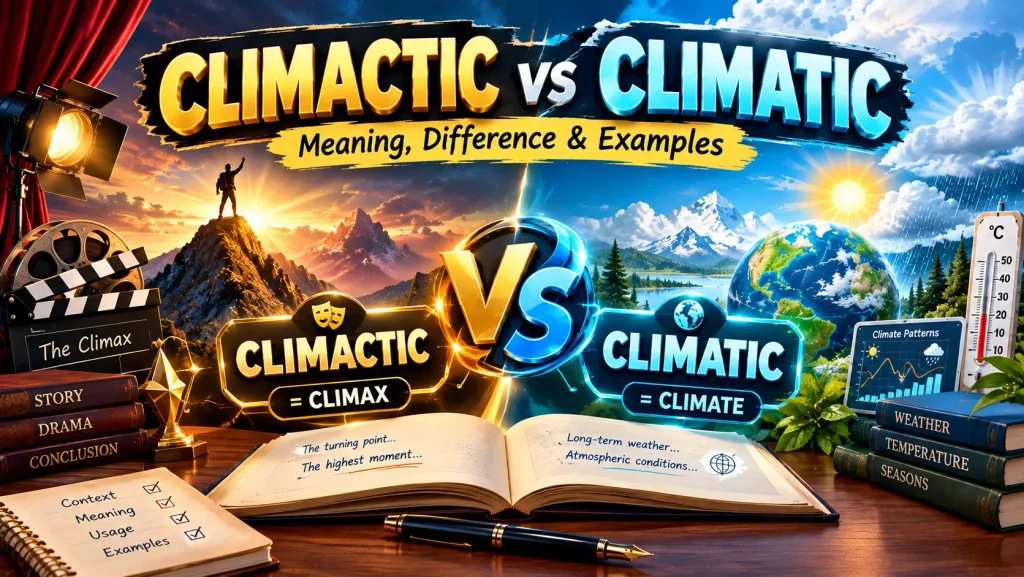
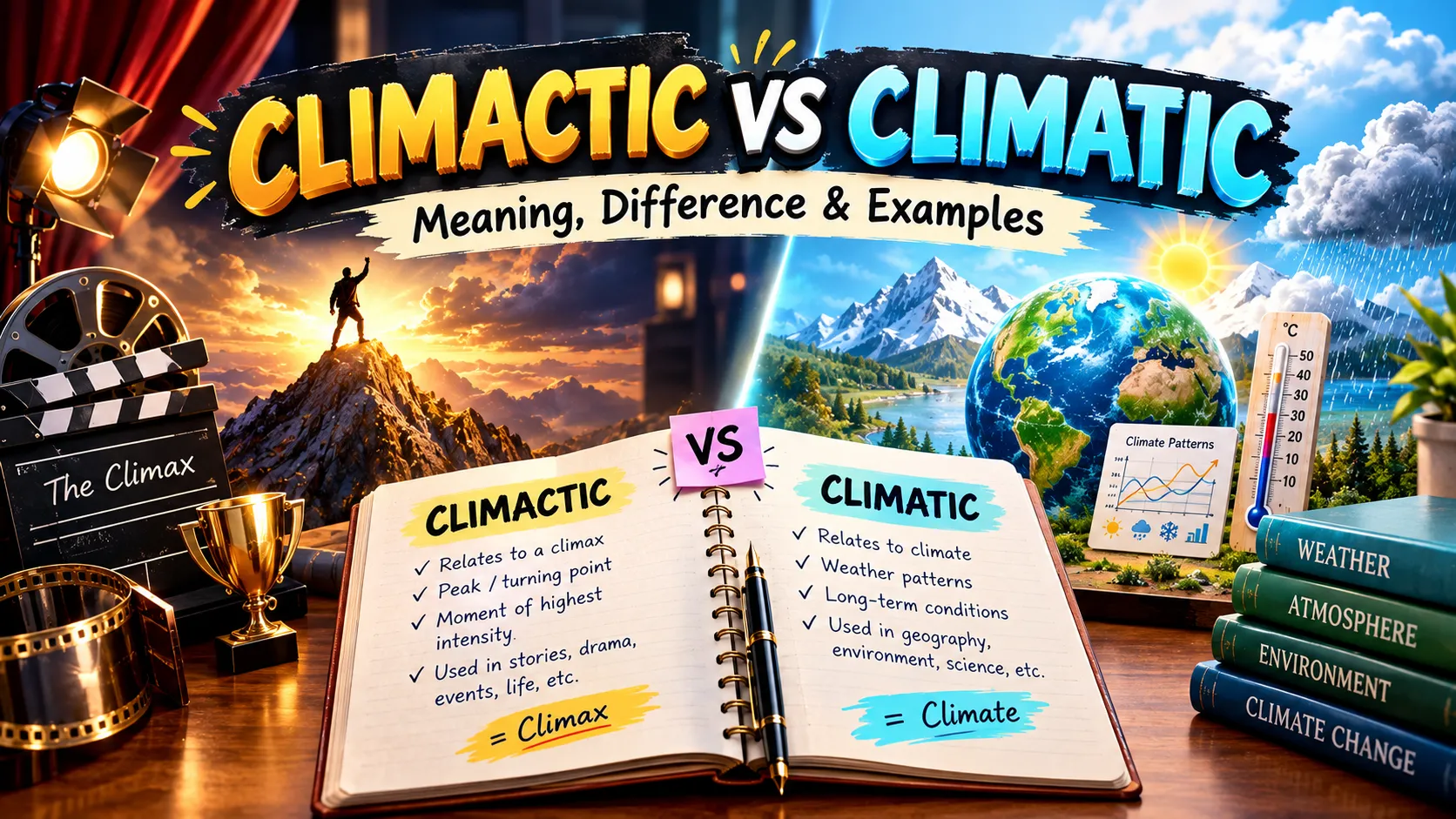
Climactic vs Climatic: Both words look and sound similar, but they have different meanings. Climactic describes the most exciting, important, or intense point of an event, story, or situation. Climatic describes something related to climate, including long-term weather patterns and atmospheric conditions.
For example, a movie can have a Climactic ending, while a region can experience Climatic changes. Understanding this difference helps you choose the correct word in academic writing, everyday conversations, essays, and professional communication.
Climactic vs Climatic: Quick Comparison
| Feature | Climactic | Climatic |
| Part of speech | Adjective | Adjective |
| Meaning | Related to a climax or peak | Related to climate |
| Root word | Climax | Climate |
| Common use | Stories, movies, speeches, competitions | Weather patterns, geography, environmental science |
| Example | The Climactic scene shocked everyone. | The region has harsh Climatic conditions. |
| Memory clue | Climactic = climax | Climatic = climate |
What Does Climactic Mean?
Climactic is an adjective that describes something related to a climax—the highest, most important, or most intense point in a series of events.
Writers commonly use this word to describe the turning point or peak of a story, movie, argument, performance, competition, or other situation.
Examples of Climactic in Sentences
- The movie ended with a Climactic battle between the hero and the villain.
- The novel’s Climactic scene revealed the truth about the missing character.
- The team won the championship in a Climactic final match.
- Her speech reached a Climactic moment when the audience stood and applauded.
- The play builds suspense before its Climactic conclusion.
- The Climactic confrontation changed the course of the story.
- The singer delivered a powerful performance during the Climactic finale.
- The final chapter contains the novel’s most Climactic moments.
In each example, Climactic refers to a peak, turning point, or moment of great intensity.
When Should You Use Climactic?
Use Climactic when you want to describe:
- The most exciting scene in a movie or novel.
- The decisive moment in a competition.
- The turning point in an argument or conflict.
- The peak of a speech or performance.
- The final, most intense stage of an event.
Example: The Climactic scene brought the entire story together.
This sentence describes the scene that delivers the story’s central dramatic payoff.
Explore More: Regimen vs Regime: Meaning, Differences, Rules
What Does Climatic Mean?
Climatic is an adjective that means relating to climate or the general atmospheric conditions of a region over time.
It commonly appears in discussions of geography, agriculture, ecology, environmental science, and climate research.
Examples of Climatic in Sentences
- Farmers must adapt to changing Climatic conditions.
- The region’s Climatic patterns support the growth of certain crops.
- Scientists studied the Climatic effects of deforestation.
- The country has several distinct Climatic zones.
- Climatic changes can influence the availability of freshwater.
- The researchers compared Climatic conditions across different regions.
- Some plants thrive only under specific Climatic conditions.
- The report examines the relationship between Climatic variation and agricultural production.
In these examples, Climatic refers to climate rather than a dramatic peak.
When Should You Use Climatic?
Use Climatic when you want to describe:
- Long-term climate patterns.
- Temperature and precipitation patterns across a region.
- Environmental conditions that affect plants and animals.
- Climate-related changes or differences.
- Climate zones and agricultural requirements.
Example: The farmers selected crops that could survive the area’s Climatic conditions.
This sentence discusses the climate’s influence on agriculture, not an exciting event.
Explore More: Loath vs Loathe: Meaning, Difference, Rules
Climactic vs Climatic: Examples Side by Side
The following examples show how one extra letter changes the meaning of a sentence.
| Climactic | Climatic |
| The film’s Climactic ending surprised viewers. | The area’s Climatic conditions challenge farmers. |
| The novel reaches its Climactic moment in the final chapter. | Scientists measured Climatic variations over time. |
| The championship ended with a Climactic match. | The region has unusual Climatic patterns. |
| The Climactic speech inspired the audience. | Climatic factors influence crop production. |
| The story’s Climactic confrontation changed everything. | The species adapts to different Climatic zones. |
| The play builds toward a Climactic conclusion. | The research examines Climatic changes. |
| The Climactic finale brought the audience to its feet. | Climatic conditions affect local ecosystems. |
| The election campaign reached a Climactic point. | The country experiences several Climatic conditions. |
Remember: If the sentence describes a dramatic peak, choose Climactic. If it discusses climate, choose Climatic.
Explore More: Flaunt vs Flout: Meaning, Difference, and Examples
How to Remember the Difference Between Climactic and Climatic
You can avoid confusing these words by using two simple memory tricks.
1. Climactic = Climax
The word Climactic contains the letters associated with climax. Both words relate to a peak or the most important point of something.
- Climax → Climactic
- A Climactic scene → the peak of a story
- A Climactic moment → the most intense moment
Example: The Climactic battle determined who would win.
2. Climatic = Climate
The word Climatic comes from climate. Both words relate to atmospheric conditions and long-term weather patterns.
- Climate → Climatic
- Climatic conditions → conditions related to climate
- Climatic changes → changes related to climate
Example: The region’s Climatic conditions favor tea cultivation.
The Quick Test
Ask yourself one question: Am I talking about a climax or a climate?
- If you mean a peak, use Climactic.
- If you mean climate, use Climatic.
Explore More: Faze vs Phase: Meaning, Differences, Rules
Common Mistakes to Avoid
Writers sometimes confuse these adjectives because they have similar spellings and pronunciations. However, they are not interchangeable.
Mistake 1: Using Climactic for Climate
Incorrect: The farmers struggled with the Climactic conditions.
Correct: The farmers struggled with the Climatic conditions.
Why? The sentence refers to climate, so Climatic is the correct adjective.
Mistake 2: Using Climatic for a Dramatic Ending
Incorrect: The movie had a Climatic ending.
Correct: The movie had a Climactic ending.
Why? The ending represents the story’s dramatic peak, so Climactic fits the meaning.
Mistake 3: Confusing Climactic with AntiClimactic
These words have different meanings.
- Climactic: Related to a climax or high point.
- AntiClimactic: Disappointing or less exciting than expected.
Examples:
The Climactic finale exceeded everyone’s expectations.
The antiClimactic finale disappointed the audience.
Do not use Climactic when you mean either of these dramatic concepts.
Mistake 4: Assuming Both Words Have the Same Meaning
Although the words look similar, their meanings differ. Always consider the context before choosing one.
Incorrect: Scientists investigated the Climactic patterns of the region.
Correct: Scientists investigated the Climatic patterns of the region.
The second sentence correctly refers to climate patterns.
Explore More: Emigrate vs Immigrate: Meaning, Differences, Rules
Climactic vs Climatic in Different Contexts
Literature and Movies
Use Climactic to describe a story’s peak or most intense scene.
Example: The Climactic confrontation reveals the protagonist’s true identity.
Speeches and Performances
Use Climactic when a speech, song, or performance reaches its most powerful point.
Example: The orchestra ended the performance with a Climactic crescendo.
Geography and Environmental Science
Use Climatic when discussing climate patterns, climate zones, or atmospheric conditions.
Example: Researchers examined Climatic differences between coastal and inland areas.
Agriculture
Use Climactic to describe climate conditions that affect crop selection, plant growth, or farming practices.
Example: Wheat production depends partly on suitable Climatic conditions.
Competitions and Major Events
Use Climactic for the decisive or most exciting stage of a competition.
Example: The Climactic final round determined the tournament winner.
Explore More: https://wordminto.com/should-have-vs-could-have/
Practice Exercises: Climactic vs Climatic
Choose the correct word to complete each sentence.
- The novel’s final chapter contains a ______ confrontation.
- Farmers must prepare for changing ______ conditions.
- The championship ended in a ______ final match.
- Scientists analyzed the region’s ______ patterns.
- The movie’s ______ scene revealed the villain’s identity.
- Several ______ factors affect the growth of crops.
- The speech reached a ______ moment near its conclusion.
- The researchers studied the effects of ______ variation.
- The play builds toward a ______ finale.
- The plants have adapted to the area’s ______ conditions.
Answers and Explanations
| Climactic |
| Climatic |
| Climactic |
| Climatic |
| Climactic |
| Climatic |
| Climactic |
| Climatic |
| Climactic |
| Climatic |
People Also Ask
Both words are correct, but they have different meanings. Use Climactic for a climax or dramatic peak and Climatic for something related to climate.
Climactic describes the most intense or important point in an event or story. Climatic describes conditions or patterns related to climate.
The Climactic battle at the end of the movie kept everyone on the edge of their seats.
The region’s Climatic conditions make it suitable for growing rice.
Yes. Climactic derives from climax and describes something that involves or forms a climax.
Yes. Climatic derives from climate and describes something associated with a region’s climate or long-term atmospheric conditions.
Conclusion
The difference between Climactic vs Climatic becomes simple when you remember their root words. Climactic relates to a climax, peak, or dramatic turning point. Climatic relates to climate, atmospheric conditions, and long-term weather patterns.
Use Climactic scene, Climactic ending, and Climactic moment when discussing stories or events. Use Climatic conditions, Climatic patterns, and Climatic changes when discussing climate.
The easiest rule to remember is: Climactic = Climax, while Climatic = Climate.











3 thoughts on “Climactic vs Climatic: Meaning, Difference, and Examples”