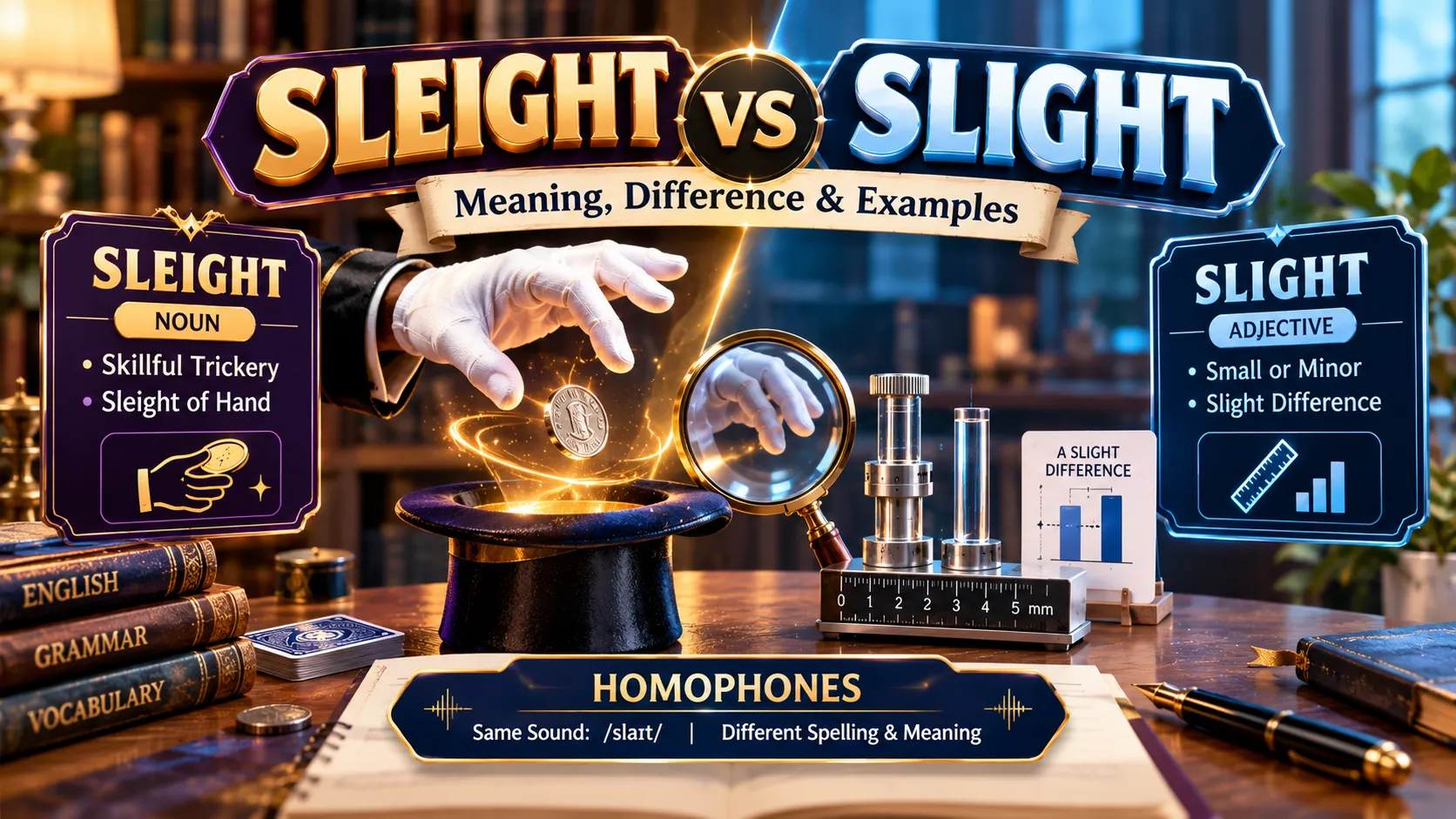
Sleight vs Slight: Sleight and slight sound exactly the same, but they have different meanings and uses. Sleight usually refers to skillful or deceptive movements, while slight describes something small, minor, or not important. Because these words are homophones, writers often confuse them.
In this guide, you will learn the difference between sleight and slight, their definitions, pronunciation, common expressions, example sentences, and practice exercises with answers.
Sleight vs Slight: Quick Difference
| Word | Meaning | Part of Speech | Example |
| Sleight | Skillful or deceptive movement, especially with the hands | Noun | The magician performed a clever sleight of hand. |
| Slight | Small, minor, or not considerable | Adjective | There is a slight difference between the two answers. |
| Slight | To ignore or insult someone deliberately | Verb | She felt hurt when her colleagues slighted her. |
| Slight | A small amount or degree | Noun | There was a slight uncertainty in his voice. |
Remember: Sleight relates to skill or trickery, while slight usually describes something small or an act of disrespect.

What Does Sleight Mean?
Sleight is a noun that refers to skill, dexterity, or clever movements, especially when someone uses their hands to perform tricks or deceive an audience.
People most commonly use this word in magic, card tricks, and expressions involving clever manipulation.
Examples of Sleight in Sentences
- The magician amazed the audience with his sleight of hand.
- The card trick required considerable sleight and practice.
- He used sleight of hand to make the coin disappear.
- The illusion depended on speed, precision, and sleight.
- The performer mastered the art of sleight of hand over many years.
Common Expression: Sleight of Hand
The phrase sleight of hand describes skillful hand movements used to perform magic tricks or conceal what someone is doing. It can also describe clever or deceptive actions in business, politics, or negotiations.
Examples:
- The magician used sleight of hand to surprise the children.
- Critics accused the company of financial sleight of hand.
- The politician’s explanation seemed like verbal sleight of hand.
In the last two examples, the phrase suggests manipulation or deception rather than a literal magic trick.
Explore More: https://wordminto.com/incite-vs-insight/
What Does Slight Mean?
Slight has several meanings. As an adjective, it describes something small, minor, or not significant. As a verb, it means to ignore or treat someone as unimportant, often in a way that causes offense.
It can also function as a noun referring to an insult or an act of disrespect.
Slight as an Adjective
- There is a slight chance of rain this evening.
- I noticed a slight improvement in her writing.
- He made a slight mistake in the final paragraph.
- The patient experienced a slight headache.
- We need to make a slight adjustment to the schedule.
Slight as a Verb
- She felt that her manager had slighted her.
- Please do not slight anyone because of their background.
- He believed his colleagues slighted his contribution.
- The host accidentally slighted one of the guests.
Example Of Slight as a Noun
- He took the comment as a personal slight.
- She considered the exclusion a deliberate slight.
- The invitation arrived late, but he did not interpret it as a slight.
Explore More: https://wordminto.com/climactic-vs-climatic/
Sleight vs Slight: Key Differences
| Feature | Sleight | Slight |
| Main meaning | Skillful or deceptive movement | Small, minor, or disrespectful |
| Usual part of speech | Noun | Adjective, verb, or noun |
| Common phrase | Sleight of hand | Slight difference |
| Related idea | Dexterity and trickery | Smallness or offense |
| Example | The magician practiced sleight of hand. | There was a slight delay. |
How to Remember Sleight vs. Slight
Use these simple memory tricks to choose the correct spelling.
- Sleight = Skill: Both relate to cleverness, dexterity, or tricks.
- Slight = Small: Think of a slight change, slight difference, or slight improvement.
- Slight = Snub: When someone ignores or disrespects another person, they may slight that person.
The standard expression is sleight of hand, not slight of hand.
Explore More: https://wordminto.com/regimen-vs-regime/
Sleight vs Slight: Common Mistakes
| Incorrect | Correct | Explanation |
| The magician used slight of hand. | The magician used sleight of hand. | Sleight refers to skillful trickery. |
| There was a sleight difference. | There was a slight difference. | Slight means small or minor. |
| He felt sleighted by his friends. | He felt slighted by his friends. | Slighted means treated with disrespect. |
| The company used slight of hand to hide the costs. | The company used sleight of hand to hide the costs. | The phrase suggests clever deception. |
Explore More: https://wordminto.com/loath-vs-loathe/

Sleight vs Slight Practice Exercises
Choose the correct word to complete each sentence. Answers appear below the exercise.
- The magician performed an impressive act of (sleight / slight) of hand.
- There was a (sleight / slight) improvement in his grades.
- She felt (sleighted / slighted) when her friends ignored her.
- The illusion depended on the magician’s (sleight / slight).
- We noticed a (sleight / slight) change in the weather.
- The manager did not intend to (sleight / slight) any employee.
- The politician was accused of using verbal (sleight / slight) of hand.
- He apologized for the unintended (sleight / slight).
- The magician practiced his tricks to perfect his (sleight / slight) of hand.
- There is a (sleight / slight) possibility that the event will be delayed.
Answers with Explanations
| Correct Answer | Explanation |
| Sleight | The expression is sleight of hand. |
| Slight | Slight describes a small improvement. |
| Slighted | Slighted means treated with disrespect. |
| Sleight | Sleight refers to skillful or deceptive movements. |
| Slight | Slight describes a small change. |
| Slight | As a verb, slight means to treat someone as unimportant. |
| Sleight | Sleight of hand can describe deceptive verbal tactics. |
| Slight | A slight can mean an act of disrespect. |
| Sleight | Sleight of hand refers to skillful hand movements. |
| Slight | Slight describes a little possibility. |
People Also Ask
The correct expression is sleight of hand. It refers to skillful hand movements used in magic tricks or to clever deception. Slight of hand is a common spelling mistake.
Yes. Both words are pronounced /slaɪt/, rhyming with kite, bite, and white. They are homophones because they sound alike but have different meanings and spellings.
Yes. As a verb, slight means to treat someone with disrespect, disregard, or insufficient attention.
Example: The coach apologized because he had unintentionally slighted one of his players.
Sleight means skillful or clever trickery, especially involving hand movements. It commonly appears in the phrase sleight of hand.
Slight means small or minor. It can also mean to ignore or disrespect someone.
Examples:
A slight delay means a small delay.
To slight a friend means to treat that friend with disregard.
Use sleight when discussing skillful tricks or deception, and use slight when describing something small or an act of disrespect.
Sleight: The magician amazed us with his sleight of hand.
Slight: There was a slight difference between the two results.
Conclusion
Although Sleight and Slight share the same pronunciation, their meanings differ. Sleight refers to skill, dexterity, or clever trickery, while slight usually means small or minor and can also refer to an act of disrespect.
Remember these two examples: a magician performs Sleight of Hand, and a small change represents a Slight Difference. With this simple distinction, you can use both words correctly in your writing.











1 thought on “Sleight vs Slight: Difference, Meaning, and Examples”