
Good vs Well: Have you ever wondered whether to say “I feel good” or “I feel well”? Both expressions are common in English, but they do not always mean the same thing. Understanding the difference between Good and Well can help you write more accurately, speak naturally, and avoid common grammar mistakes.
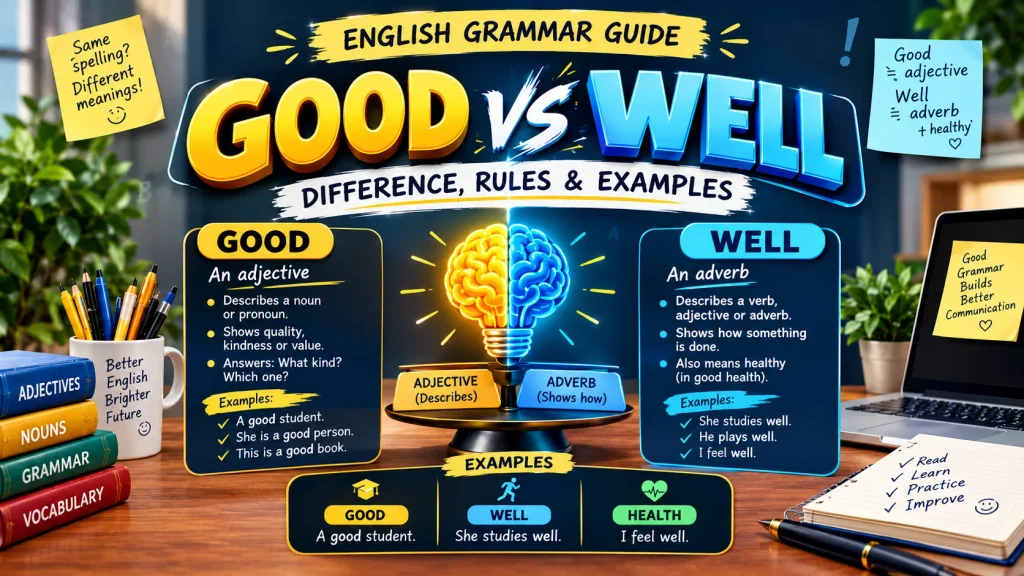
The main rule is simple: Good is usually an adjective, while well is usually an adverb. However, Well can also function as an adjective when talking about someone’s health.
In this guide, you’ll learn when to use Good or Well, explore practical examples, understand common exceptions, and discover easy tricks to remember the difference.
Good vs Well: Quick Answer
Use Good to describe a person, place, thing, experience, or condition. Use Well to describe how someone acts. When discussing health, well can describe how someone feels physically.
| Word | Part of Speech | Main Use | Example |
| Good | Adjective | Describes a noun or its condition | She is a good teacher. |
| Well | Adverb | Describes how an action is performed | She teaches well. |
| Well | Adjective | Describes someone’s health | I feel well today. |
Remember: A good singer performs well. A good meal tastes good. If you’re feeling well, you are in good health.
What Does Good Mean?
The word good is an adjective that describes a noun or provides information about a person’s, place’s, or thing’s qualities. It can refer to something positive, useful, enjoyable, suitable, or of high quality; it is commonly used after linking verbs such as be, seem, look, sound, and taste when describing a condition or impression.
Examples of Good in Sentences
- She is a good student.
- This is a good book.
- We had a good time at the concert.
- He gave me some good advice.
- Your idea sounds good.
- The food tastes good.
- That was a good decision.
- You did a good job.
- She has a good sense of humor.
- This restaurant serves good food.
In each example, good describes a person, thing, experience, or condition.
When Should You Use Good?
Use good when you want to describe:
1. A person’s qualities
- He is a good friend.
- My sister is a good listener.
- She is a good manager.
2. The quality of something
- This is a good phone.
- We watched a good movie.
- The restaurant offers good service.
3. An experience or situation
- We had a good weekend.
- It was a good opportunity.
- Today is a good day to start.
4. A condition after a linking verb
- You look good.
- The plan sounds good.
- This coffee tastes good.
In these sentences, good describes the subject rather than explaining how an action happens.
Explore More: https://wordminto.com/hyphen-rules/
What Does Well Mean?
The word well is most commonly an adverb. It explains how an action is performed and often modifies a verb.
For example, in “She sings well,” well tells us how she sings.
Well can also be an adjective meaning healthy or in good health, as in “I am well.” This use is especially important when talking about physical or general health.
Examples of Well in Sentences
- She speaks English well.
- He drives well.
- They worked well together.
- My brother plays the guitar well.
- You explained the lesson well.
- The team performed well.
- She writes well.
- He handled the situation well.
- The students listened well.
- I hope you are feeling well.
In the first nine examples, well describes how an action is performed. In the final example, well refers to someone’s condition or health.
When Should You Use Well?
1. To describe how an action is performed
- He cooks well.
- She dances well.
- They communicate well.
2. To describe performance or ability
- The team played well.
- You answered the question well.
- She did well on the test.
3. To describe how something is handled
- He managed the project well.
- She handled the problem well.
- They organized the event well.
4. To talk about health
- I feel well today.
- She is well again.
- I hope your father gets well soon.
Explore More: https://wordminto.com/a-or-an-usage/
Good vs Well: Key Differences
Although good and well can sometimes appear in similar sentences, they serve different grammatical roles.
| Feature | Good | Well |
| Usual grammatical role | Adjective | Adverb |
| Describes | Nouns and conditions | Actions and performance |
| Answers | What kind? What is it like? | How? |
| Example | He is a good player. | He plays well. |
| Health-related use | I’m good. (Often informal or general.) | I’m well. (Healthy.) |
| Common expression | Good job | Well done |
The easiest way to choose between them is to identify what you are describing. If you are describing a noun or condition, good is often correct. If you are describing an action, well is usually the better choice.
Explore More: https://wordminto.com/modal-verb-rules/
Good vs Well After Linking Verbs
One of the most confusing parts of this grammar rule is what happens after linking verbs.
Linking verbs connect a subject to a word or phrase that describes it. Common examples include be, feel, look, seem, sound, and taste.
When a linking verb describes a subject’s condition or impression, an adjective such as good is generally appropriate.
Examples
- I feel good.
- You look good.
- The food smells good.
- That sounds good.
- The soup tastes good.
- She seems good at her job.
In these examples, good describes a condition, appearance, smell, sound, taste, or quality.
Compare these sentences:
- She sings well.
- She sounds good.
In the first sentence, well describes how she sings. In the second, good describes the sound of her voice.
Important: Some verbs can function as either linking verbs or action verbs. The intended meaning determines whether an adjective or an adverb is appropriate.
For example:
- He looks good. (His appearance is attractive or healthy.)
- He looked carefully at the painting. (He acted as if he were looking carefully.)
Explore More: https://wordminto.com/run-on-sentence-rules/
I Feel Good vs I Feel Well?
Both “I feel good” and “I feel well” are grammatically correct, but they can communicate slightly different meanings.
I Feel Good
“I feel good” is a common expression that can describe your mood, emotional state, general condition, or physical comfort.
Examples:
- I feel good about my decision.
- I feel good after spending time with my family.
- I feel good today.
- I feel good about my progress.
I Feel Well
“I feel well” usually emphasizes health or the absence of illness.
Examples:
- I feel well enough to return to work.
- I feel well after recovering from the flu.
- I don’t feel well today.
- She feels well again after resting.
Which Expression Is Better?
Use “I feel good” for general feelings, mood, or a positive state. Use “I feel well” when you specifically mean that you are healthy.
In everyday American English, people frequently use “I feel good” to talk about their overall condition. It is not grammatically incorrect.
Explore More: https://wordminto.com/dangling-modifier/
I Did Good vs I Did Well?
The choice between “I did good” and “I did well” depends on whether you are following standard formal grammar or using casual conversational English.
“I did well” is the standard choice when you mean that you acted successfully.
Examples:
- I did well on my final exam.
- She did well in the interview.
- Our team did well in the tournament.
- He did well under pressure.
In each sentence, well describes performance.
“I did good” is common in informal speech, but in traditional standard grammar, good is an adjective and does not normally modify the verb did when the intended meaning is “performed successfully.”
However, good can function as a noun meaning something beneficial or morally positive. For example, “She did good in her community” can mean she performed helpful or charitable acts. This use is established in English, though “She did good deeds” or “She did good work” may be clearer in formal writing.
For school assignments, professional writing, and grammar tests, choose “I did well.”
Explore More: https://wordminto.com/misplaced-modifier/
A Good Job vs A Well Job?
The correct expression is “a good job,” not “a well job.”
Why? Because job is a noun, and an adjective is normally used to describe a noun.
Examples:
- You did a good job.
- She has a good job.
- He completed the job well.
- They handled the job well.
Notice the difference:
- A good job: Good describes the noun job.
- Did the job well: Well describes the action of doing the job.
You can also say “a well-done job,” although “a job well done” is a more natural and widely used expression.
Good at vs Well at?
Use good at when describing someone’s ability or skill in a particular activity.
Examples:
- She is good at math.
- He is good at cooking.
- They are good at solving problems.
- I’m good at remembering names.
- My brother is good at basketball.
Use well when describing how someone performs an activity.
Examples:
- She cooks well.
- He plays basketball well.
- They solve problems well.
- I remember names well.
Compare:
- She is good at singing. (Her singing ability is strong.)
- She sings well. (She sings skillfully.)
Both sentences can describe the same general ability, but their grammatical structures differ.
Explore More: https://wordminto.com/squinting-modifier/
Look Good vs Look Well?
Both expressions are possible, but they have different meanings.
Look Good
Use look good to describe appearance, attractiveness, or the impression someone or something creates.
Examples:
- You look good in that jacket.
- This room looks good after cleaning.
- The new design looks good.
- She looks good in photographs.
Look Well
Look well can mean that someone appears healthy, although this expression is less common in everyday American English than “look healthy” or “look good.”
Examples:
- You look well rested.
- She looks well after her vacation.
- He looks well for his age.
Be careful with the distinction between “look well” and “look carefully.” In “You look well,” well describes the subject’s apparent condition. In “You looked well at the documents,” well would not normally be the correct word if you mean that someone examined the documents carefully.
A more natural sentence would be “You looked carefully at the documents.”
Sound Good vs Sound Well?
The correct choice depends on what you want to express.
Use sound good when something seems appealing, suitable, or positive based on what you hear.
Examples:
- Your plan sounds good.
- That idea sounds good to me.
- The new song sounds good.
- Dinner at seven sounds good.
Use sound well when discussing the quality of the physical act of producing sound, although this wording is uncommon in everyday English. More natural alternatives often include “sound clear,” “sound professional,” or “speak well.”
Examples:
- Her voice sounds clear.
- He speaks well during presentations.
- The singer sounds great.
For most everyday conversations, “That sounds good” is the natural expression.
Taste Good vs Taste Well?
When describing the flavor of food, use taste good.
Examples:
- This pizza tastes good.
- The cake tastes good.
- Your soup tastes really good.
- These cookies taste good.
Here, taste is a linking verb that connects the food to a description of its flavor.
However, taste can also describe the action of tasting something. In that case, an adverb may be appropriate, depending on the intended meaning.
For example:
- She tasted the soup carefully.
- He tasted the sauce cautiously.
In these sentences, carefully and cautiously describe how the person acted.
“Good” describes the flavor; an adverb describes the action of tasting.
Do Well vs Do Good?
“Do good” and “do well” are both correct expressions, but their meanings differ.
/
Do Good
Do good means to help others, provide benefits, or perform positive actions.
Examples:
- Volunteers do good in their communities.
- She wants to do good in the world.
- The charity does good work.
- Small acts of kindness can do good.
Do Well
Do well means to succeed, perform effectively, or achieve a positive result.
Examples:
- He hopes to do well in school.
- The business continues to do well.
- She did well in her new position.
- I want to do well on the exam.
Quick Rule: Do good means helping or benefiting others. Do well means performing successfully.
Common Mistakes With Good and Well
Many English learners and native speakers confuse good and well because both can appear after verbs. The following examples show how to correct common mistakes in standard written English.
| Incorrect or Less Suitable | Better Choice | Explanation |
| She sings good. | She sings well. | Well modifies sings. |
| He drives good. | He drives well. | Well describes how he drives. |
| I did good on the test. | I did well on the test. | Well describes performance. |
| This food tastes well. | This food tastes good. | Good describes the flavor. |
| You did a well job. | You did a good job. | Good describes the noun job. |
| She speaks English good. | She speaks English well. | Well modifies speaks. |
| He plays good. | He plays well. | Well describes how he plays. |
| The idea sounds well. | The idea sounds good. | Good describes the idea’s appeal. |
Remember that some expressions are idiomatic, informal, or context-dependent. The corrected versions above are the preferred choices for standard grammar and formal writing.
Easy Tricks to Remember Good vs Well
Use these simple strategies to choose the correct word.
Trick 1: Ask “What Kind?”
If you want to describe a person, place, thing, or condition, good is often the correct choice.
Examples:
- What kind of movie? A good movie.
- What kind of teacher? A good teacher.
- What kind of idea? A good idea.
Trick 2: Ask “How?”
If you want to explain how someone acts, use well.
Examples:
- How does she sing? She sings well.
- How does he work? He works well.
- How did they perform? They performed well.
Trick 3: Remember the Health Exception
Well is also an adjective when it means healthy.
Examples:
- I am well.
- She feels well.
- He is getting well.
Good can also describe how someone feels, especially in casual conversation.
Trick 4: Learn Common Phrases
Memorize these natural expressions:
- Good job
- Good idea
- Good food
- Feel good
- Look good
- Speak well
- Work well
- Perform well
- Do well
- Get well soon
Learning these phrases helps you use good and well naturally without having to think about every grammar rule.
Good vs Well: Practice Quiz
Test your understanding by choosing the correct word for each sentence.
1. She speaks English very _____.
- A. good
- B. well
2. This is a _____ movie.
- A. good
- B. well
3. I don’t feel _____ today because I have a cold.
- A. good
- B. well
4. He performed _____ during the interview.
- A. good
- B. well
5. Your idea sounds _____.
- A. good
- B. well
6. My sister is _____ at playing the piano.
- A. good
- B. well
7. The food tastes _____.
- A. good
- B. well
8. They worked _____ as a team.
- A. good
- B. well
9. You did a _____ job on this project.
- A. good
- B. well
10. I hope you get _____ soon.
- A. good
- B. well
Answer Key
- Well — It describes how she speaks.
- Good — It describes the noun movie.
- Well — It refers to health; “good” is also common in everyday speech when discussing general feelings.
- Well — It describes his performance.
- Good — It describes how the idea seems.
- Good — The standard expression is “good at.”
- Good — It describes the food’s flavor.
- Well — It describes how they worked.
- Good — It describes the noun job.
- Well — “Get well soon” is a standard expression referring to recovery from illness.
People Also Ask
Both words are correct, but they serve different grammatical purposes. Good is usually an adjective that describes a person, place, thing, or condition. Well is usually an adverb that describes how an action is performed. Well can also be an adjective meaning healthy.
Both are grammatically correct. “I feel good” commonly describes your general feelings, mood, or condition. “I feel well” more specifically emphasizes health. In everyday American English, “I feel good” is very common.
Yes, in the sense of helping people or producing positive benefits, as in “She is doing good in her community.” However, when discussing successful performance, standard formal grammar generally favors “doing well,” as in “She is doing well in school.”
“I did well” is the standard choice when describing successful performance. “I did good” is common in casual speech and can be correct when good refers to beneficial or charitable actions, but it is not the preferred formal expression for performing successfully.
Use “good at” to describe someone’s skill or ability. For example, “She is good at writing.” To describe performance, use well with an action verb: “She writes well.”
Conclusion
Understanding the difference between Good vs Well becomes easier when you remember their usual grammatical roles. Good is generally an adjective used to describe people, places, things, and conditions. Well is generally an adverb used to describe how actions are performed, although it can also mean healthy when used as an adjective.
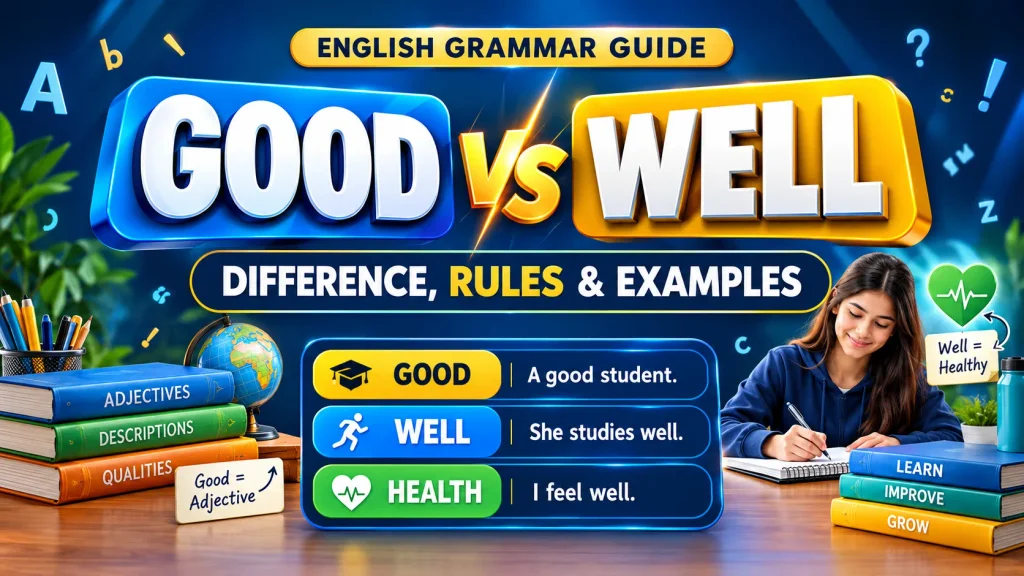
Use “a good student” to describe a person, “studies well” to describe performance, and “I feel well” when referring to health. Keep practicing with everyday sentences, and these two commonly confused words will become much easier to use correctly.
At Wordminto, our goal is to make English grammar simple, practical, and easy to understand so you can communicate with greater confidence.











2 thoughts on “Good vs Well: What’s the Difference? Meaning, Rules & Examples”