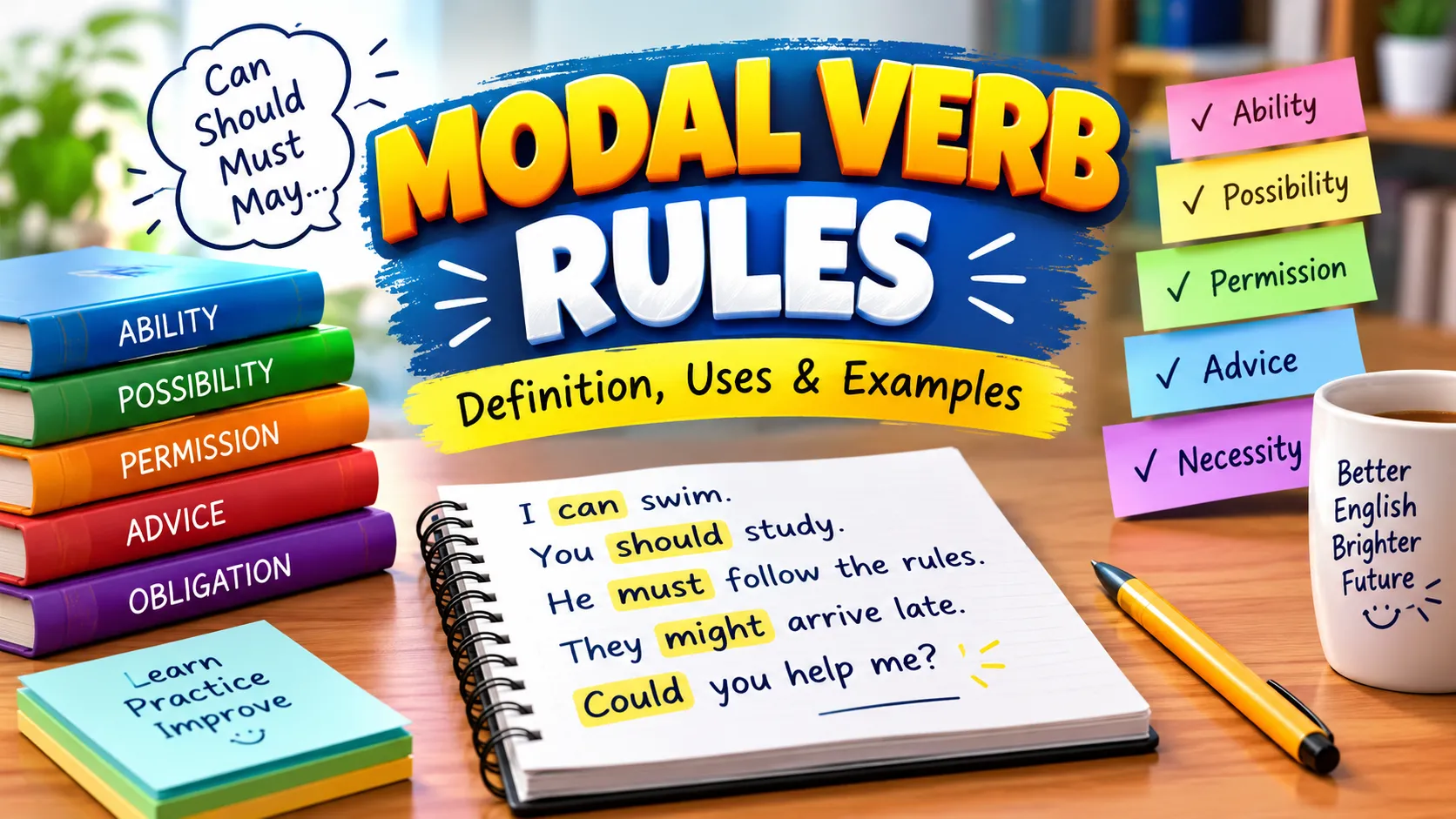
Modal Verb Rules: Modal verbs are an essential part of English grammar. They help us express ability, possibility, permission, requests, advice, necessity, and obligation. Learning modal verb rules allows you to construct accurate sentences and communicate more naturally in everyday conversations, academic writing, and professional situations.
This guide explains the rules of modal verbs with simple definitions, examples, common mistakes, and practice exercises for beginners, students, teachers, and ESL learners.
What Are Modal Verbs?
Modal verbs are auxiliary verbs that work with a main verb to express meanings such as ability, possibility, permission, advice, and necessity. They usually appear before the base form of the main verb.
Examples:
- I can swim.
- She should study harder.
- You must follow the rules.
- They might arrive late.
- Could you help me?
In these examples, can, should, must, might, and could are modal verbs. They change the meaning of the main verb and communicate the speaker’s intention.
Explore More: https://wordminto.com/run-on-sentence-rules/
List of Modal Verbs in English
English has several core modal verbs and other modal-like expressions. Each one serves a different purpose.
| Modal verb | Common use | Example |
| Can | Ability, permission, possibility | I can drive. |
| Could | Past ability, polite requests, possibility | Could you help me? |
| May | Permission, possibility | May I enter? |
| Might | Possibility | It might rain. |
| Must | Strong obligation, logical deduction | You must wear a seat belt. |
| Shall | Offers, suggestions, future reference | Shall we begin? |
| Should | Advice, expectation, duty | You should rest. |
| Will | Future, willingness, predictions | I will call you. |
| Would | Polite requests, hypothetical situations | Would you like some tea? |
| Ought to | Advice, moral duty | You ought to apologize. |
Other modal-like expressions include have to, need to, be able to, be allowed to, and had better. These expressions follow some different grammatical rules, so they are not all core modal verbs.
Explore More: https://wordminto.com/dangling-modifier/
Main Modal Verb Rules
The following rules explain how to use modal verbs correctly in English sentences.
Rule 1: Use the Base Form of the Main Verb
A modal verb normally takes the base form of the main verb without to.
Structure: Subject + modal verb + base verb
Correct examples:
- She can sing beautifully.
- He should study daily.
- They might come tomorrow.
- We must finish the work.
Incorrect examples:
- She can sings beautifully.
- He should to study daily.
- They might came tomorrow.
Remember: never add -s, -es, or -ed to the main verb directly after a core modal verb.
Rule 2: Do Not Add “To” After Core Modal Verbs
Core modal verbs take the base form of the main verb without to.
Correct:
- I can swim.
- You must leave.
- She should apologize.
Incorrect:
- I can to swim.
- You must to leave.
- She should to apologize.
However, some modal-like expressions require to:
- I have to work.
- She ought to apologize.
- We need to leave.
Rule 3: Do Not Add “-s” to a Modal Verb
Modal verbs do not change their form according to the subject. They remain the same with I, you, he, she, it, and they.
Correct:
- I can speak English.
- He can speak English.
- She will arrive soon.
- It might rain today.
Incorrect:
- He cans speak English.
- She wills arrive soon.
- It mights rain today.
Rule 4: Form Negative Sentences with “Not”
Place not immediately after the modal verb to make a negative sentence.
Structure: Subject + modal verb + not + base verb
Examples:
- I cannot swim.
- She should not worry.
- They will not attend the meeting.
- You must not touch that wire.
- He might not come today.
Common contractions include:
- Cannot → can’t
- Could not → couldn’t
- Should not → shouldn’t
- Would not → wouldn’t
- Will not → won’t
- Must not → mustn’t
Important: Mustn’t expresses prohibition, while don’t have to means something is not necessary.
- You mustn’t park here. (Parking is prohibited.)
- You don’t have to come early. (Coming early is optional.)
Rule 5: Form Questions by Placing the Modal First
To form a standard yes/no question, place the modal verb before the subject.
Structure: Modal verb + subject + base verb?
Examples:
- Can you swim?
- Should I call her?
- May I come in?
- Will they join us?
- Could you open the window?
Incorrect: Do you can swim?
Correct: Can you swim?
Core modal verbs do not normally require do or does to form questions.
Rule 6: Use Modal Verbs with the Correct Subject
Core modal verbs remain unchanged regardless of the subject.
Examples:
- I should exercise.
- He should exercise.
- We should exercise.
- They should exercise.
The modal stays the same, but the main verb must follow the appropriate structure. In a simple present sentence without a modal, we say he exercises. After a modal, we say he should exercise.
Rule 7: Use “Modal + Be” Before an Adjective or Noun
Modal verbs can precede be when the sentence describes a state, identity, or condition.
Examples:
- She may be tired.
- He must be a doctor.
- They could be ready.
- This might be the answer.
The structure is:
Subject + modal + be + adjective/noun.
Rule 8: Use “Modal + Have + Past Participle” for Past Meaning
Use a modal followed by have and a past participle to discuss past possibilities, deductions, regrets, or missed opportunities.
Examples:
- She may have forgotten the meeting.
- He must have left already.
- You should have studied harder.
- They could have won the match.
- I would have helped you.
The structure is:
Subject + modal + have + past participle.
Do not use the simple past form directly after have in this structure.
Incorrect: She might have went home.
Correct: She might have gone home.
Explore More: https://wordminto.com/misplaced-modifier/
Uses of Modal Verbs with Examples
Each modal verb can express different meanings depending on the context. The following sections explain the most important uses.
1. Can: Ability, Permission, and Possibility
Use can to express present ability, informal permission, or general possibility.
Ability
- I can speak English.
- She can play the piano.
- Birds can fly.
Permission
- Can I use your phone?
- You can leave now.
Possibility
- Heavy traffic can cause delays.
- Accidents can happen anywhere.
2. Could: Past Ability, Polite Requests, and Possibility
Use could to describe general past ability, make polite requests, or discuss possible situations.
Examples:
- I could swim when I was five.
- Could you help me with this task?
- We could visit the museum tomorrow.
- It could rain this evening.
Important distinction: For a single successful action in the past, English often uses was/were able to or managed to instead of could.
- I was able to solve the problem.
- She managed to escape.
3. May: Permission and Possibility
Use may for formal permission or a possibility.
Examples:
- May I come in?
- You may begin the test.
- It may rain tonight.
- She may join us later.
May often sounds more formal than can when asking for permission.
4. Might: Possibility
Use might to describe a possible situation, especially when you want to express uncertainty.
Examples:
- I might visit my friend tomorrow.
- He might be busy.
- They might not understand the instructions.
- We might miss the bus.
Might often suggests uncertainty, but it does not always indicate a lower probability than may. Context determines the intended meaning.
5. Must: Strong Obligation and Logical Deduction
Use must to express a strong requirement or a logical conclusion based on evidence.
Obligation
- You must wear your seat belt.
- Students must submit their assignments on time.
- Employees must follow safety procedures.
Logical deduction
- The lights are on. Someone must be home.
- She has worked all night. She must be exhausted.
For past deductions, use must have + past participle:
– He must have forgotten the appointment.
6. Shall: Offers, Suggestions, and Formal Future Reference
Use shall mainly with I and we for offers and suggestions, particularly in British English.
Examples:
- Shall we start the lesson?
- Shall I open the window?
- Shall we go for a walk?
In legal documents and formal rules, shall can also express an obligation, although modern drafting often prefers clearer wording such as must.
7. Should: Advice, Expectation, and Mild Obligation
Use should to give advice, make recommendations, or express an expectation.
Examples:
- You should drink enough water.
- She should apologize for her mistake.
- We should respect others.
- The train should arrive soon.
Use should have + past participle to express regret, criticism, or an action that was advisable but did not happen.
- You should have called me.
- I should have studied earlier.
8. Will: Future Actions, Predictions, and Willingness
Use will to talk about future events, predictions, promises, and willingness.
Examples:
- I will call you tomorrow.
- It will rain later.
- I will help you with your homework.
- She will always remember this day.
Negative form: will not or won’t.
– I won’t forget your kindness.
9. Would: Polite Requests and Hypothetical Situations
Use would to make polite requests, express preferences, or describe hypothetical situations.
Examples:
- Would you please close the door?
- I would like a cup of tea.
- I would travel more if I had enough money.
- She said she would return.
Use would have + past participle for an unreal past result.
– I would have attended the event if I had known about it.
10. Ought To: Advice and Moral Duty
Use ought to to express advice, responsibility, or what is morally right.
Examples:
- You ought to respect your parents.
- We ought to help people in need.
- He ought to apologize.
- You ought to have told the truth.
Unlike most core modal verbs, ought normally takes to before the main verb.
Explore More: https://wordminto.com/squinting-modifier/
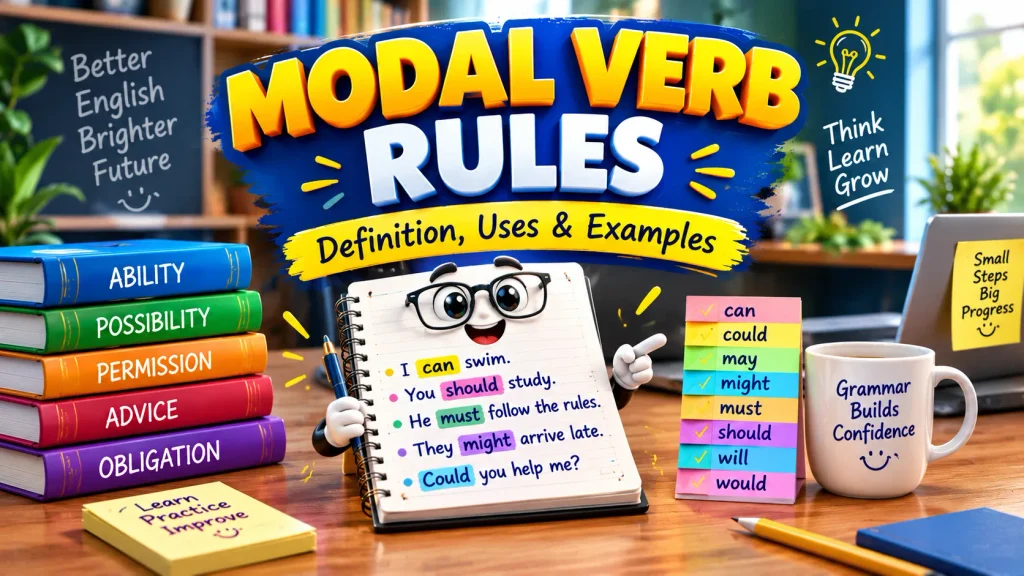
Modal Verb Rules for Different Purposes
This table summarizes common functions of modal verbs.
| Function | Modal verbs | Example |
| Ability | Can, could | She can swim. |
| Permission | Can, could, may | May I leave? |
| Possibility | May, might, could | It might snow. |
| Strong obligation | Must | You must stop. |
| External requirement | Have to | I have to work. |
| Advice | Should, ought to | You should rest. |
| Prohibition | Must not, can’t | You must not enter. |
| No necessity | Don’t have to, needn’t | You don’t have to wait. |
| Prediction | Will, should | It will improve. |
| Polite request | Could, would, can | Could you help me? |
| Offer or suggestion | Shall | Shall we begin? |
| Hypothetical result | Would, could, might | I would go if I could. |
Modal Verb Rules vs Modal-Like Expressions
Not every expression that communicates obligation, ability, or necessity is a core modal verb. Understanding the differences helps you avoid grammatical errors.
| Expression | Rule | Example |
| Have to | Have to + base verb | I have to study. |
| Need to | Need to + base verb | She needs to leave. |
| Be able to | Be able to + base verb | He is able to swim. |
| Be allowed to | Be allowed to + base verb | We are allowed to enter. |
| Had better | Had better + base verb | You had better hurry. |
| Needn’t | Needn’t + base verb | You needn’t worry. |
These expressions can often replace a modal when you need a different tense or a more specific meaning.
For example:
- Present ability: I can swim.
- Future ability: I will be able to swim longer distances.
- Past obligation: I had to work yesterday.
- Future obligation: I will have to work tomorrow.
Explore More: https://wordminto.com/setup-or-set-up/
Modal Verbs in Different Sentence Types
Affirmative Sentences
Use the subject followed by a modal and the base verb.
- She can dance.
- He will come tomorrow.
- They should listen carefully.
Negative Sentences
Place not after the modal.
- She cannot dance.
- He will not come tomorrow.
- They should not make noise.
Interrogative Sentences
Place the modal before the subject.
- Can she dance?
- Will he come tomorrow?
- Should they listen carefully?
WH-Questions
Use a question word before the modal.
- What can you do?
- Where should we go?
- When will they arrive?
- Why might she leave early?
- How could I improve my writing?
Modal Verbs in the Passive Voice
You can use modal verbs in passive constructions when the action matters more than the person performing it.
Structure: Subject + modal + be + past participle.
Examples:
- The work must be completed today.
- The rules should be followed.
- The room can be cleaned later.
- The application may be approved.
- The problem could be solved easily.
For past passive meaning, use modal + have been + past participle.
- The work should have been completed yesterday.
- The application might have been approved.
Common Modal Verb Rules Mistakes
English learners often make errors when combining modal verbs with main verbs. Review these common mistakes.
| Incorrect sentence | Correct sentence | Explanation |
| She can sings. | She can sing. | Use the base verb. |
| He must to go. | He must go. | Omit to after core modals. |
| He cans swim. | He can swim. | Modals do not take -s. |
| Do you can drive? | Can you drive? | Put the modal before the subject. |
| She should went home. | She should go home. | Use the base verb after should. |
| He might has left. | He might have left. | Use have after the modal. |
| You mustn’t come early if you don’t want to. | You don’t have to come early. | Use don’t have to for lack of necessity. |
| I will can help you. | I will be able to help you. | Use be able to after will. |
| She ought apologize. | She ought to apologize. | Include to after ought. |
| He should have went. | He should have gone. | Use the past participle after have. |
Important Differences Between Modal Verbs
Some modal verbs have similar meanings, but they do not always communicate the same level of certainty, obligation, or politeness.
Can vs Could
- Can often expresses present ability: I can drive.
- Could often expresses past general ability: I could swim when I was young.
- Could also makes a request sound more polite: Could you help me?
May vs Might
- May: It may rain tomorrow.
- Might: It might rain tomorrow.
Both express possibility. The difference in certainty depends on the context, not just the modal verb.
Must vs Have To
- Must: You must follow these instructions.
- Have to: I have to wear a uniform at work.
Both can express obligation. Must often emphasizes the speaker’s requirement, while have to frequently describes an external rule or circumstance. This distinction is not absolute.
Mustn’t vs Don’t Have To
- Mustn’t: You mustn’t share your password. (It is prohibited.)
- Don’t have to: You don’t have to attend the meeting. (It is optional.)
These expressions have different meanings, so do not use them interchangeably.
Should vs Must
- Should: You should exercise regularly. (Advice)
- Must: You must wear a helmet here. (Strong requirement)
Should generally expresses a recommendation, while must expresses a stronger obligation or a conclusion based on evidence.
Will vs Would
- Will: I will help you tomorrow.
- Would: I would help you if I had time.
Will commonly expresses future actions or willingness. Would commonly expresses hypothetical situations, polite requests, and reported future actions.
Modal Verb Rules: Quick Reference Chart
S + M + V1
Affirmative
She can swim.
S + M + not
Negative
She cannot swim.
M + S + V1?
Question
Can she swim?
M + have + V3
Past meaning
She might have left.
S = subject · M = modal verb · V1 = base verb · V3 = past participle
Modal Verb Exercises with Answers
Test your understanding of modal verb rules with the following practice questions.
Practice quiz
0 of 10 answered
Choose the correct answer for each sentence, then check your results.
1. She ___ speak three languages.
can
cans
can to
2. You ___ wear a seat belt while driving. It is required by law.
might
must
would
3. ___ you please open the window?
Would
Must
Should to
4. He ___ be at home; all the lights are off, but I am not sure.
might
must to
cans
5. You ___ bring food. We have already prepared dinner, and bringing food is optional.
mustn’t
don’t have to
can’t to
6. She should ___ harder for the exam.
studies
studied
study
7. ___ I borrow your pen, please?
May
Do may
Mays
8. They might have ___ the wrong train.
take
took
taken
9. ___ we begin the meeting?
Shall
Shalls
Do shall
10. I will ___ able to attend tomorrow.
can
be
being
Check results
People Also Ask
The 10 commonly taught core modal verbs are can, could, may, might, must, shall, should, will, would, and ought to. Strictly speaking, ought is the modal verb, and to forms part of the expression ought to.
A core modal verb normally comes before the base form of the main verb.
Example: She can dance.
Do not write She can dances or She can to dance.
No. Core modal verbs do not take regular subject-based endings.
Correct: He can swim.
Incorrect: He cans swim.
Standard English generally does not place two core modal verbs directly together.
Incorrect: I will can swim.
Correct: I will be able to swim.
Place not after the modal verb.
Examples:
I cannot drive.
She should not worry.
They might not arrive today.
Examples: be, do, and have serve as auxiliary verbs, while can, should, and might are modal verbs.
Conclusion
Modal Verb Rules help you construct clear and grammatically correct English sentences. The most important principle is to use a core modal verb followed by the base form of the main verb. Remember to place not after the modal in negative sentences and put the modal before the subject in questions.
Practice the differences between can and could, may and might, must and have to, and should and must. With regular practice, you can use modal verbs confidently in conversations, schoolwork, examinations, and professional writing.










3 thoughts on “Modal Verb Rules: Complete Guide with Meanings, Examples, and Exercises”