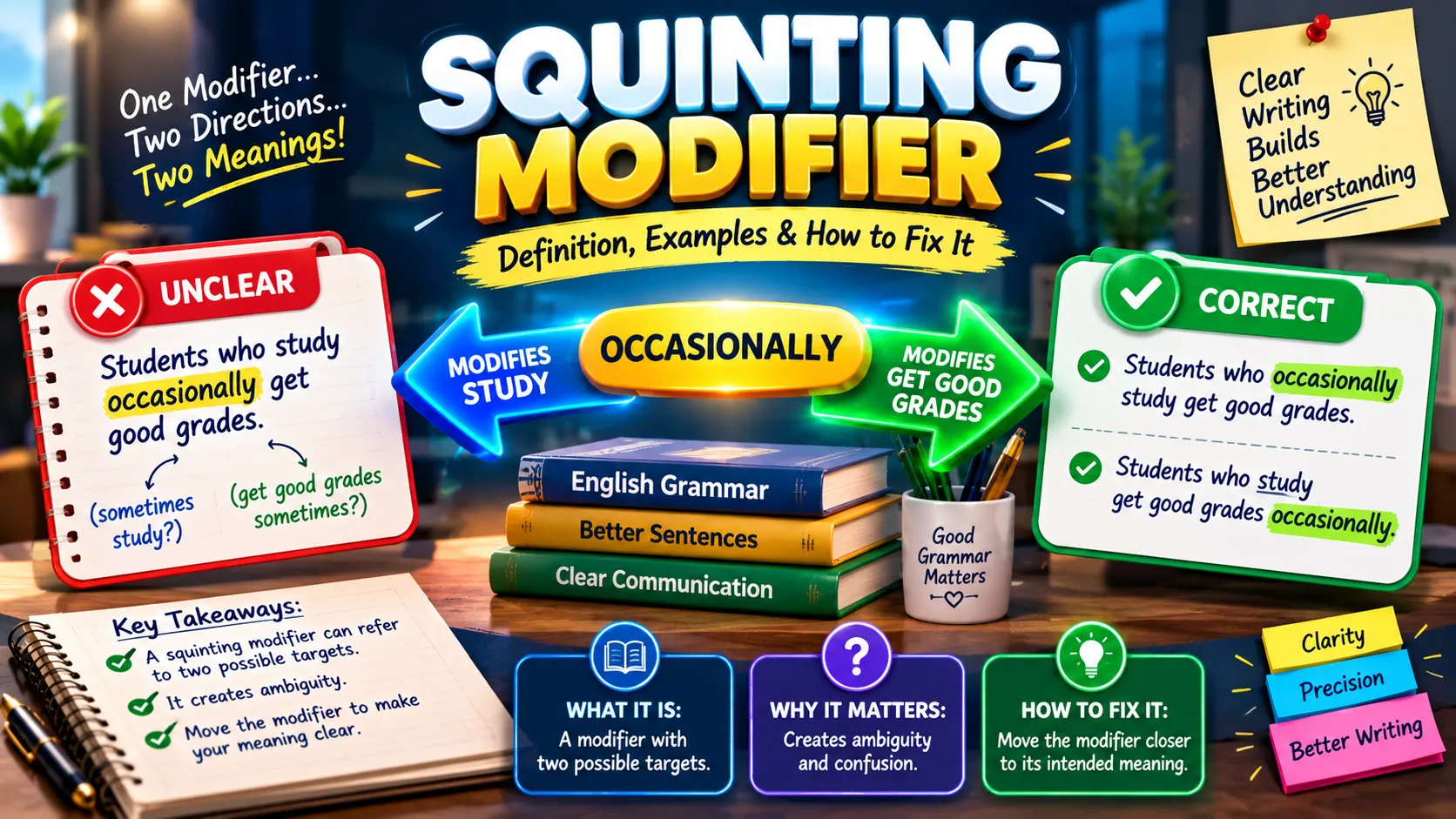
A Squinting Modifier is a word or phrase that can modify either the words before it or the words after it in a sentence. This placement creates ambiguity because readers cannot tell exactly which part of the sentence the modifier describes.
Writers often create squinting modifiers when they place an adverb or modifying phrase between two possible targets.
Example of a squinting modifier:
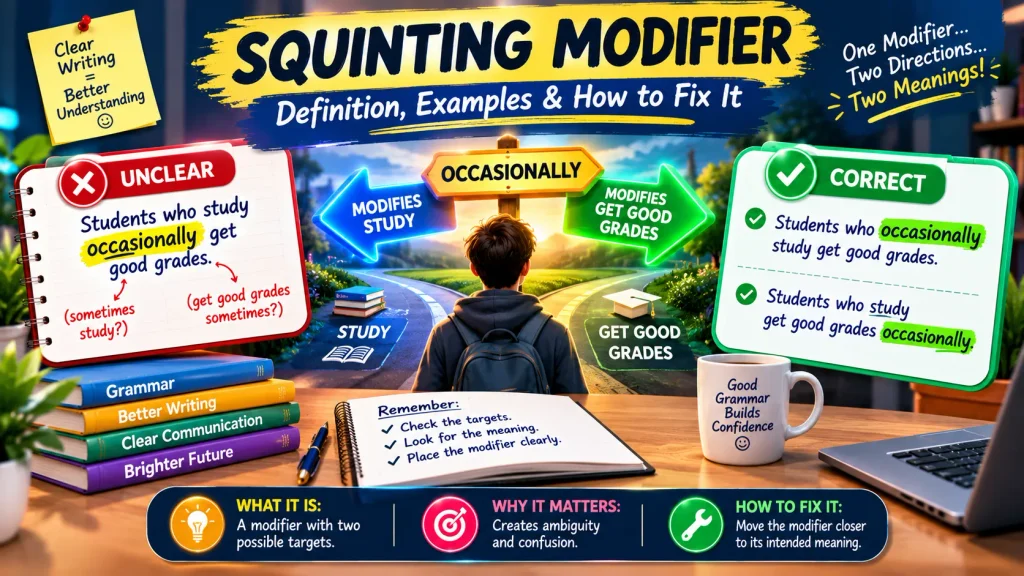
- Unclear: Students who study occasionally get good grades.
- Meaning 1: Students who study sometimes get good grades.
- Meaning 2: Students who study get good grades occasionally.
The word occasionally creates confusion because it can modify either study or get good grades.
Corrected versions:
- Students who occasionally study get good grades.
- Students who study get good grades occasionally.
Both corrected sentences communicate a clear meaning.
How Does a Squinting Modifier Work?
A Squinting Modifier sits between two words, phrases, or clauses that it could logically modify. It seems to look in both directions, which explains the term squinting.
Consider this example:
Unclear: The teacher said yesterday the students needed extra practice.
The word yesterday could refer to when the teacher spoke or when the students needed extra practice.
You can remove the ambiguity by moving the modifier:
- Teacher spoke yesterday: Yesterday, the teacher said the students needed extra practice.
- Students needed practice yesterday: The teacher said the students needed extra practice yesterday.
The revised sentences make the intended meaning easier to understand.
Explore More: https://wordminto.com/setup-or-set-up/
Squinting Modifier Examples
Here are common examples that show how modifier placement affects meaning.
| Incorrect or unclear sentence | Clear correction |
| People who exercise regularly stay healthy. | People who regularly exercise stay healthy. |
| She said after lunch she would call me. | After lunch, she said she would call me. |
| Employees who work sometimes receive bonuses. | Employees who sometimes work receive bonuses. |
| I told him eventually I would help. | Eventually, I told him I would help. |
| The manager announced today the new policy. | Today, the manager announced the new policy. |
| Children who eat often feel hungry. | Children who often eat feel hungry. |
Some sentences in the table may be grammatically correct in context, but their modifier placement can allow more than one interpretation. The best correction depends on the writer’s intended meaning.
Explore More: https://wordminto.com/adapt-vs-adopt/
Common Types of Squinting Modifiers
Squinting Modifiers can involve different words and phrases. Recognizing these patterns helps writers identify and correct ambiguity.
1. Adverbs as Squinting Modifiers
Adverbs frequently create squinting modifiers because they can modify verbs, adjectives, or entire clauses.
Example:
Unclear: Drivers who speed frequently cause accidents.
This sentence can mean that drivers who frequently speed cause accidents, or that speeding drivers cause accidents frequently.
Clear alternatives:
- Drivers who frequently speed cause accidents.
- Drivers who speed cause accidents frequently.
2. Time Expressions as Squinting Modifiers
Time expressions can refer to the action before them or the action after them.
Example:
Unclear: She explained on Monday the new procedure.
Did she explain it on Monday, or did the new procedure take effect on Monday?
Clear alternatives:
- On Monday, she explained the new procedure.
- She explained that the new procedure would begin on Monday.
3. Frequency Words as Squinting Modifiers
Words such as sometimes, often, usually, and occasionally can cause ambiguity when they sit between two possible targets.
Example:
Unclear: Students who practice sometimes improve quickly.
Clear alternatives:
- Students who sometimes practice improve quickly.
- Students who practice improve quickly sometimes.
4. Phrases Between Two Possible Targets
A longer modifying phrase can also create ambiguity when it appears between two clauses or actions.
Example:
Unclear: The coach said before the game the team needed rest.
Clear alternatives:
- Before the game, the coach said the team needed rest.
- The coach said the team needed rest before the game.
The placement determines which action the time phrase describes.
Explore More: https://wordminto.com/can-vs-could/
Squinting Modifier vs Dangling Modifier
Squinting Modifiers and Dangling Modifiers both create problems with clarity, but they work differently.
| Feature | Squinting Modifier | Dangling Modifier |
| Main problem | The modifier can refer to two targets. | The modifier lacks a clear or logical target. |
| Cause | Ambiguous placement between possible targets. | Missing or incorrectly expressed subject. |
| Example | Students who study occasionally get high grades. | Walking to school, the rain soaked Maya. |
| Correction | Move the modifier closer to its intended target. | Rewrite the sentence to identify the person or thing performing the action. |
Dangling modifier correction: While Maya was walking to school, the rain soaked her.
This revision identifies Maya as the person walking.
Squinting Modifier vs Misplaced Modifier
A misplaced modifier appears in a position that makes its intended meaning unclear or creates an unintended meaning. A squinting modifier is a particular kind of ambiguous placement in which the modifier can attach to either the preceding or following material.
For example:
- Squinting modifier: Students who study occasionally pass exams.
- Misplaced modifier: She served sandwiches to the children on paper plates.
In the second sentence, on paper plates appears to describe the children, although the writer likely means that the sandwiches were served on paper plates.
Correction: She served the children sandwiches on paper plates.
Explore More: https://wordminto.com/other-vs-another/
How to Fix a Squinting Modifier
Use these practical techniques to make sentences clearer.
1. Move the Modifier Closer to Its Intended Target
Place the modifier next to the word or phrase it describes.
- Unclear: People who exercise regularly feel better.
- Clear: People who regularly exercise feel better.
2. Rewrite the Sentence
Sometimes, moving one word does not resolve the ambiguity. Restructure the sentence instead.
- Unclear: The doctor said recently the treatment worked.
- Clear: The doctor recently said that the treatment worked.
3. Use a More Specific Expression
Replace a vague or ambiguous expression with wording that clearly communicates the intended meaning.
- Unclear: The company announced yesterday the results were final.
- Clear: Yesterday, the company announced that the results were final.
4. Read the Sentence From Both Directions
Check whether the modifier makes sense with the words before it and the words after it.
For example:
Employees who arrive early sometimes receive recognition.
Ask yourself:
- Do employees sometimes arrive early?
- Do employees who arrive early sometimes receive recognition?
If both interpretations make sense, move the modifier or rewrite the sentence.
5. Ask Whether the Sentence Has Two Possible Meanings
If a reasonable reader could understand the sentence in two different ways, revise it to express one clear meaning.
Clear writing requires more than grammatical correctness. It also requires precise modifier placement.
Explore More: https://wordminto.com/direct-vs-indirect-speech/
Why Should You Avoid Squinting Modifiers?
Squinting modifiers can make writing confusing, particularly in academic assignments, professional documents, instructions, and other situations where precision matters.
Avoiding them helps you:
- Communicate your intended meaning.
- Improve sentence clarity and readability.
- Prevent misunderstandings.
- Write stronger essays and reports.
- Make instructions easier to follow.
- Improve the quality of professional communication.
Although readers can often infer the intended meaning from context, writers should not force them to guess.

Squinting Modifier Exercises
Test your understanding by identifying the ambiguous modifier in each sentence and choosing a clearer version.
Exercise 1
Sentence: People who exercise regularly feel energetic.
What is the possible problem?
A. The subject is missing.
B. The word regularly may modify either exercising or feeling energetic.
C. The sentence contains a dangling modifier.
Answer: B. The placement of regularly can create two interpretations.
Exercise 2
Sentence: The manager said yesterday the project was complete.
Which revision clearly states that the manager spoke yesterday?
A. Yesterday, the manager said the project was complete.
B. The manager said the project was complete yesterday.
Answer: A. Placing yesterday at the beginning clearly identifies when the manager spoke.
Exercise 3
Sentence: Students who practice often perform better.
Rewrite the sentence to express the idea that students frequently practice.
Answer: Students who often practice perform better.
Exercise 4
Sentence: She told her friend after dinner she was leaving.
Rewrite the sentence to show that she spoke after dinner.
Answer: After dinner, she told her friend she was leaving.
Exercise 5
Sentence: Workers who arrive early sometimes receive awards.
Rewrite the sentence to show that workers who arrive early receive awards on some occasions.
Answer: Workers who arrive early receive awards sometimes.
People Also Ask
A squinting modifier is a word or phrase placed between two possible targets, making it unclear which one the modifier describes.
It is called a squinting modifier because it appears to look in two directions. The reader may connect it to the preceding words or the following words.
“Students who study occasionally get good grades” is a common example. The word occasionally could describe how often students study or how often they get good grades.
Squinting modifiers do not always make a sentence structurally ungrammatical. However, they can create ambiguity, so writers should revise them when the intended meaning is unclear.
Look for an adverb or modifying phrase positioned between two possible targets. If both interpretations make sense, the sentence may contain a squinting modifier.
Conclusion
A Squinting Modifier creates ambiguity when a word or phrase can modify either the preceding or following part of a sentence. Words such as sometimes, often, regularly, and yesterday can cause this problem when writers place them between two possible targets.
To correct a Squinting Modifier, identify the intended meaning, move the modifier to a clearer position, and rewrite the sentence if necessary. With careful editing, you can make your writing more precise, readable, and effective.










3 thoughts on “Squinting Modifier: Definition, Examples, and How to Fix It”