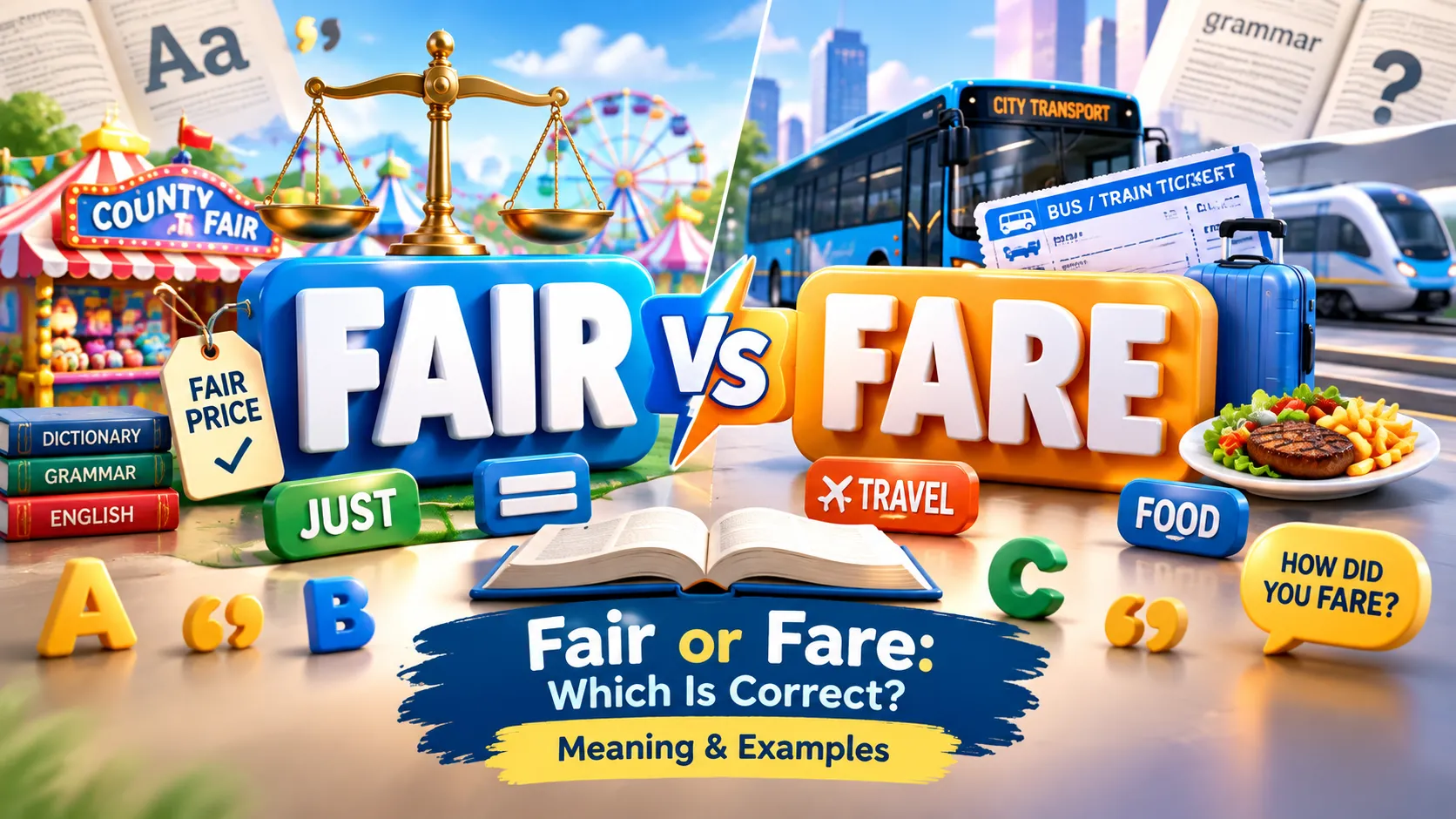
Fair or Fare: Fair and fare are classic English homophones: they sound the same but have different spellings, meanings, and grammatical uses. That is why you may know the pronunciation perfectly but still hesitate when writing “bus fare,” “fair treatment,” or “How did you fare?”
The easiest distinction is:
Fair usually relates to justice, reasonableness, appearance, weather, or an event.
Fare usually relates to transportation cost, food, or how someone performs or progresses.
For example:
- The judge made a fair decision. ✅
- The bus fare increased. ✅
- We visited the county fair. ✅
- How did you fare in the exam? ✅
This guide explains the difference between fair and fare, including meanings, parts of speech, common phrases, tricky cases, memory tricks, examples, exercises, and frequently asked questions. Major reference and educational sources likewise distinguish the words by meaning and grammatical function.
Fair or Fare: Quick Answer
| Word | Main meanings | Example |
| Fair | just, reasonable, impartial, light-colored, pleasant weather, public event | The teacher gave everyone a fair chance. |
| Fare | transportation cost, food, passenger, perform/progress | The train fare is expensive. |
| Fare | perform or progress as a verb | How did you fare in the interview? |
Simple memory rule
Fair = fairness, equality, events, appearance, weather
Fare = travel, transportation cost, food, performance
So:
- fair price ✅
- bus fare ✅
- fair treatment ✅
- train fare ✅
- county fair ✅
- traditional fare ✅
- farewell ✅

What Is the Difference Between Fair and Fare?
The principal difference is meaning, not pronunciation.
Both words are generally pronounced /fer/ in standard varieties where they are homophones. Because they sound alike, listening alone cannot tell you which spelling to choose. You must use the context.
Fair
Fair can be an adjective or noun and has several meanings.
It can mean:
- just or impartial
- reasonable
- acceptable or moderately good
- light in color
- pleasant or clear, especially of weather
- a public event, exhibition, or gathering
Fare
Fare is commonly used as a noun and verb.
As a noun, it can mean:
- money charged for transportation
- a passenger who pays for transportation
- food or a type of food
- something offered as entertainment or content
As a verb, fare means:
- to get on
- to do
- to perform
- to progress
- to turn out
Dictionary.com similarly identifies fair as an adjective with meanings including equitable, reasonable, pale, and clear, while fare covers transportation charges, food, and performance.
Fair: Meaning and Uses
1. Fair Means Just or Equal
The most common use of fair is to describe something reasonable, impartial, or just.
Examples
- The teacher gave every student a fair chance.
- The judge made a fair decision.
- Everyone deserves fair treatment.
- That doesn’t seem fair.
- The company has a fair hiring process.
- Both players received a fair opportunity.
In each sentence, fair relates to equality, justice, or reasonable treatment.
Fair vs. Unfair
The natural opposite of fair in this sense is unfair.
- The decision was fair.
- The decision was unfair.
2. Fair Means Reasonable or Acceptable
Fair can also mean reasonable or acceptable, especially when discussing prices, offers, amounts, or conditions.
Examples
- That is a fair price for the laptop.
- The seller offered me a fair deal.
- We received a fair amount of compensation.
- She asked for a fair salary.
- That seems like a fair offer.
Notice the important distinction:
fair price = a reasonable price
fare = a transportation charge
Therefore:
- The taxi fare was expensive. ✅
- The taxi fair was expensive. ❌
But:
- The taxi company offered a fair price. ✅
3. Fair Means Light in Color
Fair can describe light-colored skin, hair, or complexion.
Examples
- She has fair hair.
- He has fair skin.
- The character was described as having fair hair.
- She has a fair complexion.
Here, fair has nothing to do with justice or transportation.
4. Fair Means Pleasant or Clear Weather
Fair can describe pleasant, clear, or favorable weather.
Examples
- We had fair weather during our trip.
- The forecast predicts fair skies tomorrow.
- The sailors waited for fair weather.
- The afternoon remained fair and dry.
This is another reason context matters.
5. Fair Means Moderately Good
In some contexts, fair means reasonably good or acceptable, but not excellent.
Examples
- Her performance was fair.
- The restaurant received a fair review.
- His knowledge of French is fair.
- Business has been fair this month.
The exact meaning depends on context.
6. Fair as a Noun: An Event
A fair can be an organized public event featuring activities, exhibitions, entertainment, products, food, or services.
Examples
- We went to the county fair.
- The school held a science fair.
- She attended a job fair.
- The town hosts an annual summer fair.
- I bought a book at the book fair.
This is one of the most important noun uses of fair.
Fare: Meaning and Uses
1. Fare Means Transportation Cost
This is probably the most important use of fare.
A fare is the amount of money charged for transportation.
Examples
- The bus fare increased.
- How much is the train fare?
- The taxi fare was surprisingly high.
- I paid my airfare online.
- The subway fare is affordable.
- What is the fare from the airport to downtown?
So remember:
You pay a fare to travel.
Common Transportation Expressions
- bus fare
- train fare
- taxi fare
- subway fare
- rail fare
- air fare/airfare
- ferry fare
- cab fare
2. Fare Can Mean a Passenger
Fare can also refer to a passenger who pays for transportation, particularly in contexts involving taxis or similar services.
Example
The driver picked up his last fare of the evening.
Here, fare does not mean the price. It refers to the passenger.
This meaning is less common for everyday English learners, but it is useful to recognize it.
3. Fare Means Food
Fare can refer to the type or range of food served or available.
This usage is particularly common in descriptions of restaurants, regions, cultures, and travel.
Examples
- The restaurant serves traditional Italian fare.
- The festival featured local fare.
- The pub offers simple British fare.
- The hotel serves excellent vegetarian fare.
- Seafood is common fare along the coast.
Important distinction
Food is the everyday word.
Fare is often more formal or descriptive.
For example:
The restaurant serves traditional Mexican food.
and
The restaurant serves traditional Mexican fare.
Both can be correct, but fare emphasizes the type or style of food being offered.
4. Fare as a Verb: To Perform or Progress
This is the use that causes one of the most common mistakes.
As a verb, fare means to do, perform, progress, or turn out in a particular way.
Examples
- How did you fare on the test?
- She fared well in the interview.
- The company fared badly during the recession.
- The team fared better than expected.
- How will the new product fare in the market?
- He fared poorly in the competition.
A useful substitution test is:
If do, perform, or progress makes sense, fare may be the correct word.
For example:
How did you fare in the exam?
≈
How did you do in the exam?
Therefore:
- How did you fare? ✅
- How did you fair? ❌
Dictionary.com specifically identifies this verbal use of fare with meanings such as “get on,” “manage,” and “turn out.”
Fair vs. Fare: Complete Comparison Table
| Feature | Fair | Fare |
| Pronunciation | Same as fare | Same as fair |
| Homophone? | Yes | Yes |
| Adjective | Yes | Generally no |
| Noun | Yes | Yes |
| Verb | Specialized uses exist | Common |
| Justice/equality | ✅ | ❌ |
| Reasonable price | ✅ | ❌ |
| Transportation cost | ❌ | ✅ |
| Food/type of food | ❌ | ✅ |
| Public event | ✅ | ❌ |
| Light-colored | ✅ | ❌ |
| Pleasant weather | ✅ | ❌ |
| Perform/progress | ❌ in ordinary usage | ✅ |
| Example | a fair decision | a train fare |
Fair or Fare: Examples in Sentences
Easy Examples
Fair
- That isn’t fair.
- She gave me a fair chance.
- We visited the fair.
- He has fair hair.
- The weather was fair.
Fare
- The bus fare is $2.
- The train fare increased.
- How did you fare?
- The restaurant serves local fare.
- She fared well in the competition.
Medium-Level Examples
- The manager promised a fair hiring process.
- The airline reduced its fares during the holiday season.
- The students attended a science fair.
- The restaurant specializes in traditional regional fare.
- How did your team fare against the defending champions?
- The judge wanted to ensure a fair trial.
- The taxi fare was higher than expected.
- The company fared better than its competitors last quarter.
Advanced Examples
Fair
The committee attempted to establish a fair and transparent selection process.
Here, fair means impartial and reasonable.
Fare
The new transportation policy may affect how commuters fare during peak hours.
The first fare-related idea concerns performance or experience, while transportation provides the broader context.
Another example
Although the entrance fee was fair, the additional train fare made the trip more expensive than expected.
Here:
- fair = reasonable
- fare = transportation cost
Fair and Fare in Different Contexts
Daily Conversation
Fair:
That’s not fair!
Fare:
How much is the bus fare?
School and Education
Fair:
Our school is organizing a science fair.
Fare:
How did you fare in your mathematics exam?
Business English
Fair:
We need a fair and transparent recruitment process.
Fare:
The company fared well during the difficult quarter.
Travel English
Fair:
We had fair weather throughout the journey.
Fare:
The train fare was higher than I expected.
Restaurant English
Fair:
The restaurant offered a fair price.
Fare:
The restaurant serves traditional local fare.
Fair Price vs. Fare Price
This is an especially common confusion.
Fair price
Fair price means a reasonable or acceptable price.
The seller offered a fair price.
Fare
Fare means a transportation charge.
The bus fare is $3.
Therefore:
❌ The taxi has a high fair.
✅ The taxi has a high fare.
But:
✅ The taxi company charges a fair price.
Fair Treatment vs. Fare Treatment
The correct expression is:
fair treatment ✅
Because the meaning is equal, reasonable, or impartial treatment.
Example:
Every employee deserves fair treatment.
Not:
Every employee deserves fare treatment. ❌
Fair Chance vs. Fare Chance
The correct expression is:
fair chance ✅
Example:
Everyone deserves a fair chance to succeed.
Here, fair means equal or reasonable.
Bus Fair or Bus Fare?
The correct spelling is:
bus fare ✅
A bus fare is the amount charged for traveling by bus.
Examples:
- The bus fare has increased.
- I don’t have enough money for the bus fare.
- What is the bus fare to the city center?
Bus fair is incorrect when you mean transportation cost.
Train Fair or Train Fare?
The correct expression is:
train fare ✅
Example:
The train fare from Lahore to Islamabad was higher than expected.
The word fare refers to the cost of transportation.
Airfare or Airfair?
The correct spelling is:
airfare ✅
Airfare means the price paid for air transportation.
Examples:
- The airfare was expensive.
- We found affordable airfare online.
- International airfares vary by season.
Not:
airfair ❌
Fair Well or Fare Well?
When you mean do well, progress well, or have things go well, use:
fare well ✅
Example:
I hope you fare well in your new position.
Not:
I hope you fair well. ❌
This is because fare is the verb meaning to get on or progress.
Farewell or Fairwell?
The correct spelling is:
farewell ✅
Farewell is a noun, adjective, or interjection associated with saying goodbye.
Examples:
- We said our farewells before leaving.
- She wrote a farewell message.
- Farewell, my friend.
Fairwell is not the standard spelling of this word.
The word is historically connected with the phrase fare well, which explains the spelling.
How Did You Fare or How Did You Fair?
The correct expression is:
How did you fare? ✅
Use it when asking how someone performed, managed, or did.
Examples:
- How did you fare in the interview?
- How did you fare on your exam?
- How did your team fare against its rivals?
Incorrect:
How did you fair in the exam? ❌
Fair or Fare: Common Mistakes
| Incorrect | Correct | Why? |
| The bus fair is expensive. | The bus fare is expensive. | Fare = transportation cost |
| That’s not fare. | That’s not fair. | Fair = just/reasonable |
| How did you fair? | How did you fare? | Fare = perform/do |
| We went to the county fare. | We went to the county fair. | Fair = event |
| The restaurant serves traditional fair. | The restaurant serves traditional fare. | Fare = food |
| She has fare hair. | She has fair hair. | Fair = light-colored |
| Everyone deserves fare treatment. | Everyone deserves fair treatment. | Fair = equitable |
| The airline reduced its fair. | The airline reduced its fare. | Fare = transportation price |
| We had fare weather. | We had fair weather. | Fair = pleasant/clear |
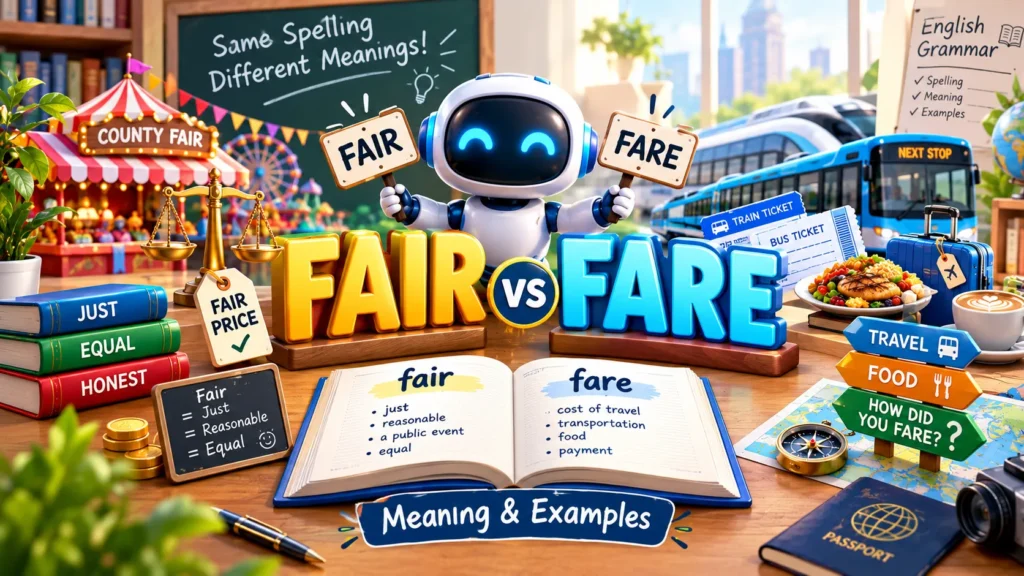
Why Do People Confuse Fair and Fare?
The main reason is pronunciation.
Fair and fare are homophones in standard varieties where they share the same pronunciation. Their sounds do not provide enough information to determine the spelling.
Compare:
- fair → /fer/
- fare → /fer/
The difference becomes visible in writing rather than speech.
This is similar to other homophone pairs such as:
- bare / bear
- brake/break
- hear / here
- pair/pear
- right / write
- sea / see
The solution is therefore not to memorize the pronunciation. Instead, connect each spelling with its meaning and context.
Easy Memory Tricks for Fair and Fare
Trick 1: Fair = Fairness
Think:
Fair → fairness
If the sentence involves justice, equality, or impartiality, choose fair.
- fair treatment
- fair decision
- fair chance
- fair rules
Trick 2: Fare = Travel
Think:
Fare → transportation
If you’re paying to travel, you pay a fare.
- bus fare
- train fare
- taxi fare
- airfare
Trick 3: Fare = How You Do
Remember:
How did you fare? = How did you do?
Examples:
- How did you fare on the test?
- The team fared well.
- The business fared poorly.
Trick 4: Fair = Event
A fair can be an event.
- book fair
- science fair
- county fair
- job fair
A One-Line Rule to Remember
Fair is about what is just or reasonable; fare is about travel costs, food, or how someone does.
There are additional meanings, so this is a memory aid rather than an exhaustive grammatical rule.
Fair vs. Fare: Quick Decision Test
When you’re unsure, ask yourself what the sentence means.
Does it mean justice or equality?
→ FAIR
Everyone deserves a fair opportunity.
Does it mean reasonable?
→ FAIR
That’s a fair price.
Does it describe light hair or skin?
→ FAIR
She has fair hair.
Does it describe pleasant weather?
→ FAIR
We had fair weather.
Does it mean an event?
→ FAIR
We went to the county fair.
Does it mean transportation cost?
→ FARE
The bus fare is expensive.
Does it mean food?
→ FARE
The restaurant serves traditional fare.
Does it mean perform or progress?
→ FARE
How did you fare in the competition?
Fair and Fare in Exam Questions
These words are common candidates for spelling, vocabulary, sentence-correction, and error-detection questions.
Question 1
Choose the correct word:
The taxi _____ was too expensive.
A. fair
B. fare
Answer: B. fare
A transportation charge is a fare.
Question 2
The teacher gave every student a _____ chance.
A. fair
B. fare
Answer: A. fair
The sentence refers to equal opportunity.
Question 3
How did you _____ in the examination?
A. fair
B. fare
Answer: B. fare
Here, fare is a verb meaning “perform” or “do.”
Question 4
We visited the county _____.
A. fair
B. fare
Answer: A. fair
A public event is a fair.
Question 5
The restaurant serves traditional Italian _____.
A. fair
B. fare
Answer: B. fare
Here, fare means food or cuisine.
Practice Exercise: Fill in the Blanks
Choose fair or fare.
- The bus _____ increased this year.
- Everyone deserves a _____ chance.
- How did you _____ in the interview?
- We visited the county _____.
- The restaurant serves local _____.
- She has _____ hair.
- The judge made a _____ decision.
- The airline reduced its _____.
- We enjoyed _____ weather.
- The company _____ better than expected.
Answers
- fare
- fair
- fare
- fair
- fare
- fair
- fair
- fare
- fair
- fared
Multiple-Choice Questions
1. Which sentence is correct?
A. The bus fair is expensive.
B. The bus fare is expensive.
C. The bus fere is expensive.
D. The bus fear is expensive.
Answer: B
Fare means the amount paid for transportation.
2. Which word means “just or impartial”?
A. Fare
B. Fair
C. Fear
D. Fere
Answer: B — Fair
3. Which sentence is correct?
A. How did you fair on the test?
B. How did you fare on the test?
C. How did you fear on the test?
D. How did you fere on the test?
Answer: B
Fare is the verb meaning to perform or do.
4. Which sentence uses fair correctly?
A. The train fair increased.
B. I paid the fair.
C. The judge made a fair decision.
D. She fared hair.
Answer: C
5. Which sentence uses fare correctly?
A. Everyone deserves fare treatment.
B. We went to the county fare.
C. The restaurant serves traditional fare.
D. She has fare hair.
Answer: C
Sentence Correction Practice
Correct the errors.
1. The bus fair was expensive.
Correct: The bus fare was expensive.
2. That’s not fare!
Correct: That’s not fair!
3. How did you fair in your exam?
Correct: How did you fare in your exam?
4. We attended a book fare.
Correct: We attended a book fair.
5. The restaurant serves traditional Italian fair.
Correct: The restaurant serves traditional Italian fare.
6. Everyone deserves fare treatment.
Correct: Everyone deserves fair treatment.
Challenge Exercise
Choose the correct word in each sentence.
- The referee made a fair/fare decision.
- The train fair/fare was reasonable.
- The team fair/fared well in the tournament.
- We attended a science fair/fare.
- The hotel serves excellent local fair/fare.
- She has fair/fare skin.
- The company offered a fair/fare price.
- How did you fair/fare in the competition?
- The weather was fair/fare.
- The airline increased its fair/fares.
Answer Key
- fair
- fare
- fared
- fair
- fare
- fair
- fair
- fare
- fair
- fares
Explore More: https://wordminto.com/ssd-or-hdd/
Fair or Fare in British and American English
Unlike spelling pairs such as color/colour, fair and fare are not American-versus-British spelling variants.
The distinction remains based on meaning in both varieties:
- fair = just/reasonable/event/etc.
- fare = transportation cost/food/performance
So changing from British English to American English does not change:
bus fare
into:
bus fair
Both varieties use bus fare.
This distinction is also reflected in contemporary learner resources that explicitly note that the spellings remain the same across US and UK English.
Fair vs. Fare vs. Fairly
Do not confuse fair with fairly.
Fair
The decision was fair.
Here fair is an adjective.
Fairly
The students were treated fairly.
Here fairly is an adverb meaning in a fair or impartial manner.
Compare:
| Word | Function | Example |
| fair | adjective | It was a fair decision. |
| fairly | adverb | She was treated fairly. |
Fair vs. Fare vs. Farewell
These three forms are worth learning together.
Fair
The decision was fair.
Meaning: just or reasonable.
Fare
How did you fare?
Meaning: how did you do or progress?
Farewell
We said farewell before leaving.
Meaning: goodbye.
The spelling of farewell is connected historically with the expression fare well.
Related Expressions With Fair
Some common expressions include:
- fair chance
- fair treatment
- fair price
- fair deal
- fair play
- fair game
- fair share
- fair decision
- fair competition
- fair weather
- fair-minded
- fair enough
- fair and square
- county fair
- science fair
- book fair
- job fair
Examples
Everyone deserves a fair chance.
That’s fair enough.
She received her fair share.
The players agreed to fair play.
Related Expressions With Fare
Common expressions include:
- bus fare
- train fare
- taxi fare
- cab fare
- airfare
- subway fare
- ferry fare
- fare well
- fare badly
- fare poorly
- fare better
- fare worse
- traditional fare
- local fare
- simple fare
Examples
The train fare is affordable.
How did you fare in the competition?
The restaurant offers traditional local fare.
Information You Should Not Mix Up
A particularly useful way to understand these words is to separate their semantic fields.
Fair belongs strongly to these ideas:
justice → equality → reasonableness → appearance → weather → events
Fare belongs strongly to these ideas:
transportation → cost → food → passengers → performance/progress
This semantic grouping is more reliable than trying to memorize dozens of isolated sentences.
Why “Fair Price” and “Fare Price” Are Different
This distinction deserves special attention because both expressions can appear to involve money.
Fair price
A fair price is a reasonable price.
The customer thought $50 was a fair price.
Fare
A fare is the amount charged for transportation.
The taxi fare was $50.
Therefore, a single sentence can correctly use both:
The fare was expensive, but the passenger thought it was still a fair price.
That sentence demonstrates the distinction perfectly.
Real-Life Mini Story
Consider this sentence:
On a fair summer morning, Sara paid the fare for a train to the city, where she visited a book fair and sampled traditional local fare. Later, she wondered how her presentation would fare at work.
There are several different meanings:
- fair summer morning → pleasant weather
- fare for a train → transportation cost
- book fair → public event
- local fare → food
- fare at work → perform/progress
This illustrates why context is the key to mastering these homophones.
People Also Ask
Both are correct words, but they have different meanings. Use fair for meanings such as just, reasonable, light-colored, pleasant weather, or an event. Use fare for transportation costs, food, or the verb meaning to perform or progress.
Bus fare is correct because fare means the amount paid for transportation.
Fair price is correct when you mean a reasonable price.
How did you fare? is correct when asking how someone performed or did.
Fare well is correct when you mean “do well” or “progress well.”
The standard expression is fair weather, meaning pleasant or clear weather.
Fair or Fare: Final Summary
Fair and Fare sound alike, but they are different words with different meanings.
Use fair when talking about:
- justice
- Equality
- reasonable conditions
- reasonable prices
- light-colored hair or skin
- pleasant weather
- public events or exhibitions
Use fare when talking about:
- transportation costs
- passengers
- food or cuisine
- how someone performs or progresses
The most useful examples to memorize are:
Everyone deserves a fair chance.
The bus fare is expensive.
We went to the county fair.
The restaurant serves traditional fare.
How did you fare in the exam?
Once you connect each spelling with its meaning, this homophone pair becomes much easier to use correctly. The key is simple: fair describes fairness and several related qualities or events; fare concerns travel costs, food, or performance. This distinction is consistent across the major explanations and educational resources reviewed for this topic.
Would you like a shorter, exam-focused version of this article?










2 thoughts on “Fair or Fare: Which Is Correct? Meaning, Difference, Rules & Examples”