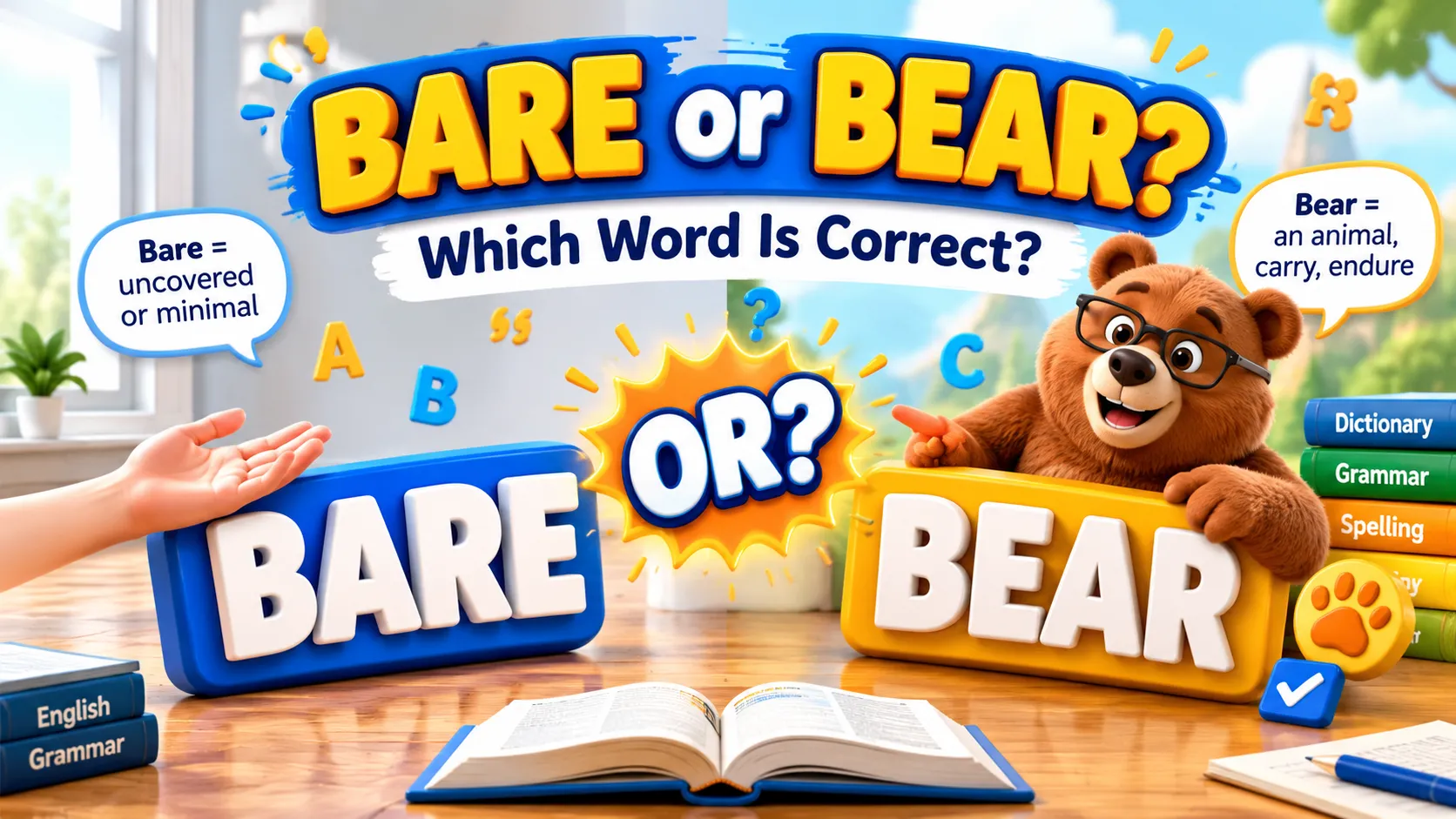
Bare or Bear? Both are correct English words, but they have completely different meanings and uses.
Bare usually means uncovered, exposed, empty, plain, or minimal. It can also be a verb meaning to uncover or reveal.
Bear can refer to the animal, but it is also a versatile verb meaning to carry, support, tolerate, endure, accept, or produce.
For example:
- She walked with bare feet. ✅
- We saw a bear in the forest. ✅
- I cannot bear the noise. ✅
- The room was almost bare. ✅
The two words are commonly treated as homophones because they have the same pronunciation in many varieties of English but different spellings and meanings.
Bare vs Bear: The Quick Difference
| Word | Main meaning | Part of speech | Example |
| Bare | uncovered, exposed, empty, plain, minimal | Adjective, verb | She walked on the bare floor. |
| Bear | animal; carry, support, endure, tolerate, produce | Noun, verb | I cannot bear the noise. |
Easy rule to remember
Bare = uncovered, exposed, empty, or minimal.
Bear = the animal or a verb meaning carry, support, tolerate, endure, accept, or produce.
Compare:
- Bare feet = feet without shoes or socks
- Bare walls = walls without decoration
- Bare minimum = the smallest necessary amount
- Bear responsibility = carry or accept responsibility
- Bear the pain = endure the pain
- Bear fruit = produce fruit
- A bear = the animal
This basic distinction agrees with established grammar references, although the full range of meanings is broader than the simple “bare = uncovered, bear = animal” shortcut.
What Does Bare Mean?
Bare generally describes something that is uncovered, exposed, empty, plain, or lacking something normally present.
Cambridge Dictionary gives several related uses, including something not covered, something reduced to only the basics, and a room or cupboard containing little or nothing.
Bare as an adjective
As an adjective, bare describes a noun.
Examples:
- He walked across the bare floor.
- She had bare feet.
- The tree had bare branches.
- The apartment looked bare without furniture.
- The wall was bare after the paintings were removed.
- We were given the bare facts.
- They survived on the bare necessities.
In each case, bare expresses the idea of having little or nothing covering, decorating, or adding to something.
Common phrases with bare
Some frequent expressions include:
- Bare feet
- Bare hands
- Bare arms
- Bare skin
- Bare walls
- Bare floor
- Bare branches
- Bare facts
- Bare essentials
- Bare necessities
- Bare minimum
- Bare bones
For example:
She picked up the hot pan with her bare hands.
Here, bare means her hands had no protective covering.
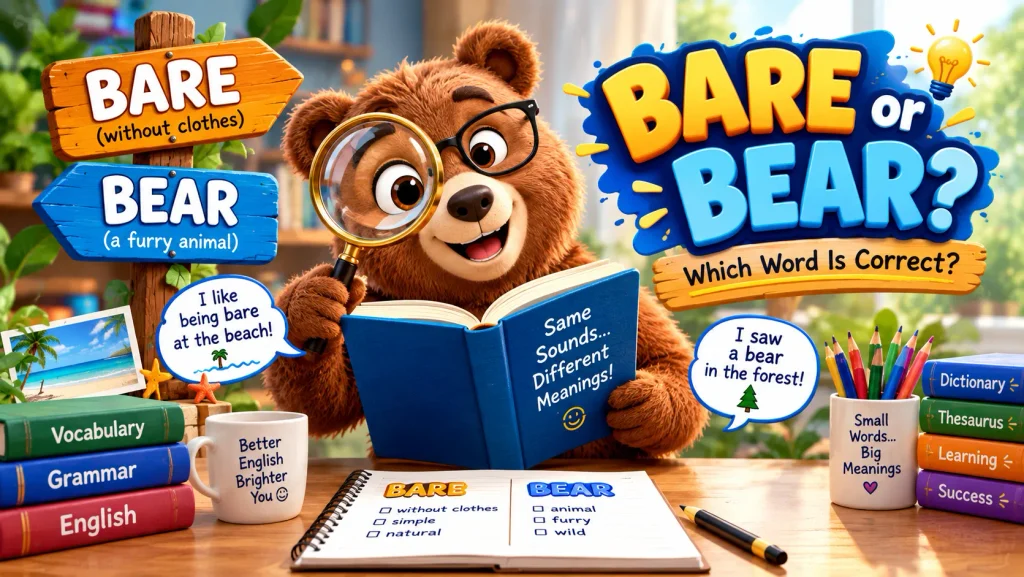
How to Use Bare as a Verb
Bare can also be a verb meaning to uncover, expose, reveal, or make something visible. Cambridge specifically gives examples such as someone baring their head or a dog baring its teeth.
Examples:
He bared his chest.
The dog bared its teeth.
She bared her feelings to her friend.
The investigation bared the truth.
The common verb forms are:
| Form | Example |
| bare | I will bare my feelings. |
| bares | The dog bares its teeth. |
| bared | He bared his arms. |
| baring | She is baring her emotions. |
Bare or bareing?
The present participle is:
bare → baring
Not:
bare → bareing ❌
The final e is dropped before -ing.
What Does Bear Mean?
Bear has several meanings, which is one reason learners frequently confuse it with bare.
As a noun, bear refers to the animal.
As a verb, bear can mean:
- carry
- support
- tolerate
- endure
- accept
- have or display
- produce
Scribbr and QuillBot both identify bear as a noun and a highly versatile verb.
How to Use Bear as a Noun
The most familiar noun meaning of bear is the large mammal.
Examples:
We saw a bear in the forest.
A black bear crossed the road.
The polar bear lives in Arctic regions.
The children learned about bears at school.
Use:
bear ✅
Not:
bare ❌
Memory trick
Think:
b + ear = bear
A bear has ears, so the animal is spelled bear.
This is only a memory aid, however. Remember that bear has many meanings beyond the animal.
How to Use Bear as a Verb
The verb bear has several important meanings.
1. Bear = carry
The truck can bear a heavy load.
Here, bear means carry.
2. Bear = support
The bridge must bear the weight of the vehicles.
Here, bear means support a weight or load.
3. Bear = endure
I cannot bear the pain.
Here, bear means endure.
4. Bear = tolerate
She could not bear the noise.
Here, bear means tolerate.
5. Bear = accept or handle
He had to bear the consequences of his decision.
Here, the idea is accepting or dealing with something difficult.
6. Bear = produce
The tree will bear fruit next year.
Here, bear means produce or yield.
7. Bear = have or display
The document bears his signature.
Here, bears means carries or displays.
Because bear has so many meanings, memorizing it only as the name of an animal can lead to mistakes.
Bare or Bear With Me: Which Is Correct?
The correct expression is:
Please bear with me. ✅
Not:
Please bare with me. ❌
Bear with me means please be patient with me or please wait while I do something. This is a fixed expression using the verb bear.
Examples:
Please bear with me while I check the information.
Bear with me for a moment.
Thank you for bearing with me.
Please bear with us while we resolve the issue.
Why is “bear with me” correct?
The verb bear can mean endure or tolerate.
So:
Bear with me = Be patient with me.
The phrase does not mean to uncover or expose anything, so bare is not the appropriate spelling.
Bare Minimum or Bear Minimum?
The correct phrase is:
Bare minimum ✅
Not:
Bear minimum ❌
Bare minimum means the smallest amount necessary. Cambridge specifically defines this expression as the least possible amount.
Example:
He did the bare minimum required to complete the assignment.
Other common expressions include:
- Bare essentials
- Bare necessities
- Bare facts
- Bare bones
Memory trick
If you mean only what is necessary and nothing extra, use:
bare
Therefore:
bare minimum ✅
Bear in Mind or Bare in Mind?
The correct expression is:
Bear in mind ✅
Not:
Bare in mind ❌
Bear in mind means remember, consider, or keep something in your thoughts.
Examples:
Bear in mind that the deadline is tomorrow.
You should bear in mind the cost of maintenance.
Bear in mind that prices may change.
This is another fixed expression where bear is the correct word.
Bear Witness or Bare Witness?
The standard expression is:
bear witness ✅
Not:
bare witness ❌
To bear witness means to provide evidence of something or testify to it.
Examples:
The document bears witness to the changes.
Several people bore witness to the event.
Here, bear is connected with carrying or presenting something.
Bear Fruit or Bare Fruit?
The correct expression when you mean produce fruit is:
Bear fruit ✅
Example:
The apple trees bear fruit in autumn.
It can also be used figuratively:
Her hard work finally bore fruit.
Here, bear means produce or yield.
By contrast, Bare Fruit could only be correct when bare has its ordinary meaning of uncovered or exposed.
Bare Feet or Bear Feet?
When you mean feet without shoes or socks, the correct phrase is:
Bare feet ✅
Not:
Bear feet ❌
Examples:
She walked across the grass with bare feet.
The children ran around with bare feet.
Use bare because the feet are uncovered.
But:
We studied the footprints of a bear.
Here, bear refers to the animal.
Bare Hands or Bear Hands?
The correct phrase is:
Bare hands ✅
Example:
He picked up the object with his bare hands.
Bare hands means hands without gloves or another covering.
Bear hands would normally refer to the hands or paws of a bear, or another unusual literal context.
Bear Responsibility or Bare Responsibility?
The usual expression is:
Bear responsibility ✅
Example:
Managers must bear responsibility for their decisions.
Here, bear means carry or accept responsibility.
Compare:
She had bare hands.
This means her hands were uncovered.
She had to bear responsibility.
This means she had to accept or carry responsibility.
The spelling changes because the meanings change.
Bare vs Bear: British and American English
There is no standard British-versus-American spelling difference between bare and bear.
In both varieties:
- Bare = uncovered, exposed, plain, empty, minimal, etc.
- Bear = the animal or the verb meaning carry, support, endure, tolerate, produce, etc.
Grammar Monster likewise notes that the two words are used the same way in British and American English.
Therefore, do not choose bare or bear based on whether you are writing for a US or UK audience.
Choose according to meaning and context.
Bare and Bear: Pronunciation and Homophones
Bare and bear are commonly classified as homophones.
That means they have the same pronunciation in wide varieties of English but different spellings and meanings.
This creates a particular problem in listening-based situations.
For example, if someone says:
“I can’t bear it.”
You cannot determine the spelling from the sound alone.
You need to understand the meaning.
Because the sentence means “I cannot tolerate it,” the correct spelling is:
bear.
Bare and Bear: Word Origins
The two words have different histories even though their modern pronunciations are similar.
Bare is historically associated with the idea of being uncovered or exposed.
The verb bare developed from the same basic concept of uncovering or revealing.
Bear, when referring to the animal, has a separate historical origin, while the verb bear comes from an Old English verb associated with carrying or bringing.
This historical distinction reinforces an important point:
Bare and bear are not alternate spellings of the same word.
They are separate words that happen to sound alike.
Common Mistakes With Bare and Bear
Mistake 1: “Please bare with me.”
❌ Incorrect:
Please bare with me.
✅ Correct:
Please bear with me.
Meaning: Please be patient with me.
Mistake 2: “Bear minimum”
❌ Incorrect:
He did the bear minimum.
✅ Correct:
He did the bare minimum.
Meaning: He did only the smallest amount necessary.
Mistake 3: “Bear feet”
❌ Incorrect when you mean uncovered feet:
She walked with bear feet.
✅ Correct:
She walked with bare feet.
Mistake 4: “Bare the responsibility”
❌ Incorrect when you mean accept or carry responsibility:
She had to bare the responsibility.
✅ Correct:
She had to bear the responsibility.
Mistake 5: “Bare fruit”
❌ Incorrect when you mean produce fruit:
The tree will bare fruit.
✅ Correct:
The tree will bear fruit.
Mistake 6: “Bear your soul”
If you mean reveal your deepest thoughts or feelings, the correct expression is:
Bare your soul ✅
Here, bare means reveal or expose.
This example shows why the shortcut “bear = everything else” is not always enough. Meaning and context should determine the spelling.
Easy Tricks to Remember Bare vs Bear
Trick 1: Bare = uncovered
Think of:
- bare feet
- bare hands
- bare walls
- bare skin
All of these involve something being uncovered or without its usual covering.
Trick 2: Bear has “ear”
A bear has ears.
So:
b + ear = bear
I saw a bear in the forest.
Trick 3: Bear can carry a burden
Imagine a bear carrying a heavy load.
Think:
Bear = carry, support, or endure.
Therefore:
- bear responsibility
- bear the cost
- bear the weight
- bear the pressure
- bear the pain
Trick 4: Remember “bare minimum”
If you mean the smallest amount necessary, remember:
bare minimum.
Bare vs Bear: A Simple Decision Test
When you are unsure, ask yourself these questions.
Does it mean uncovered, exposed, empty, plain, or minimal?
Use:
bare
Example:
The room was bare.
Does it mean the animal?
Use:
bear
Example:
We saw a bear.
Does it mean carry, support, tolerate, endure, accept, or produce?
Use:
bear
Example:
I cannot bear the pain.
Does it mean reveal or uncover?
Use:
bare
Example:
She decided to bare her feelings.
This four-question test handles most everyday uses.
Explore More: https://wordminto.com/weather-whether/
Bare vs Bear Examples in Sentences
| Correct word | Example | Meaning |
| bare | She walked with bare feet. | uncovered |
| bare | The room was bare. | empty |
| bare | He told me the bare facts. | only the essentials |
| bare | She bared her feelings. | revealed |
| bear | We saw a bear. | animal |
| bear | I cannot bear the noise. | tolerate |
| bear | The bridge can bear the weight. | support |
| bear | Trees bear fruit. | produce |
| bear | Please bear with me. | be patient |
| bear | Bear in mind the deadline. | remember |
| bear | He must bear responsibility. | accept/carry |
Bare vs Bear in Everyday English
Understanding the surrounding words can make the distinction much easier.
Physical covering
She walked in bare feet.
Bare = uncovered.
Minimal amount
We have only the bare essentials.
Bare = only the minimum necessary.
Animal
A bear was spotted near the campsite.
Bear = animal.
Tolerance
I cannot bear this heat.
Bear = tolerate or endure.
Responsibility
Someone must bear responsibility for the mistake.
Bear = accept or carry.
Production
The trees bear fruit every summer.
Bear = produce.
Patience
Please bear with me.
Bear = be patient or tolerate the situation.
Practice Questions: Bare or Bear?
Choose bare or bear to complete each sentence.
1. She walked across the beach with ___ feet.
Answer: bare
Her feet were uncovered.
2. We saw a large ___ near the campsite.
Answer: bear
It refers to the animal.
3. Please ___ with me while I check the information.
Answer: bear
The fixed expression is bear with me.
4. He completed only the ___ minimum.
Answer: bare
Bare minimum means the smallest necessary amount.
5. I cannot ___ this noise anymore.
Answer: bear
Here, bear means tolerate or endure.
6. The tree will ___ fruit next year.
Answer: bear
Here, bear means produce.
7. The apartment looked ___ after the furniture was removed.
Answer: bare
The apartment was empty or sparsely furnished.
8. She decided to ___ her feelings.
Answer: bare
Here, bare means reveal or expose.
9. You should ___ in mind that the schedule may change.
Answer: bear
The fixed expression is bear in mind.
10. The hikers encountered a black ___.
Answer: bear
It refers to the animal.
Quick Revision Table
| If you mean… | Use | Example |
| uncovered | bare | bare feet |
| exposed | bare | bare skin |
| empty | bare | a bare room |
| basic/minimal | bare | bare necessities |
| reveal | bare | bare your soul |
| animal | bear | a brown bear |
| carry | bear | bear the weight |
| support | bear | bear a load |
| tolerate | bear | bear the pain |
| endure | bear | bear the pressure |
| accept responsibility | bear | bear responsibility |
| produce | bear | bear fruit |
| be patient | bear | bear with me |
| remember/consider | bear | bear in mind |
People Also Ask
Both are correct words. The correct choice depends on the meaning.
Use bare for something uncovered, exposed, empty, plain, or minimal.
Use bear for the animal or for meanings such as carry, support, tolerate, endure, accept, and produce.
Yes. Bare and bear are commonly classified as homophones because they have the same pronunciation in wide varieties of English but different spellings and meanings.
The standard expression is bear with me.
It means please be patient with me.
The correct phrase is bare minimum.
It means the smallest amount necessary.
When you mean feet without shoes or socks, use bare feet.
The correct expression is bear in mind, meaning to remember or consider something.
Final Answer: Bare or Bear?
Bare and Bear are both correct words, but they are not interchangeable.
Use bare when you mean:
- uncovered
- Exposed
- empty
- plain
- minimal
- revealed or uncovered
Examples:
bare feet
.
bare walls
.
bare minimum
.
bare your soul
Use bear when you mean:
- the animal
- carry
- support
- tolerate
- endure
- accept
- produce
Examples:
a bear
bear the weight
.
bear responsibility
.
bear the pain
.
bear fruit
And remember these especially common expressions:
Please bear with me.
Bear in mind.
.
Bear witness.
.
Bear fruit.
.
Bare minimum.
The key is not the sound of the word. It is the meaning and grammatical function. Once you connect bare with being uncovered, exposed, empty, or minimal, and bear with the animal, carrying, enduring, supporting, or producing, choosing the correct spelling becomes much easier.










1 thought on “Bare or Bear: Which Word Is Correct? Meaning, Difference & Examples”