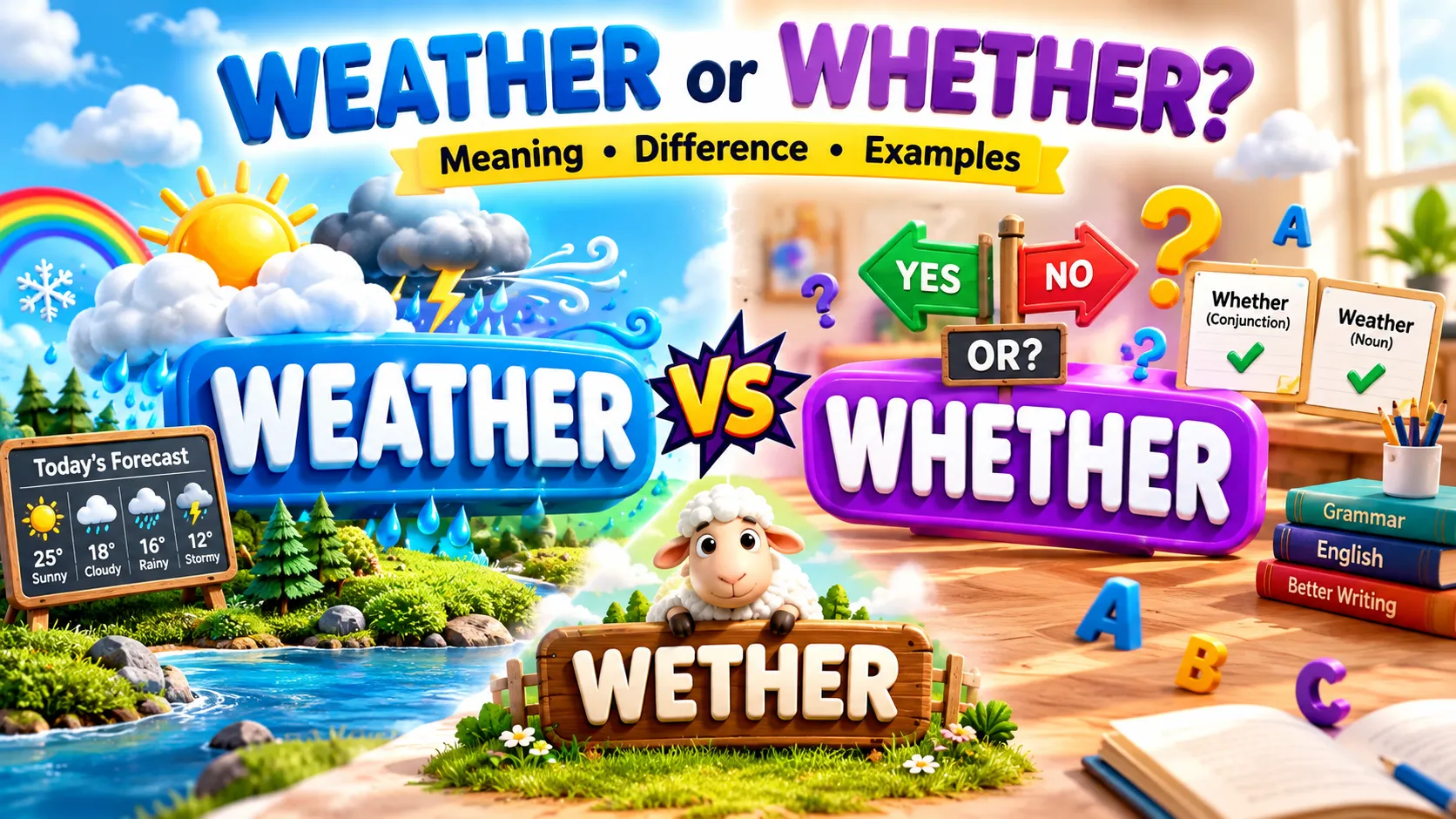
Weather/Whether? These two words sound the same in many varieties of English, but they have completely different meanings and grammatical functions.
Use weather when you are talking about atmospheric conditions such as rain, wind, temperature, sunshine, or storms.
Use whether when you are talking about a choice, possibility, uncertainty, or an indirect yes/no question.
For example:
- The weather is beautiful today. ✅
- I don’t know whether she will come. ✅
There is also a third word that sounds similar: wether, which means a castrated male sheep.
Quick rule:
Weather = conditions outside
Whether = choice or possibility
Wether = a type of sheep
Let’s examine the difference in detail so you can confidently choose the correct word in speaking, writing, exams, and everyday English.
Weather/Whether: Quick Answer
The easiest way to distinguish weather and whether is to look at the meaning of the sentence.
| Word | Meaning | Example |
| Weather | Atmospheric conditions | The weather is cold today. |
| Whether | Choice, possibility, or uncertainty | I don’t know whether he will come. |
| Wether | A castrated male sheep | The farmer has a wether in the flock. |
Weather/Whether
Use weather for:
- Rain
- Wind
- Sunshine
- Snow
- Temperature
- Storms
- Clouds
- Atmospheric conditions
- Enduring a difficult situation
Use whether for:
- Choices
- Alternatives
- Possibilities
- Uncertainty
- Indirect questions
- whether … or
- whether or not
- whether to + verb
Examples
Weather:
The weather is rainy today.
Whether:
I don’t know whether she will attend the meeting.
Wether:
The farmer separated the wether from the other sheep.
What Is the Difference Between Weather and Whether?
Weather/Whether
The primary difference is meaning and grammatical function.
Weather is commonly a noun describing the condition of the atmosphere. It can also be used as a verb.
Whether is a conjunction used to introduce alternatives, possibilities, uncertainty, or indirect questions.
Compare these sentences:
The weather changed suddenly.
This sentence is about atmospheric conditions.
She couldn’t decide whether to stay.
This sentence is about a choice.
The pronunciation can make these words confusing because weather and whether are homophones in many varieties of English. Therefore, context is more useful than pronunciation when choosing the spelling.
Remember: Sound may be identical, but meaning determines the spelling.
Weather Meaning and Definition
Weather refers to the condition of the atmosphere at a particular time and place.
It can include:
- Rain
- Wind
- Sunshine
- Snow
- Clouds
- Temperature
- Storms
- Humidity
- Heat
- Cold
For example:
The weather is sunny today.
We had terrible weather during our vacation.
The cold weather made driving difficult.
What will the weather be like tomorrow?
The flight was delayed because of bad weather.
Weather as a Noun
The most common use of weather is as a noun.
It is generally treated as an uncountable noun when referring to atmospheric conditions.
For example:
The weather is pleasant today.
We stayed indoors because of the bad weather.
The weather forecast predicts heavy rain.
Mountain weather can change quickly.
A useful pattern is:
the weather + be + adjective
Examples:
- The weather is cold.
- The weather is beautiful.
- The weather was terrible.
- The weather has been unpredictable.
Weather as a Verb
Weather can also function as a verb.
As a verb, it can mean to survive, endure, or successfully deal with a difficult situation.
The company managed to weather the financial crisis.
She weathered several difficult years.
They hope to weather the storm.
Weather can also describe physical change caused by exposure to atmospheric conditions.
The wooden house has weathered badly.
Here, weathered means that the material has changed because of exposure to wind, rain, sunlight, or other environmental conditions.
Compare:
The company weathered the recession.
Here, the company survived a difficult period.
The building weathered badly.
Here, the building physically changed because of exposure.
Whether Meaning and Definition
Whether is a conjunction used to express a choice, possibility, uncertainty, or an indirect question.
It commonly appears when someone is considering whether something is true, possible, or preferable.
Examples:
I don’t know whether he will come.
She asked whether I needed help.
We haven’t decided whether to stay.
I’m wondering whether this is correct.
They discussed whether the plan would work.
Unlike weather, whether is not used to describe rain, wind, temperature, or other atmospheric conditions.
Whether for Choices and Alternatives
Weather/Whether
One of the most important uses of whether is to introduce alternatives.
The alternatives may be explicitly stated with or, or they may simply be understood from the context.
Examples
I can’t decide whether to stay or leave.
We need to determine whether to buy or rent.
She wasn’t sure whether to call him or send a message.
I don’t know whether we should take the train or drive.
Tell me whether you want tea or coffee.
In these sentences, whether introduces two or more possibilities.
Common Structure
whether + option A + or + option B
Examples:
whether to stay or leave
.
whether to buy or rent
.
whether to study or work
.
whether the problem is technical or financial
.
Whether for Uncertainty
Weather/Whether
Whether can also express uncertainty even when two alternatives are not explicitly mentioned.
For example:
I’m not sure whether he knows.
She wondered whether the information was accurate.
We don’t know whether the store is open.
He questioned whether the decision was correct.
In each sentence, the speaker is uncertain about something.
A useful question to ask yourself is:
Am I expressing uncertainty about something?
If yes, whether may be the appropriate word.
Whether in Indirect Questions
This is an important use of whether that is sometimes overlooked in basic explanations.
Consider a direct yes/no question:
Is she coming?
When this becomes an indirect question, we can use whether:
I don’t know whether she is coming.
Another example:
Direct question:
Will they accept the offer?
Indirect question:
We don’t know whether they will accept the offer.
More examples:
She asked whether I was ready.
I wonder whether he knows the answer.
Tell me whether you agree.
We need to find out whether the plan will work.
Direct vs. Indirect Questions
| Direct question | Indirect question |
| Is he coming? | I don’t know whether he is coming. |
| Will she attend? | We don’t know whether she will attend. |
| Is this correct? | I’m wondering whether this is correct. |
| Can they help us? | We need to know whether they can help us. |
Weather vs Whether: Side-by-Side Comparison
Weather/Whether
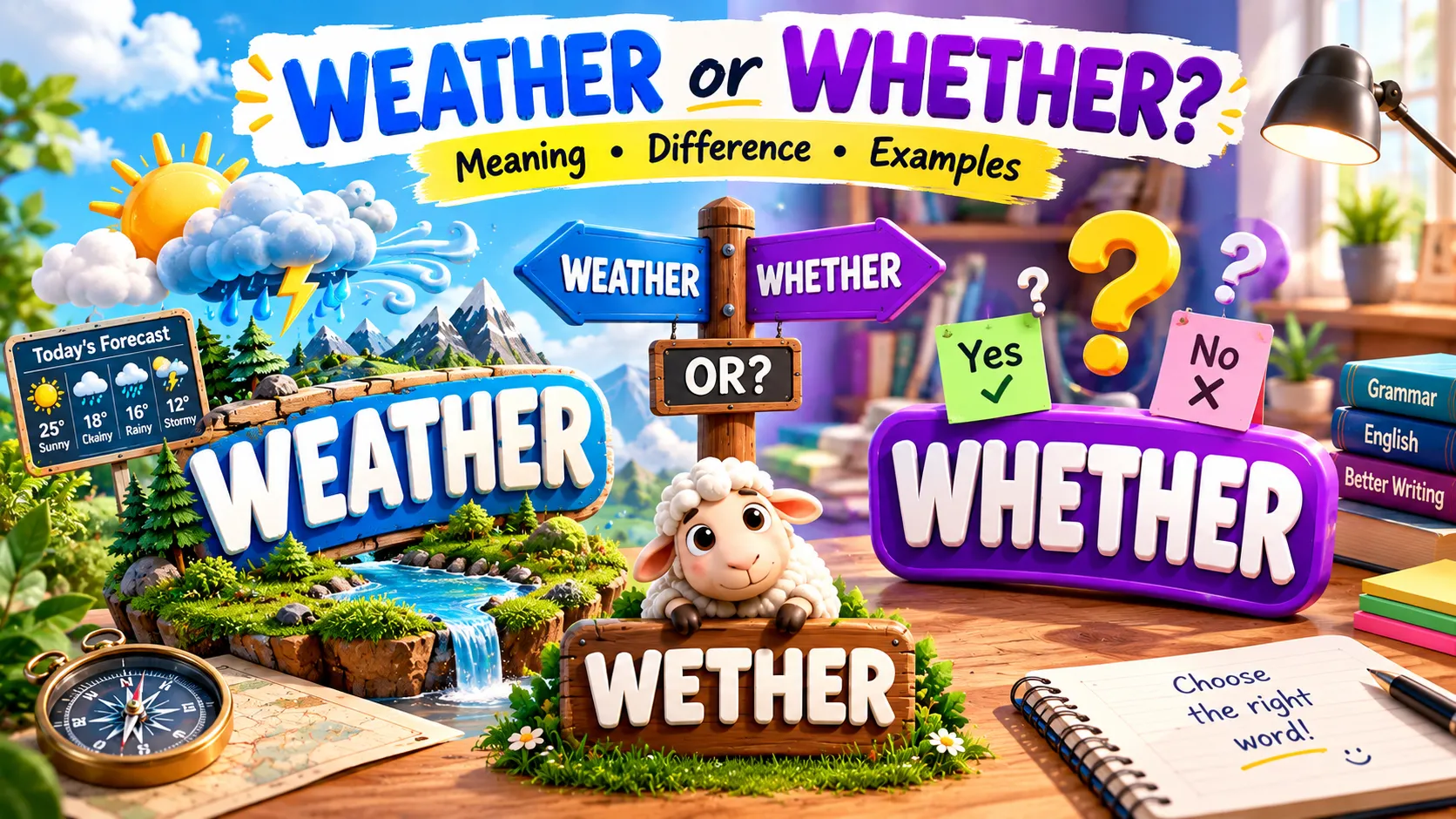
| Feature | Weather | Whether |
| Main function | Noun; also verb | Conjunction |
| Main meaning | Atmospheric conditions | Choice, possibility, uncertainty |
| Related ideas | Rain, wind, heat, snow, storms | Alternatives, decisions, uncertainty |
| Example | The weather is cold. | I don’t know whether to go. |
| Can it be a verb? | Yes | No |
| Used before to + verb? | No | Yes |
| Used in indirect questions? | No | Yes |
| Common phrase | weather forecast | whether or not |
| Pronunciation | Often /ˈweðər/ | Often /ˈweðər/ |
Weather Examples in Sentences
Weather/Whether
Here are examples showing the correct use of weather.
Very Easy Examples
- The weather is nice.
- I like warm weather.
- The weather is cold.
- We stayed home because of the bad weather.
- The weather changed suddenly.
Everyday Examples
The weather is beautiful today.
We checked the weather before going outside.
Bad weather delayed our trip.
The weather forecast says it will rain tomorrow.
The children cannot play outside because of the weather.
Academic and Professional Examples
Severe weather affected transportation across the region.
The researchers monitored changes in weather conditions.
The construction project was delayed because of extreme weather.
The airline issued a warning because of dangerous weather.
Weather as a Verb
The company successfully weathered the economic downturn.
The building has weathered years of exposure to rain and wind.
The organization must weather the current crisis.
Whether Examples in Sentences
Now look at examples using whether.
Very Easy Examples
- I don’t know whether he is coming.
- She asked whether I was ready.
- We need to decide whether to stay.
- I’m not sure whether this is correct.
- He wondered whether she knew.
Everyday Examples
I can’t decide whether to call him.
She isn’t sure whether she should go.
We need to find out whether the store is open.
Tell me whether you want coffee or tea.
I wonder whether they will arrive on time.
Business English
The management team must decide whether to expand the business.
We need to determine whether the proposal is financially viable.
The client asked whether the project could be completed this month.
The company is evaluating whether to invest in the new technology.
Academic English
The researchers examined whether the treatment produced measurable results.
The study investigated whether environmental factors influenced the outcome.
Further research is needed to determine whether the hypothesis is supported.
Weather/Whether: Common Mistakes
Weather/Whether
Because these words sound alike, they are frequently confused in writing.
Mistake 1: “I don’t know weather he will come.”
❌ Incorrect:
I don’t know weather he will come.
✅ Correct:
I don’t know whether he will come.
Why?
The sentence expresses uncertainty about a possibility. Therefore, use whether.
Mistake 2: “The whether is beautiful today.”
❌ Incorrect:
The whether is beautiful today.
✅ Correct:
The weather is beautiful today.
Why?
The sentence describes atmospheric conditions, so weather is correct.
Mistake 3: “Weather or not”
When you mean regardless of whether something happens, the standard expression is:
✅ whether or not
Whether or not you agree, we need to continue.
Not:
❌ Weather or not you agree, we need to continue.
The word whether introduces the alternatives:
- you agree
- you do not agree
Therefore, whether or not is correct.
Whether or Not vs Weather or Not
Weather/Whether
This is one of the most common mistakes involving these words.
Correct: Whether or Not
Whether or not it rains, we will go.
I’ll attend whether or not you come.
She will finish the project whether or not she receives help.
Whether or not they agree, the decision has been made.
The phrase whether or not indicates that either of two possibilities is being considered, often with the result remaining unchanged.
Incorrect in Ordinary Grammar: Weather or Not
❌ Weather or not you agree, we will continue.
The correct form is:
✅ Whether or not you agree, we will continue.
A Fun Exception: Wordplay
You may occasionally see weather or not intentionally used as a pun, especially in advertising, headlines, or humorous writing.
For example:
Weather or not, we’re ready for the rain!
This can be deliberate wordplay because weather relates to atmospheric conditions.
However, in standard grammar, use whether or not when expressing an alternative or uncertainty.
Weather Forecast or Whether Forecast?
Weather/Whether
The correct phrase is:
✅ weather forecast
A weather forecast is a prediction about future atmospheric conditions.
Examples:
I checked the weather forecast before leaving.
The weather forecast says it will rain tomorrow.
According to the weather forecast, temperatures will fall tonight.
Not:
❌ whether forecast
The word whether does not describe atmospheric conditions.
Whether to or Weather to?
Weather/Whether
When you see to + verb after the word, whether is generally the correct choice.
Correct
I don’t know whether to go.
She can’t decide whether to stay.
We need to determine whether to continue.
He is considering whether to accept the offer.
Incorrect
❌ I don’t know weather to go.
❌ She can’t decide weather to stay.
Easy Pattern
Remember:
whether + to + verb
Examples:
- whether to go
- whether to stay
- whether to buy
- whether to accept
- whether to continue
- whether to apply
This is one of the most useful patterns for avoiding the weather/whether spelling mistake.
Whether vs If: Are They Interchangeable?
Sometimes whether can be replaced by if, but the two words are not interchangeable in every construction.
For example:
I don’t know whether he is coming.
can often become:
I don’t know if he is coming.
Both sentences can express uncertainty about a yes/no question.
However, there are important constructions where whether is preferred or required.
Whether Before a To-Infinitive
Use:
I don’t know whether to go.
Not:
❌ I don’t know if to go.
The standard construction is whether + to-infinitive.
Whether After a Preposition
Use:
It depends on whether we have enough money.
The construction whether is preferred after a preposition such as on.
Whether With Alternatives
Whether is especially useful when alternatives are explicitly presented.
I don’t know whether to take the bus or the train.
Tell me whether you want tea or coffee.
So, while if and whether overlap in some indirect yes/no questions, whether has a broader range of grammatical uses.
Whether … Or
Use whether … or when presenting alternatives.
Examples
I don’t know whether to stay or leave.
Tell me whether you want tea or coffee.
She couldn’t decide whether to study or work.
We need to determine whether the problem is technical or financial.
The alternatives do not always have to be expressed as verbs.
For example:
We need to determine whether the problem is technical or financial.
Here, the alternatives are technical and financial.
Whether or Not
The expression whether or not is used when two possibilities are being considered, particularly when the result does not depend on which possibility is true.
Examples:
Whether or not it rains, the event will continue.
I’ll go whether or not you come.
She will finish the project whether or not she receives help.
Whether or not they agree, we have to proceed.
Whether You Like It or Not
A common expression is:
Whether you like it or not, we have to finish.
It means that the outcome will happen regardless of whether the person likes it.
Weather, Whether, and Wether: What’s the Difference?
Don’t stop at two words. There is a third English word that can sound almost identical.
Weather
Meaning: Atmospheric conditions.
The weather is cold.
Whether
Meaning: Choice, possibility, or uncertainty.
I don’t know whether he is coming.
Wether
Meaning: A castrated male sheep.
The farmer has a wether in the flock.
Three-Word Comparison
| Word | Meaning | Example |
| weather | Atmospheric conditions | The weather is rainy. |
| whether | Choice or possibility | I don’t know whether to go. |
| wether | Castrated male sheep | The farmer owns a wether. |
Wether is much less common in everyday English, but you may encounter it in farming, livestock, agriculture, or historical contexts.
How to Remember Weather/Whether
You don’t need to memorize complicated grammar terminology. Use a simple meaning-based test.
Memory Trick 1: Weather = Outside
Think:
Weather → wind, rain, clouds, sunshine
If you’re talking about what is happening outside, use weather.
Examples:
The weather is rainy.
.
The weather is getting warmer.
.
The weather forecast predicts snow.
Memory Trick 2: Whether = Choice
Think:
Whether → Which possibility?
Examples:
Whether to stay or leave?
.
Whether to buy or rent?
.
Whether he comes or not?
If the sentence involves a decision or alternative, whether is usually the right choice.
Memory Trick 3: Try “If”
When you’re unsure whether to use whether, try replacing it with if.
I don’t know whether she will come.
→ I don’t know if she will come.
The substitution works naturally, suggesting that whether is being used to express uncertainty.
However, this is a test, not a universal rule. Remember that whether and if are not interchangeable in every construction.
Memory Trick 4: Look for “Or”
If the sentence presents alternatives, whether is often the correct word.
I don’t know whether to walk or drive.
Tell me whether you want tea or coffee.
She hasn’t decided whether to study or work.
Explore More: https://wordminto.com/canon-or-cannon/
Are Weather and Whether Homophones?
Yes, weather and whether are homophones in wide varieties of English.
A homophone is a word that has the same pronunciation as another word but a different meaning or spelling.
The words are commonly pronounced approximately as:
- weather: /ˈweðər/
- whether: /ˈweðər/
Because they can sound identical, listening alone may not tell you which spelling is correct.
That is why context is essential.
Sound tells you little; sentence meaning tells you which spelling to choose.
Common Phrases With Weather
Several familiar English expressions use weather.
Under the Weather
Meaning: Feeling slightly ill or unwell.
I’m feeling under the weather today.
Weather the Storm
Meaning: To survive or endure a difficult situation.
The company managed to weather the storm.
The expression can refer literally to surviving bad weather or figuratively to surviving a difficult period.
Weather Permitting
Meaning: If the weather conditions are suitable.
We’ll play outside tomorrow, weather permitting.
Fair-Weather Friend
A fair-weather friend is someone who remains supportive mainly during good or easy times.
He turned out to be a fair-weather friend.
Common Phrases With Whether
Whether or Not
I will go whether or not you come.
Whether … Or
I don’t know whether to stay or leave.
Whether To
She hasn’t decided whether to apply.
Whether It Is
I don’t know whether it is possible.
Whether You Like It or Not
Whether you like it or not, we have to finish.
These constructions are particularly useful in formal, academic, professional, and everyday English.
Weather/Whether in American and British English
There is no American-versus-British spelling difference for these words.
Both American and British English use:
- weather for atmospheric conditions
- whether for choices, alternatives, possibilities, uncertainty, and related conjunction uses
For example, both varieties use:
The weather is cold.
and:
I don’t know whether he will come.
The distinction is therefore based on meaning and grammatical function, not regional spelling.
Where Do Weather and Whether Come From?
Although weather and whether sound alike in modern English, they have different historical origins.
Weather developed through Middle English forms from Old English weder, referring to air, sky, wind, or storm.
Whether comes from an Old English form associated with the idea of which of two or choosing between alternatives.
Their different historical development helps explain why similar pronunciation does not mean that the words have the same meaning.
Weather/Whether: Correct the Mistake
| Incorrect | Correct | Reason |
| I don’t know weather he is coming. | I don’t know whether he is coming. | Uncertainty |
| The whether is cold. | The weather is cold. | Atmospheric conditions |
| Check the whether forecast. | Check the weather forecast. | Atmospheric forecast |
| I don’t know weather to go. | I don’t know whether to go. | Choice |
| Weather or not you agree… | Whether or not you agree… | Alternative |
| We discussed if to continue. | We discussed whether to continue. | Whether + infinitive |
| The weather he comes is unknown. | Whether he comes is unknown. | Possibility |
Weather/Whether: Sentence Pattern Guide
Sometimes recognizing the sentence pattern is faster than thinking about the definition.
| Pattern | Correct Word | Example |
| the ___ is cold | weather | The weather is cold. |
| bad ___ | weather | We had bad weather. |
| ___ forecast | weather | Check the weather forecast. |
| ___ permitting | weather | Weather permitting, we’ll leave. |
| ___ the storm | weather | They weathered the storm. |
| don’t know ___ he will come | whether | I don’t know whether he will come. |
| ___ to go | whether | I don’t know whether to go. |
| ___ or not | whether | Whether or not you agree… |
| ___ to stay or leave | whether | Whether to stay or leave |
| wonder ___ it is true | whether | I wonder whether it is true. |
A Simple Decision Test
When you’re unsure, follow these steps.
Step 1: Is the sentence about atmospheric conditions?
Think about:
- rain
- wind
- sunshine
- snow
- temperature
- storms
If yes, use weather.
The weather is terrible.
Step 2: Is the sentence about a choice or possibility?
If yes, use whether.
I don’t know whether to go.
Step 3: Is there an indirect yes/no question?
Use whether in appropriate constructions.
She asked whether I was ready.
Step 4: Is there “whether … or”?
Use whether.
I can’t decide whether to stay or leave.
Step 5: Is there “whether or not”?
Use whether.
Whether or not it rains, we’ll go.
Step 6: Is there “to + verb”?
Use whether.
I don’t know whether to accept the offer.
Weather/Whether: Practice Quiz
Choose weather or whether in each sentence.
1. The _____ is beautiful today.
A. whether
B. weather
2. I don’t know _____ she will come.
A. weather
B. whether
3. We checked the _____ forecast.
A. weather
B. whether
4. She couldn’t decide _____ to stay or leave.
A. weather
B. whether
5. _____ or not you agree, we need to continue.
A. Weather
B. Whether
6. The company managed to _____ the crisis.
A. weather
B. whether
7. I wonder _____ this is possible.
A. weather
B. whether
8. Heavy _____ delayed the flight.
A. weather
B. whether
9. I don’t know _____ to accept the offer.
A. weather
B. whether
10. The _____ has been unusually cold this week.
A. weather
B. whether
Practice Quiz Answers
1. Weather
The weather is beautiful today.
The sentence describes atmospheric conditions.
2. Whether
I don’t know whether she will come.
The sentence expresses uncertainty.
3. Weather
We checked the weather forecast.
A forecast about atmospheric conditions is a weather forecast.
4. Whether
She couldn’t decide whether to stay or leave.
The sentence presents alternatives.
5. Whether
Whether or not you agree, we need to continue.
The expression is whether or not.
6. Weather
The company managed to weather the crisis.
Here, weather is a verb meaning to endure or survive.
7. Whether
I wonder whether this is possible.
The sentence expresses uncertainty.
8. Weather
Heavy weather delayed the flight.
The sentence refers to atmospheric conditions.
9. Whether
I don’t know whether to accept the offer.
The construction is whether + to-infinitive.
10. Weather
The weather has been unusually cold this week.
The sentence describes atmospheric conditions.
Sentence Correction Exercise
Correct the spelling mistake in each sentence.
- I don’t know weather he will attend.
- The whether is getting warmer.
- Check the whether forecast before leaving.
- She doesn’t know weather to accept the offer.
- Weather or not you agree, we must continue.
- We had terrible whether during our vacation.
Answers
- I don’t know whether he will attend.
- The weather is getting warmer.
- Check the weather forecast before leaving.
- She doesn’t know whether to accept the offer.
- Whether or not you agree, we must continue.
- We had terrible weather during our vacation.
Exam-Style Error Detection
Identify the incorrect word in each sentence.
Question 1
I am not sure weather the answer is correct.
Answer: weather → whether
Question 2
The whether forecast predicts heavy rain.
Answer: whether → weather
Question 3
We cannot decide weather to continue the project.
Answer: weather → whether
Question 4
The team will continue whether or not the conditions change.
Answer: No error.
Question 5
The company managed to weather the economic crisis.
Answer: No error.
Quick Revision Box
Before finishing, remember these three words:
🌦️ Weather → atmospheric conditions
❓ Whether → choice, possibility, or uncertainty
🐑 Wether → castrated male sheep
The fastest test
Ask:
Is the sentence about what’s happening outside?
→ weather
Is the sentence about a choice or possibility?
→ whether
Three examples to memorize
The weather is getting colder.
I don’t know whether it will get colder.
The farmer owns a wether.
People Also Ask
It depends on the meaning. Use weather for atmospheric conditions and whether for choices, possibilities, uncertainty, and related indirect-question constructions.
Remember:
Weather = outside conditions.
Whether = choice or possibility.
If you mean regardless of whether something happens, the standard expression is whether or not.
Whether or not you agree, we will continue.
No. Whether functions as a conjunction.
Weather, however, is commonly a noun and can also be a verb.
Yes. In many contexts, whether can introduce a yes/no question or express uncertainty similarly to if.
For example:
I don’t know whether he is coming.
I don’t know if he is coming.
However, they are not interchangeable in every construction. Whether is used before a to-infinitive:
I don’t know whether to go.
Final Takeaway
The difference between weather and whether becomes much easier when you focus on meaning and sentence function, rather than pronunciation.
Remember the three words:
Weather → rain, wind, temperature, sunshine, storms, and atmospheric conditions.
Whether → choices, alternatives, possibilities, uncertainty, and indirect questions.
Wether → a castrated male sheep.
The fastest decision rule is:
Is the sentence about what’s happening outside? → weather.
Is the sentence about a choice or possibility? → whether.
Compare:
The weather is getting colder.
with:
I don’t know whether it will get colder.
And when you mean “regardless of whether something happens,” remember:
whether or not
not:
❌ weather or not
Once you learn to identify the meaning, grammatical role, and sentence pattern, the weather/whether confusion becomes far easier to eliminate.
The key is simple: weather describes conditions; whether introduces possibilities.










1 thought on “Weather or Whether: Which Is Correct? Meaning, Difference & Examples”