
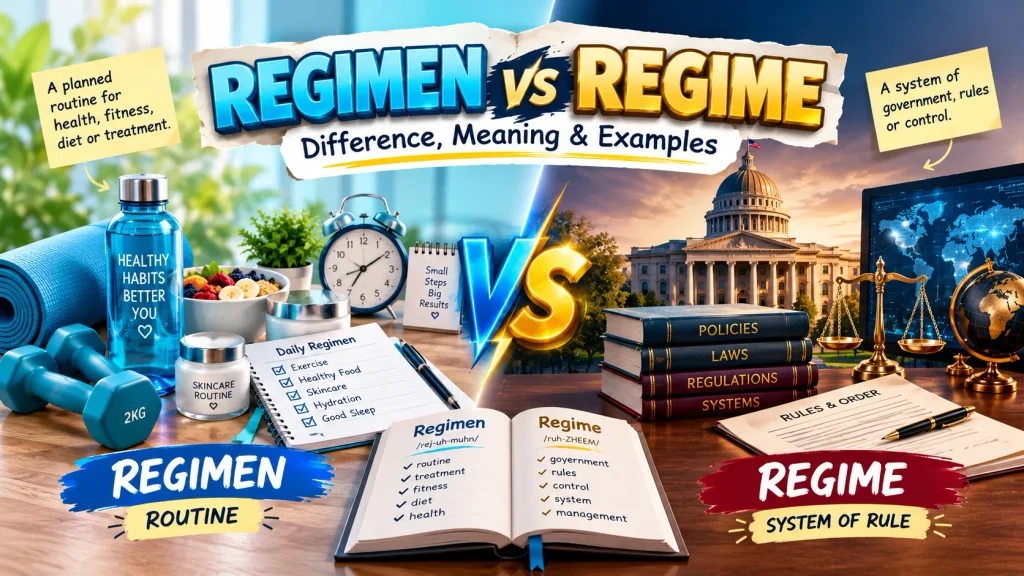
Regimen vs Regime: Regimen and Regime look similar and share a historical connection, but they have different meanings in modern English. Regimen usually refers to a planned routine for health, fitness, diet, or treatment, while Regime commonly refers to a system of government or an organized system of rules and control.
This complete guide explains the difference between Regimen and Regime with simple definitions, examples, usage rules, common mistakes, and practice exercises.
Regimen vs Regime: Quick Difference
| Word | Meaning | Common Usage | Example |
| Regimen | A planned routine or course of action | Health, fitness, diet, treatment | She follows a daily exercise regimen. |
| Regime | A system of government, rules, or management | Politics, institutions, systems | The new regime introduced strict laws. |
Easy way to remember: A regimen is a routine you follow; a regime is a system that governs or controls something.
What Does Regimen Mean?
Regimen (pronounced REJ-uh-muhn) is a noun that means a structured plan or routine designed to achieve a particular goal. People commonly use it when discussing health, medical treatment, skincare, exercise, nutrition, and daily habits.
A regimen often involves specific activities, instructions, or treatments that someone follows consistently.
Examples of Regimen in Sentences
- My doctor recommended a new medication regimen.
- She follows a strict skincare regimen every morning.
- The athlete follows a demanding training regimen.
- A balanced diet is an important part of his fitness regimen.
- The patient completed the prescribed treatment regimen.
- He developed a morning regimen to improve his productivity.
- Her hair-care regimen includes shampooing and conditioning.
- The coach designed a strength-training regimen for the team.
Common Uses of Regimen
- Medical regimen: A planned course of medication or treatment.
- Fitness regimen: A structured exercise and training routine.
- Dietary regimen: A planned approach to eating.
- Skincare regimen: A regular sequence of skincare activities.
- Study regimen: A structured study routine.
In medical contexts, follow a prescribed regimen as directed by a qualified healthcare professional.
Explore More: Loath vs Loathe: Meaning, Difference, Rules, and Examples
What Does Regime Mean?
Regime (pronounced ruh-ZHEEM or ray-ZHEEM) is a noun that usually means a system of government, a ruling administration, or an organized system of rules and control. People often use it in political, historical, economic, scientific, and organizational contexts.
The word can carry a negative connotation when it describes an authoritarian or oppressive government. However, it does not always have a negative meaning.
Examples of Regime in Sentences
- The new regime introduced several political reforms.
- The country lived under an authoritarian regime for decades.
- The government changed its economic regime to encourage investment.
- The company adopted a stricter regulatory regime.
- The researchers studied the region’s rainfall regime.
- The new tax regime reduced the burden on some taxpayers.
- The country transitioned to a democratic regime.
- The patient followed a strict exercise regime.
Common Uses of Regime
- Political regime: A system of government or political authority.
- Economic regime: A framework governing economic policy or activity.
- Tax regime: A set of rules for calculating and collecting taxes.
- Regulatory regime: A system of laws, standards, and regulations.
- Climate regime: A characteristic pattern of climatic conditions.
- Exercise regime: A structured system of physical activity.
Notice that regime can also refer to a system of treatment, diet, or exercise. In these contexts, it can overlap with regimen.
Explore More: Flaunt vs Flout: Meaning, Difference, and Examples
Regimen vs Regime: Key Differences
| Feature | Regimen | Regime |
| Main meaning | A planned routine or course | A system of rule or control |
| Typical context | Health and personal routines | Government, economics, and regulations |
| Common phrases | Treatment regimen, skincare regimen | Political regime, tax regime |
| Connotation | Usually neutral | Neutral or negative, depending on context |
| Pronunciation | REJ-uh-muhn | ruh-ZHEEM |
| Example | He follows a fitness regimen. | The regime changed the law. |
Explore More: Faze vs Phase: Meaning, Differences, Rules, and Examples
When to Use Regimen
Use regimen when you want to emphasize a planned routine, prescribed course, or organized set of practices.
Choose regimen in these situations:
- You describe a medical treatment plan.
- You explain a regular fitness routine.
- You discuss skincare or hair care.
- You refer to a structured diet.
- You describe a personal or professional routine.
Examples:
- The doctor prescribed a new treatment regimen.
- I follow a consistent morning regimen.
- Her workout regimen includes strength training and cardio.
Explore More: Emigrate vs Immigrate: Meaning, Differences, Rules, and Examples
When to Use Regime
Use regime when you refer to a system of government, administration, rules, or organized control.
Choose regime in these situations:
- You discuss a country’s government.
- You describe political authority or a ruling administration.
- You refer to economic or tax systems.
- You discuss regulatory frameworks.
- You describe an established system of management or control.
Examples:
- The military regime restricted political opposition.
- The country introduced a new tax regime.
- The regulator established a stricter compliance regime.
Explore More: Should Have vs Could Have: Meaning, Difference, Rules, and Examples
Can Regimen and Regime Be Used Interchangeably?
Sometimes, yes. Both words can describe a structured plan for health, diet, exercise, or treatment. However, regimen generally sounds more precise in medical and personal-routine contexts.
For example:
- She follows a strict exercise regimen.
- She follows a strict exercise regime.
Both sentences are acceptable, although exercise regimen is a particularly common and clear choice.
However, you cannot normally replace regime with regimen when discussing a government.
- Correct: The regime introduced new laws.
- Incorrect for the intended political meaning: The regimen introduced new laws.
The second sentence suggests a routine or treatment plan rather than a government.
Explore More: https://wordminto.com/fomo-meaning/
Regimen vs Regime vs Regiment
Do not confuse these three similar words.
| Word | Meaning | Example |
| Regimen | A planned routine | She follows a training regimen. |
| Regime | A system of government or control | The regime introduced new policies. |
| Regiment | A military unit | The regiment returned to its base. |
Remember: a regime may deploy a regiment, whose soldiers follow a training regimen.
Common Mistakes to Avoid
Mistake 1: Using Regime for Every Routine
Incorrect or less precise: She follows a skincare regime.
Better for a clear, standard expression: She follows a skincare regimen.
Skincare regime is also accepted, particularly in British English.
Mistake 2: Using Regimen for a Government
Incorrect for the intended meaning: The new regimen took control of the country.
Correct: The new regime took control of the country.
Mistake 3: Assuming Regime Always Means Dictatorship
Incorrect assumption: Every regime is authoritarian.
Correct understanding: A regime can describe a government or a system of rules without necessarily implying oppression.
Mistake 4: Confusing Regime with Regiment
A regime describes a system; a regiment describes a military unit. They are not alternative spellings of the same word.
Explore More: Aural vs Oral: Meaning, Difference, Examples, and Usage
Memory Trick: How to Remember Regimen vs Regime
Use these simple associations:
- Regimen = Routine: Think about a regular health, fitness, or treatment plan.
- Regime = Rule: Think about a government or system of authority.
- Regiment = Military: Think about a group of soldiers.
For example, if you visit a doctor, you may receive a treatment regimen. If you study a country’s government, you may learn about its political regime.
People Also Ask
Both expressions are acceptable. Skincare regimen is a common choice when describing a planned skincare routine.
In many contexts, yes. Both can refer to a planned course of medical treatment. Medical regimen is a precise and widely used expression.
No. Although it often appears in discussions of authoritarian governments, it can also describe neutral systems, such as a tax regime or regulatory regime.
The plural is regimens.
Example: The hospital uses several treatment regimens.
The plural is regimes.
Example: Historians have studied different political regimes.
Use regimen for a clear, standard choice: “My exercise regimen includes running and weight training.” You can also use exercise regime.
Conclusion
The main difference between Regimen and Regime lies in their usual meanings and contexts. Use regimen for a planned routine, especially one involving health, fitness, diet, or treatment. Use regime for a system of government, administration, rules, or control. Both words can describe organized routines in certain contexts, so the intended meaning matters more than the spelling alone.
Quick Rule: A Regimen is a routine. A Regime is a system of rules.











1 thought on “Regimen vs Regime: Meaning, Differences, Rules, and Examples”