
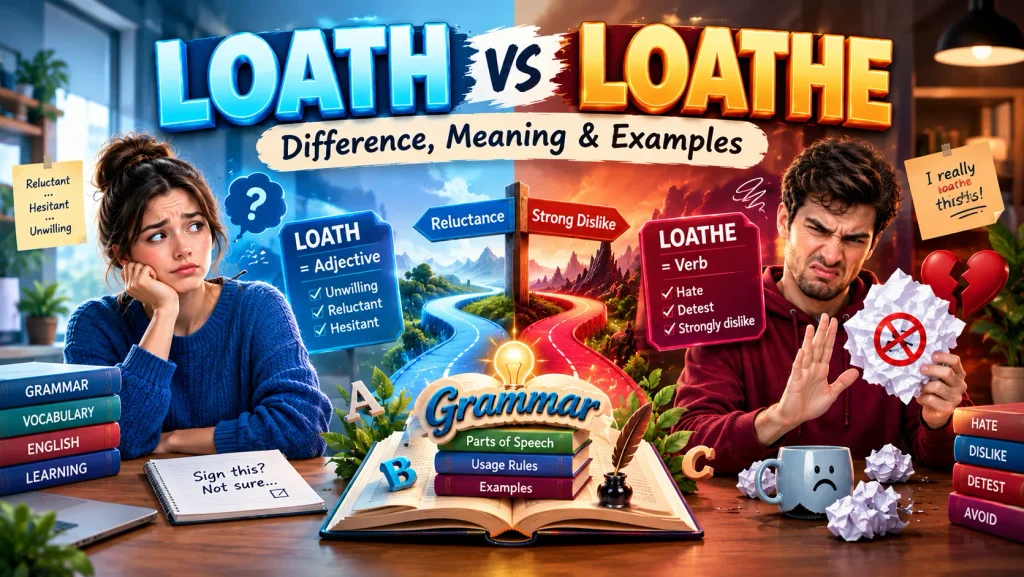
Loath vs Loathe: These words look similar and share a connection to dislike, but they serve different grammatical purposes. Loath is an adjective that means unwilling or reluctant, while Loathe is a verb that means to hate or strongly dislike something.
Understanding the difference between loath and loathe helps you avoid spelling mistakes and use both words correctly in writing.
Loath vs Loathe: Quick Difference
| Feature | Loath | Loathe |
| Part of speech | Adjective | Verb |
| Meaning | Unwilling or reluctant | To hate or strongly dislike |
| Pronunciation | /loʊθ/ (rhymes with both) | /loʊð/ (rhymes with clothe) |
| Usage | Describes reluctance | Expresses strong dislike |
| Example | She was loath to complain. | She loathes dishonesty. |
| Memory tip | Loath = reluctant | Loathe = hate |
Quick Rule: Use loath when someone feels reluctant to do something. Use loathe when someone strongly dislikes something.
What Does Loath Mean?
Loath is an adjective that means unwilling, reluctant, or hesitant to do something. It describes a person’s feelings about an action or situation.
People often use loath in the phrase “loath to do something.”
Examples of Loath in Sentences
- She was loath to admit her mistake.
- He felt loath to leave his family behind.
- I am loath to criticize someone without knowing the facts.
- They were loath to spend their savings on unnecessary items.
- The manager seemed loath to change the company’s policies.
- She was loath to share her personal problems.
- He is loath to ask for help.
- We were loath to abandon the project after months of hard work.
In each example, loath describes reluctance or unwillingness rather than hatred.
How to Use Loath Correctly
Use loath before an infinitive phrase, especially one beginning with to.
Common structure:
Subject + be + loath + to + base verb
Examples:
- I am loath to disagree with my teacher.
- She was loath to reveal the truth.
- They are loath to accept the proposal.
You can also use loath after linking verbs such as seem and feel.
- He seems loath to participate.
- She felt loath to interfere.
Explore More: Flaunt vs Flout: Meaning, Difference, and Examples
What Does Loathe Mean?
Loathe is a verb that means to hate, detest, or strongly dislike someone or something. It expresses a strong negative feeling toward a person, action, habit, or situation.
Unlike loath, which describes reluctance, loathe describes an emotion.
Examples of Loathe in Sentences
- I loathe people who lie to others.
- She loathes waking up early.
- He loathes being interrupted during meetings.
- They loathe unfair treatment.
- We loathe wasting food.
- My brother loathes crowded places.
- She began to loathe her daily commute.
- Many people loathe dishonesty and betrayal.
In these sentences, loathe describes strong dislike rather than unwillingness.
How to Use Loathe Correctly
Use loathe as a verb. Its form changes according to the tense and subject.
| Form | Example |
| Loathe | I loathe cruelty. |
| Loathes | She loathes dishonesty. |
| Loathed | He loathed the unfair decision. |
| Loathing | They are loathing the experience. |
The last example is grammatically possible but less natural in ordinary English. A more natural sentence is “They are beginning to loathe the experience.”
Remember that loathes ends in -es, while loathe is the base form.
Explore More: Faze vs Phase: Meaning, Differences, Rules, and Examples
Loath vs Loathe: Key Differences Explained
1. Difference in Meaning
Loath means reluctant or unwilling, whereas loathe means to hate or strongly dislike.
- Loath: I am loath to reject the offer. (I am reluctant to reject it.)
- Loathe: I loathe the offer. (I strongly dislike it.)
2. Difference in Grammar
Loath functions as an adjective. Loathe functions as a verb.
- Adjective: He was loath to speak publicly.
- Verb: He loathes public speaking.
3. Difference in Sentence Structure
Loath commonly appears after a linking verb and before an infinitive phrase.
– She is loath to complain.
Loathe takes a direct object or a gerund phrase.
- She loathes complaints.
- She loathes complaining.
4. Difference in Pronunciation
Both words begin with the same vowel sound, but their final consonants differ.
- Loath: Ends with the voiceless th sound, as in thin.
- Loathe: Ends with the voiced th sound, as in this.
This distinction helps you recognize the words in spoken English.
Explore More: Emigrate vs Immigrate: Meaning, Differences, Rules, and Examples
Loath vs Loathe Examples in Everyday English
| Loath | Loathe |
| I am loath to argue. | I loathe arguments. |
| She is loath to leave. | She loathes leaving early. |
| He was loath to apologize. | He loathes admitting defeat. |
| We are loath to waste money. | We loathe unnecessary expenses. |
| They were loath to interfere. | They loathe interfering in others’ affairs. |
| I am loath to judge him. | I loathe his dishonest behavior. |
| She seemed loath to participate. | She loathes participating in debates. |
| He is loath to take risks. | He loathes taking unnecessary risks. |
These pairs demonstrate how the adjective describes reluctance while the verb expresses strong dislike.
Explore More: Should Have vs Could Have: Meaning, Difference, Rules, and Examples
Common Mistakes to Avoid
Mistake 1: Using Loath When You Mean Hate
Incorrect: I loath dishonesty.
Correct: I loathe dishonesty.
Loathe is the verb required to express strong dislike.
Mistake 2: Using Loathe When You Mean Reluctant
Incorrect: She was loathe to admit her mistake.
Correct: She was loath to admit her mistake.
In formal standard usage, loath is the adjective that describes reluctance.
Mistake 3: Confusing Loathe With Loathes
Incorrect: He loathe loud music.
Correct: He loathes loud music.
Use loathes with third-person singular subjects such as he, she, and it in the simple present tense.
Mistake 4: Assuming Both Words Are Interchangeable
Incorrect: I am loathe to complain.
Correct: I am loath to complain.
Although some writers use loathe incorrectly in this expression, loath is the appropriate adjective.
Explore More: https://wordminto.com/fomo-meaning/
Memory Tricks: How to Remember Loath vs Loathe
Try these simple tips to remember the difference.
- Loath = reluctant: If you are loath to do something, you do not want to do it.
- Loathe = hate: If you loathe something, you strongly dislike it.
- Loathe has an E: Remember that loathe is the verb expressing a strong emotion.
- Check the sentence: If the word describes someone’s willingness, choose loath. If it describes what someone hates, choose loathe.
For example:
- I am loath to complain. (I am reluctant.)
- I loathe complaining. (I strongly dislike it.)
Synonyms of Loath and Loathe
These words have different meanings, so their synonyms also differ.
| Loath synonyms | Loathe synonyms |
| Reluctant | Hate |
| Unwilling | Detest |
| Hesitant | Despise |
| Disinclined | Abhor |
| Averse | Dislike intensely |
Note that loath does not always mean complete unwillingness. It can also describe hesitation or reluctance.
Explore More: Aural vs Oral: Meaning, Difference, Examples, and Usage

Practice Exercise: Loath or Loathe?
Choose the correct word to complete each sentence.
- She was _____ to discuss the disagreement.
- I _____ dishonesty in all its forms.
- He is _____ to spend money unnecessarily.
- My sister _____ getting stuck in traffic.
- They were _____ to leave their hometown.
Answers:
- Loath
- Loathe
- Loath
- Loathes
- Loath
People Also Ask
Both spellings are correct, but they have different meanings. Loath is an adjective meaning reluctant or unwilling, while loathe is a verb meaning to hate or strongly dislike.
Loath is an adjective. For example, “He is loath to admit defeat.” The word describes his reluctance to admit defeat.
Yes. Loathe is a verb that means to hate or strongly dislike something. For example, “I loathe dishonesty.”
The phrase means to be reluctant or unwilling to do something.
Example: “She was loath to interrupt the conversation.”
This means she was hesitant to interrupt.
Both words describe unwillingness or hesitation. However, loath often appears in the construction “loath to do something,” while reluctant has broader everyday usage.
Loath ends with a voiceless “th” sound, as in thin. Loathe ends with a voiced “th” sound, as in this.
Conclusion
The difference between Loath vs Loathe comes down to meaning and grammatical function. Loath is an adjective that means reluctant or unwilling, while Loathe is a verb that means to hate or strongly dislike.
Use Loath in sentences such as “I am loath to complain,” and use Loathe in sentences such as “I loathe dishonesty.”
Remembering this simple distinction will help you spell and use both words correctly in everyday communication and formal writing.











2 thoughts on “Loath vs Loathe: Meaning, Difference, Rules, and Examples”