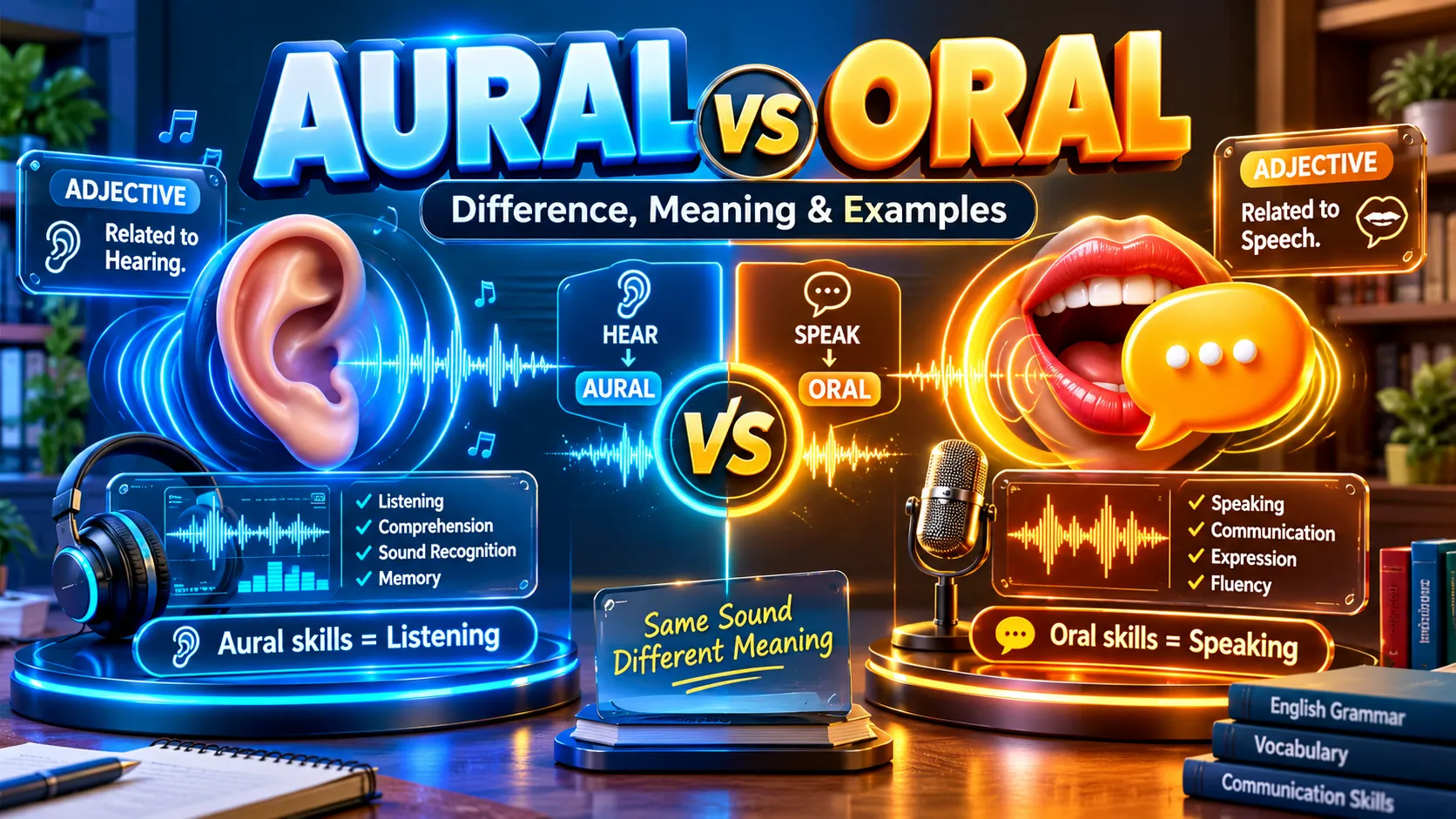
Aural vs Oral is a common English vocabulary comparison because both words relate to the senses and communication, but they have different meanings. Aural refers to hearing or the ears, while oral refers to speaking, the mouth, or something communicated verbally.
Understanding the difference between aural and oral helps you choose the correct word in academic writing, everyday conversations, language learning, and professional communication.
In this article, you will learn the meanings, pronunciation, grammatical usage, examples, common mistakes, and practice exercises for Aural vs Oral.
Aural vs Oral: Quick Difference
| Feature | Aural | Oral |
| Meaning | Related to hearing or listening | Related to the mouth or spoken communication |
| Associated with | Ears and hearing | Mouth and speech |
| Part of speech | Adjective | Adjective |
| Pronunciation | OR-uhl | OR-uhl |
| Example | The student completed an aural test. | The student completed an oral test. |
| Common phrases | Aural skills, aural memory, aural perception | Oral exam, oral presentation, oral communication |
Quick rule: Use aural when you mean hearing or listening. Use oral when you mean speaking or communicating through spoken words.
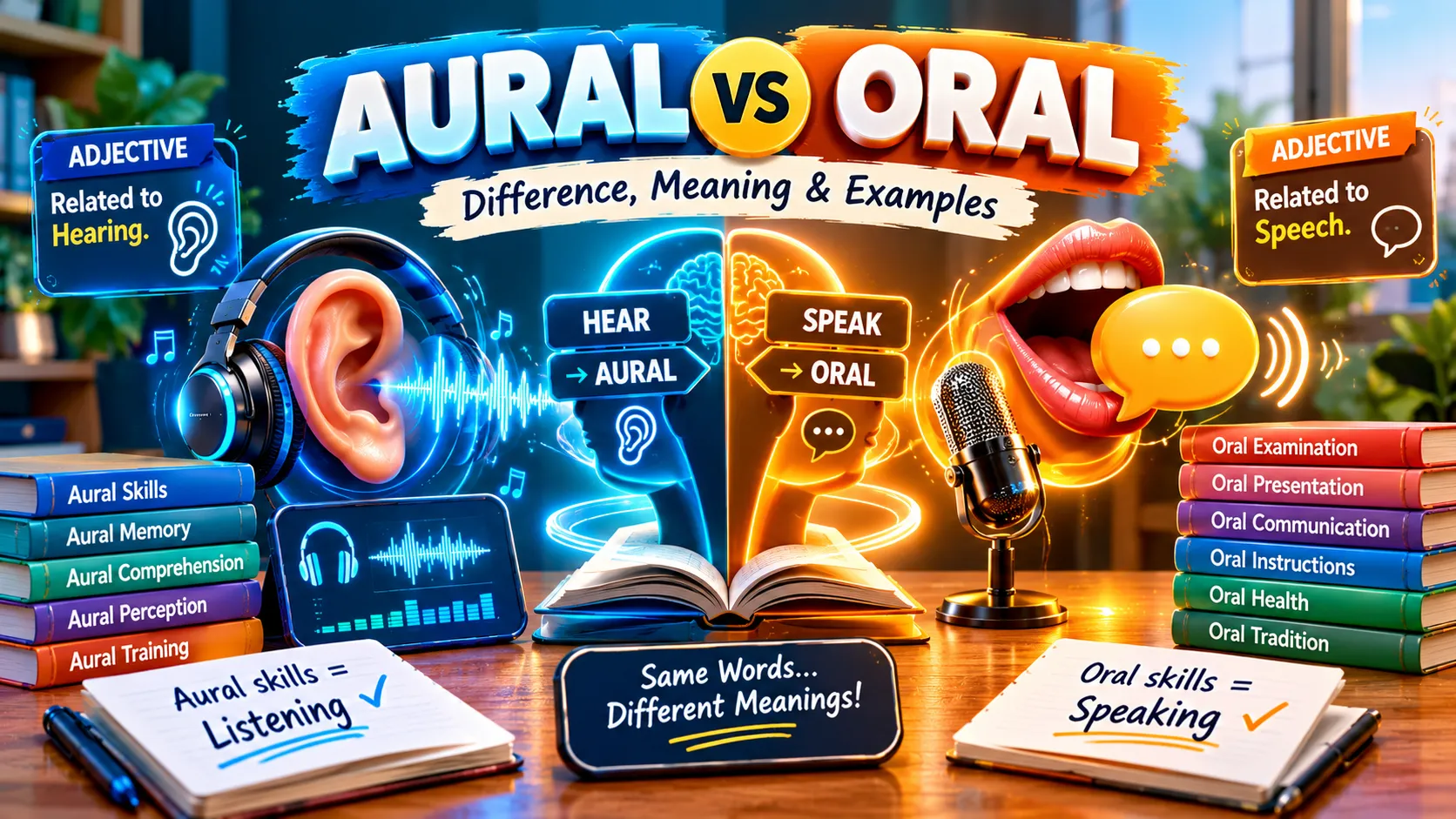
What Does Aural Mean?
Aural is an adjective that means related to the ears or the sense of hearing. It describes how people hear, recognize, remember, or process sounds.
People commonly use aural in music, education, audiology, language learning, and sound studies.
Examples of Aural in Sentences
- The music teacher tested the students’ aural skills.
- Aural training helps musicians recognize different musical notes.
- The child has excellent aural memory.
- The students completed an aural comprehension exercise.
- The therapist evaluated the patient’s aural perception.
- Aural learning activities help students distinguish between sounds.
- The musician developed strong aural recognition through daily practice.
- The course includes aural exercises and listening activities.
Common Phrases with Aural
- Aural skills: Abilities related to recognizing and understanding sounds.
- Aural comprehension: The ability to understand information through listening.
- Aural memory: The ability to remember sounds.
- Aural perception: The process of detecting and interpreting sounds.
- Aural training: Exercises that develop listening and sound-recognition skills.
- Aural stimulation: Activities or experiences that provide sound input.
When Should You Use Aural?
Use aural when the context involves hearing, listening, or processing sound.
Examples:
- The examination includes an aural component.
- She has excellent aural skills.
- The teacher used aural exercises to improve listening comprehension.
- The musician relied on aural memory to reproduce the melody.
Explore More: Everyday vs Daily: Meaning, Difference, and Examples
What Does Oral Mean?
Oral is an adjective that means related to the mouth or involving spoken words. It often describes communication, examinations, presentations, instructions, and traditions passed down through speech.
People commonly use oral in education, healthcare, communication, and everyday life.
Examples of Oral in Sentences
- The student passed the oral examination.
- She gave an oral presentation about climate change.
- The teacher provided oral instructions to the class.
- Oral communication plays an important role in teamwork.
- The doctor examined the patient’s oral health.
- The professor asked the student to defend the research in an oral examination.
- The community preserves its history through oral traditions.
- The manager gave oral feedback after the meeting.
Common Phrases with Oral
- Oral examination: A test in which a student answers questions by speaking.
- Oral presentation: A presentation delivered through spoken words.
- Oral communication: The exchange of information through speech.
- Oral instructions: Directions given verbally.
- Oral health: The health of the mouth, teeth, and gums.
- Oral tradition: Stories, beliefs, or customs passed from one generation to another through speech.
- Oral history: Historical information collected through spoken accounts and interviews.
When Should You Use Oral?
Use oral when the context involves the mouth or spoken communication.
Examples:
- The candidate attended an oral interview.
- The teacher asked for an oral response.
- Oral hygiene helps maintain healthy teeth and gums.
- The speaker delivered an oral report to the audience.
Explore More: Verbless Clauses: Examples, Meaning, Types, Rules, and Usage
Aural vs Oral: Key Differences Explained
Although aural and oral look and sound similar, their meanings differ.
1. Hearing vs Speaking
Aural focuses on hearing and listening, whereas oral often focuses on speaking.
- Aural: The student listened to an audio recording during the test.
- Oral: The student answered the examiner’s questions aloud.
The first example emphasizes listening; the second emphasizes speaking.
2. Aural Test vs Oral Test
An aural test measures listening or sound-recognition skills. An oral test assesses a person’s ability to answer questions or communicate verbally.
- Aural test: Students listen to a recording and answer comprehension questions.
- Oral test: Students answer questions directly in spoken form.
A language examination may include both aural and oral components.
3. Aural Skills vs Oral Skills
Aural skills involve identifying, interpreting, and understanding sounds. Oral skills involve expressing ideas through speech.
- Aural skills: Understanding spoken English.
- Oral skills: Speaking English clearly and confidently.
Language learners often develop both skills to improve their overall communication.
4. Aural Learning vs Oral Communication
Aural learning emphasizes learning through listening. Oral communication emphasizes sharing information through speech.
- Aural learning: Listening to a recorded lecture to understand a topic.
- Oral communication: Explaining the same topic to classmates.
These activities may overlap, but they emphasize different aspects of communication.
Explore More: Predicate Nominatives: Meaning, Rules, Examples, and Exercises
Aural vs Oral Examples in Everyday English
Consider these examples to understand how each word works in context.
| Aural Example | Oral Example |
| The musician improved her aural memory. | The student improved his oral presentation. |
| The class completed an aural comprehension test. | The class completed an oral examination. |
| The training developed aural recognition. | The training developed oral communication. |
| The researcher studied aural perception. | The doctor evaluated oral health. |
| The student practiced aural exercises. | The student practiced oral responses. |
| The course improved aural learning skills. | The course improved oral speaking skills. |
Aural or Oral: Which Word Should You Use?
Choosing the correct word becomes easier when you focus on the action or subject.
Use aural for:
- Listening to a recording.
- Recognizing musical notes.
- Understanding spoken sounds.
- Developing listening comprehension.
- Remembering sounds and melodies.
Use oral for:
- Answering questions aloud.
- Giving a speech or presentation.
- Taking a spoken examination.
- Communicating verbally.
- Discussing the mouth, teeth, or gums.
Compare These Sentences
Incorrect for the intended meaning: The student took an oral listening test.
Clearer wording: The student took an aural listening test.
The second sentence emphasizes the listening component, although an oral test can also include listening and speaking.
Example 2
- The teacher assessed the student’s aural comprehension. (Listening ability)
- The teacher assessed the student’s oral fluency. (Speaking ability)
Example 3
- The musician practiced aural recognition. (Recognizing sounds)
- The musician gave an oral explanation of the composition. (Explaining through speech)
Explore More: Council vs Counsel: Meaning, Difference, and Examples
Are Aural and Oral Pronounced the Same?
Yes. In many varieties of English, aural and oral share the same or a very similar pronunciation: OR-uhl.
Their pronunciation can overlap, so listeners may not easily distinguish the words in conversation. Their spelling and context clarify their meanings.
- Aural: Related to hearing.
- Oral: Related to the mouth or spoken communication.
When writing, choose the word that matches your intended meaning rather than relying on pronunciation alone.
Common Mistakes to Avoid
1. Using Oral Instead of Aural for Listening
Incorrect for a listening-focused activity: The students completed an oral comprehension test.
Better: The students completed an aural comprehension test.
Note: An oral examination may assess spoken responses, while an aural test typically assesses listening.
2. Using Aural Instead of Oral for Speaking
Incorrect: The student gave an aural presentation.
Correct: The student gave an oral presentation.
A presentation delivered through speech is oral, not aural.
3. Confusing Listening Skills with Speaking Skills
Listening and speaking are related but distinct communication skills.
- Aural comprehension measures how well someone understands sounds or spoken information.
- Oral fluency measures how effectively someone expresses ideas through speech.
4. Assuming Aural Always Means Audio
Aural specifically relates to hearing or the ears. Although people often use it to describe audio-based activities, it can also describe hearing, sound perception, and auditory abilities more generally.
5. Assuming Oral Always Means an Examination
Oral appears in many contexts beyond education, including oral health, oral traditions, oral instructions, and oral communication.
Explore More: LMK Meaning: What Does LMK Mean in Texting and Social Media?
Aural vs Oral in Different Fields
| Field | Aural | Oral |
| Education | Listening comprehension | Spoken examination |
| Music | Recognizing pitches and rhythms | Explaining a musical idea verbally |
| Language learning | Understanding spoken language | Speaking a language |
| Healthcare | Hearing-related assessment | Examination of the mouth |
| Communication | Processing sounds | Expressing ideas through speech |
| Research | Studying auditory perception | Conducting oral interviews |
Memory Trick: How to Remember Aural vs Oral
Use these simple associations to remember the difference.
- Aural = Audio: Both relate to hearing and sound.
- Oral = Oration: An oration is a formal speech, which helps you connect oral with speaking.
- Aural = Ears: Think about listening.
- Oral = Mouth: Think about speaking.
Easy reminder: Aural means hearing; oral means speaking or relating to the mouth.

Practice Exercises: Aural vs Oral
Choose the correct word to complete each sentence.
- The music teacher tested the students’ _____ skills.
- The candidate gave an _____ presentation.
- The course includes _____ comprehension exercises.
- The professor scheduled an _____ examination.
- The musician developed excellent _____ memory.
- The doctor checked the patient’s _____ health.
- The language course improves listening and _____ fluency.
- The students listened to an _____ recording.
Answers with Explanations
- Aural — It refers to hearing and listening.
- Oral — A presentation delivered through speech is oral.
- Aural — Comprehension exercises based on listening are aural.
- Oral — An oral examination involves spoken answers.
- Aural — Aural memory refers to remembering sounds.
- Oral — Oral health concerns the mouth, teeth, and gums.
- Oral — Oral fluency refers to speaking ability.
- Aural — The sentence emphasizes listening to a recording.
People Also Ask
Aural means related to hearing or listening, while oral means related to the mouth or spoken communication. For example, an aural test assesses listening skills, whereas an oral test assesses spoken responses.
No. An aural exam generally assesses listening or sound-recognition skills. An oral exam usually requires students to answer questions verbally. Some examinations assess both skills.
Aural relates primarily to hearing and listening. It describes the ability to recognize, understand, or process sounds.
Yes. In communication and education, oral often means spoken or expressed through speech. For example, an oral presentation involves delivering information aloud.
An aural learner is someone who benefits from hearing information. Listening to explanations, discussions, lectures, and audio recordings may help such learners understand and remember information.
Oral communication involves exchanging information through spoken words. Conversations, speeches, meetings, interviews, and presentations are common examples.
Conclusion
The difference between Aural vs Oral lies in hearing and speaking. Aural describes things related to the ears, listening, and sound perception. Oral describes things related to the mouth and spoken communication.
Remember the simple distinction: Aural = Hearing; Oral = Speaking or the mouth. Use aural comprehension for listening activities and oral examination for tests that require spoken answers.
Understanding this difference helps you communicate accurately in academic writing, language learning, music, healthcare, and everyday English.











3 thoughts on “Aural vs Oral: Meaning, Difference, Examples, and Usage”