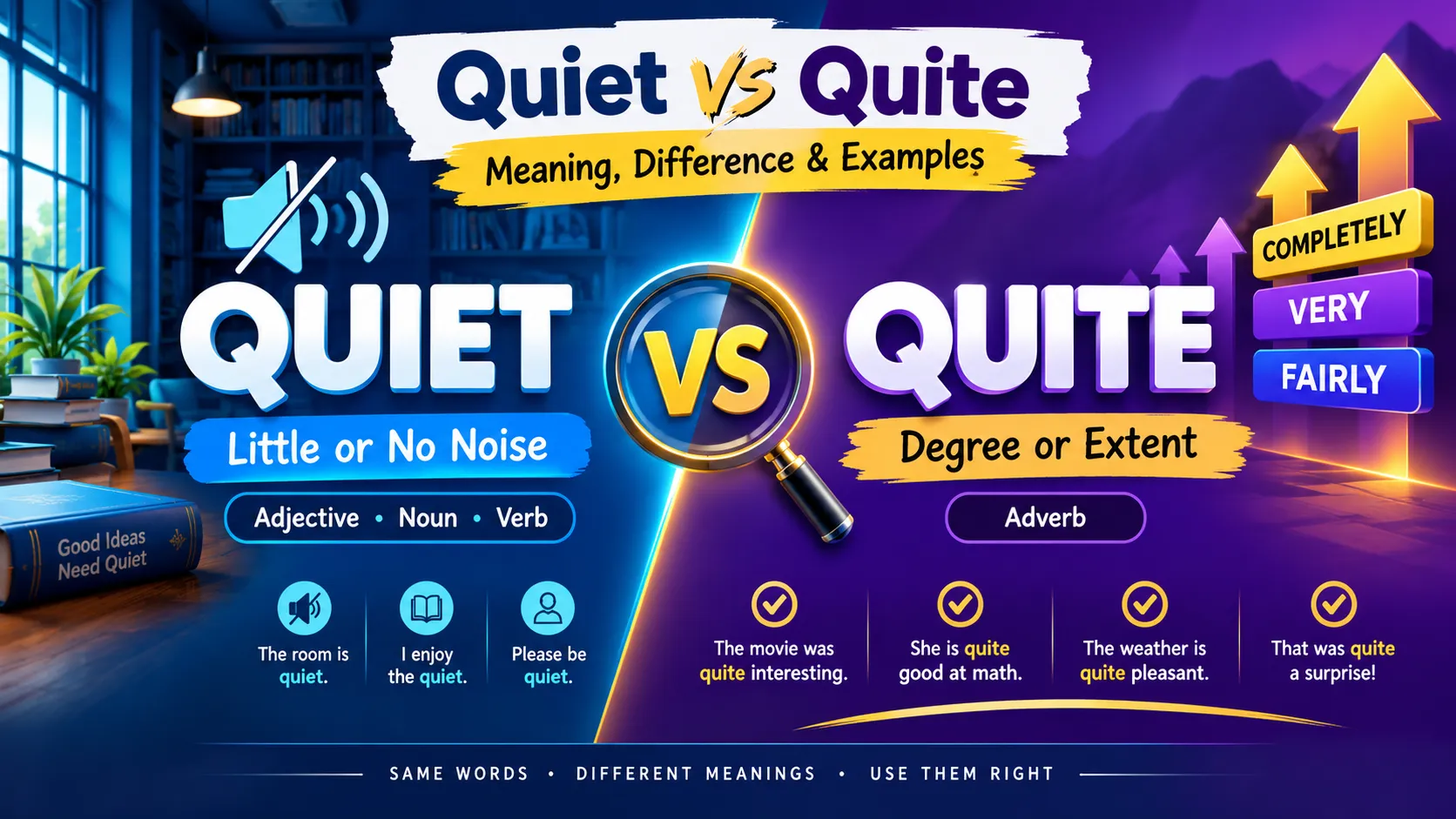
Quiet vs Quite: Have you ever confused quiet with quite while writing a sentence? You are not alone. These two English words look almost identical, but they have different meanings and uses. Using the wrong word can change the meaning of your sentence completely.
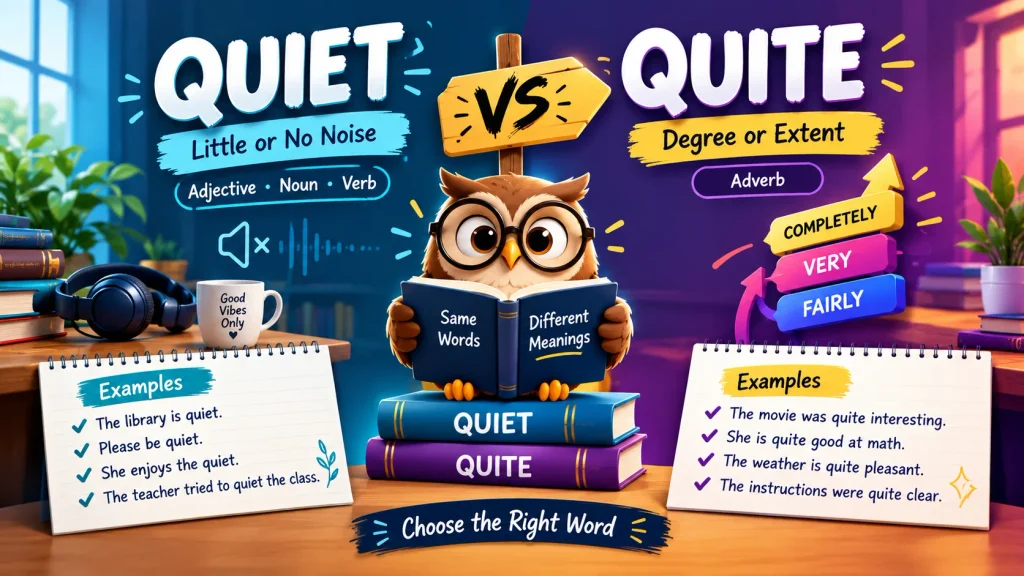
The main difference is simple: Quiet means making little or no noise, while Quite means fairly, very, or completely, depending on the context.
For example, if you ask someone to be quiet, you want them to stop making noise. If you say something is quite interesting, you mean it is fairly or very interesting.
In this guide, you will learn the meanings of quiet and quite, how to use them correctly, their differences in sentences, and simple tricks to remember which word to choose.
Quick Category Overview
| Word | Part of Speech | Meaning | Example |
| Quiet | Adjective | Making little or no noise | The library is quiet. |
| Quiet | Noun | A state of silence or calm | I enjoy the quiet. |
| Quiet | Verb | To make someone or something less noisy | She tried to quiet the baby. |
| Quite | Adverb | Fairly, very, or completely | The test was quite easy. |

What Does Quiet Mean?
Quiet is usually an adjective that describes a person, place, or situation that makes little or no noise. It can also describe someone who speaks very little or behaves calmly.
Examples of Quiet
- The classroom was quiet during the exam.
- Please be quiet while the baby is sleeping.
- We found a quiet place to study.
- He is a quiet person who enjoys reading.
- The neighborhood becomes quiet at night.
- I prefer quiet restaurants where I can talk comfortably.
- She gave me a quiet smile.
- The students remained quiet during the presentation.
In these sentences, quiet describes a lack of noise, a calm atmosphere, or a person who does not speak much.
Quiet as a Noun
Quiet can also be used as a noun to describe silence or peacefulness.
Examples:
- I enjoy the quiet of the early morning.
- We sat in quiet for several minutes.
- She wanted some quiet after a busy day.
- The quiet of the countryside helped me relax.
Quiet as a Verb
The word quiet can also function as a verb, meaning to make someone or something less noisy or to become calmer.
Examples:
- The teacher tried to quiet the class.
- A lullaby helped quiet the crying baby.
- The crowd finally quieted down.
- He took a deep breath to quiet his mind.
Explore More: https://wordminto.com/good-vs-well/
What Does Quite Mean?
Quite is an adverb that changes or adds emphasis to the meaning of an adjective, another adverb, or sometimes a verb.
Depending on the context and variety of English, quite can mean fairly, rather, very, or completely.
Examples of Quite
- The movie was quite interesting.
- Your answer is quite correct.
- She is quite good at mathematics.
- The weather is quite pleasant today.
- That was quite a surprise!
- The room is quite large.
- He speaks English quite well.
- The instructions were quite clear.
The exact meaning of quite depends on the sentence. For example, “quite good” may mean fairly good or very good, depending on the speaker and context.
Quite Meaning: Fairly or Rather
In many everyday sentences, particularly in British English, quite can mean fairly or moderately.
Examples:
- The restaurant is quite expensive.
- The book was quite interesting.
- It is quite cold outside.
- The journey was quite long.
These sentences suggest a noticeable degree without necessarily meaning the highest possible degree.
Quite Meaning: Completely or Entirely
In other contexts, quite means completely or entirely.
Examples:
- You are quite right.
- The statement is quite false.
- I am quite certain about the answer.
- The two situations are quite different.
The adjective and the context help determine which meaning is intended.
Explore More: https://wordminto.com/hyphen-rules/
Quiet vs Quite: Key Differences
Although quiet and quite differ by only one letter’s position, they perform different grammatical jobs.
| Feature | Quiet | Quite |
| Main meaning | Low noise or calm | Fairly, very, or completely |
| Usual part of speech | Adjective | Adverb |
| Describes | People, places, sounds, or situations | The degree or extent of something |
| Example | The room is quiet. | The room is quite clean. |
| Common phrase | Keep quiet | Quite good |
| Opposite or contrast | Noisy, loud | Depends on context |
Remember that quiet describes silence or a lack of noise, while quite tells you how much, how strongly, or to what extent something is true.
Quiet vs Quite: Example Sentences
Compare these sentences to see how one letter changes the meaning.
1. Quiet vs Quite interesting
- Quiet: The students were quiet during the lecture.
- Quite: The lecture was quite interesting.
The first sentence describes the students’ behavior. The second expresses the degree of interest in the lecture.
2. Quiet vs Quite room
- Quiet: We booked a quiet room.
- Quite: The room was quite comfortable.
A quiet room has little noise. A quite comfortable room is fairly or very comfortable.
3. Quiet vs Quite person
- Quiet: My brother is a quiet person.
- Quite: My brother is quite friendly.
The first sentence describes his personality. The second describes how friendly he is.
4. Quiet vs Quite cold
- Quiet: The quiet street was almost empty.
- Quite: It is quite cold this morning.
The first describes a street with little noise or activity. The second describes the degree of coldness.
5. Quiet vs Quite sure
- Quiet: The child became quiet.
- Quite: I am quite sure about my decision.
The child stopped making noise, while the second speaker expresses a high degree of certainty.
Explore More: https://wordminto.com/a-or-an-usage/
How to Remember Quiet vs Quite
If you often mix up these words, use these simple memory tricks.
1. Associate Quiet With Silence
Think of the word quiet whenever you talk about noise, silence, or calmness.
Examples:
- A quiet room
- A quiet voice
- A quiet neighborhood
- Keep quiet
2. Associate Quite With Degree
Think of quite as a word that tells you how much or to what extent something is true.
Examples:
- Quite easy
- Quite happy
- Quite difficult
- Quite certain
3. Remember the Letter Order
The word quiet contains the letters “u-i-e,” while quite contains “q-u-i-t-e.” Look carefully at the position of the letters after Q.
A simple reminder is: quiet describes noise; quite describes degree.
4. Replace Quite With Fairly or Completely
When you are unsure, try replacing quite with “fairly,” “very,” or “completely.” If the sentence still makes sense, quite may be the correct choice.
For example:
- The exam was quite difficult.
- The exam was fairly difficult.
Both sentences can make sense, depending on the intended meaning.
Explore More: https://wordminto.com/modal-verb-rules/
Common Mistakes With Quiet and Quite
Even fluent English speakers occasionally mistype these words. Here are common mistakes to avoid.
Mistake 1: Please be quite.
Incorrect: Please be quite during the movie.
Correct: Please be quiet during the movie.
Why? You are asking someone to stop making noise, so quiet is the correct word.
Mistake 2: The food was quiet good.
Incorrect: The food was quiet good.
Correct: The food was quite good.
Why? You need an adverb to describe how good the food was. Use quite.
Mistake 3: I need a quite place to study.
Incorrect: I need a quite place to study.
Correct: I need a quiet place to study.
Why? The place needs to be peaceful and free from noise. Use the adjective quiet.
Mistake 4: She is quiet happy with the result.
Incorrect: She is quiet happy with the result.
Correct: She is quite happy with the result.
Why? The sentence describes the degree of her happiness, so quite is needed.
Mistake 5: The children were quite during class.
Incorrect: The children were quite during class.
Correct: The children were quiet during class.
Why? The sentence describes the children’s behavior, not the degree of something.
Explore More: https://wordminto.com/run-on-sentence-rules/
Quiet vs Quite in Everyday English
Both words appear frequently in conversations, emails, schoolwork, and professional writing.
School
- Please remain quiet during the test.
- The homework was quite easy.
- We need a quiet place to study.
- The teacher was quite pleased with the class.
Work
- The office is quiet this morning.
- Your presentation was quite impressive.
- I need a quiet moment to think.
- The report is quite detailed.
Home
- The baby is finally quiet.
- This room is quite comfortable.
- I enjoy the quiet after dinner.
- The house is quite clean now.
In Casual Conversation
- It is quiet in here.
- That is quite funny.
- He is a quiet guy.
- I am quite tired today.
These examples show that both words are useful, but they cannot be substituted for each other without changing the meaning.
Explore More: https://wordminto.com/dangling-modifier/
Is Quiet an Adjective or an Adverb?
Quiet is most commonly an adjective, but it can also function as a noun or verb.
Examples:
- Adjective: The street is quiet.
- Noun: I enjoy the quiet.
- Verb: Please quiet the children.
The related adverb is quietly, not quiet in standard expressions such as “speak quietly.”
Examples:
- She spoke quietly.
- He walked quietly into the room.
- The baby slept quietly.
Do not confuse quiet with quite. They are separate words with separate meanings.
Is Quite the Same as Very?
Not always. Quite and very can have similar meanings, but they are not interchangeable in every sentence.
For example:
- The movie was very good.
- The movie was quite good.
Depending on the speaker and context, the first may express a stronger degree of praise, while the second may mean fairly good or may also express strong approval.
However, in a sentence such as “You are quite right,” quite can mean completely right. Replacing it with “very” may sound unnatural.
The safest approach is to consider the adjective and the context rather than assuming that quite always means very.
Quiet vs Quite: Pronunciation
Quiet and quite have different pronunciations.
- Quiet: commonly pronounced /ˈkwaɪ.ət/ (roughly “KWY-uht”), with two syllables.
- Quite: commonly pronounced /kwaɪt/ (roughly “KWYT”), with one syllable.
The pronunciation difference can help you recognize the words when speaking and listening. However, because they look similar when written, spelling mistakes are still common.
Practice saying these pairs aloud:
- Quiet room / quite comfortable
- Quiet child / quite happy
- Quiet street / quite cold
Quiet vs Quite: Quick Grammar Test
Choose the correct word in each sentence.
- Please be _____ while the baby sleeps.
- This book is _____ interesting.
- We found a _____ corner in the library.
- I am _____ certain that I locked the door.
- The children became _____ after the teacher arrived.
- The hotel room was _____ comfortable.
- She prefers a _____ place to work.
- That is _____ an unusual idea.
Answers:
- Quiet
- Quite
- Quiet
- Quite
- Quiet
- Quite
- Quiet
- Quite
In sentence 8, quite an unusual idea is a standard construction in which quite modifies the phrase beginning with “an unusual idea.”
People Also Ask
Quiet means making little or no noise, while quite is an adverb meaning fairly, rather, very, or completely, depending on context.
The correct phrase is “be quiet” when asking someone to stop making noise.
Example: Please be quiet during the movie.
The correct phrase is “quite good.” The word quite modifies the adjective good.
Yes, quiet can mean silent or nearly silent. It can also describe a calm person, place, or situation.
Example: The library is quiet.
Sometimes. Quite can mean very, but it can also mean fairly, rather, or completely. Its meaning depends on the context and variety of English.
Conclusion
Understanding the difference between Quiet and Quite is simple once you remember their meanings. Quiet refers to silence or a lack of noise, while Quite means fairly, rather, very, or completely, depending on the context.
For example, you can say, “Please be quiet” when asking someone to stop making noise, and “The movie was quite interesting” when describing how interesting it was.
Remember this easy rule: Quiet is about noise; Quite is about degree. With a little practice, you can use both words correctly in everyday conversations and writing.
At Wordminto, we make English words, grammar rules, and commonly confused expressions easier to understand with simple explanations and practical examples.











2 thoughts on “Quiet vs Quite: Difference, Meaning, and Examples”