
Tomorrow Morning or Tomorrow’s Morning: When talking about the morning of the next day, the correct and natural expression is “tomorrow morning.” The phrase “tomorrow’s morning” sounds unnatural in standard modern English and rarely appears in everyday conversation.
If you want to talk about the morning that follows today, use tomorrow morning.
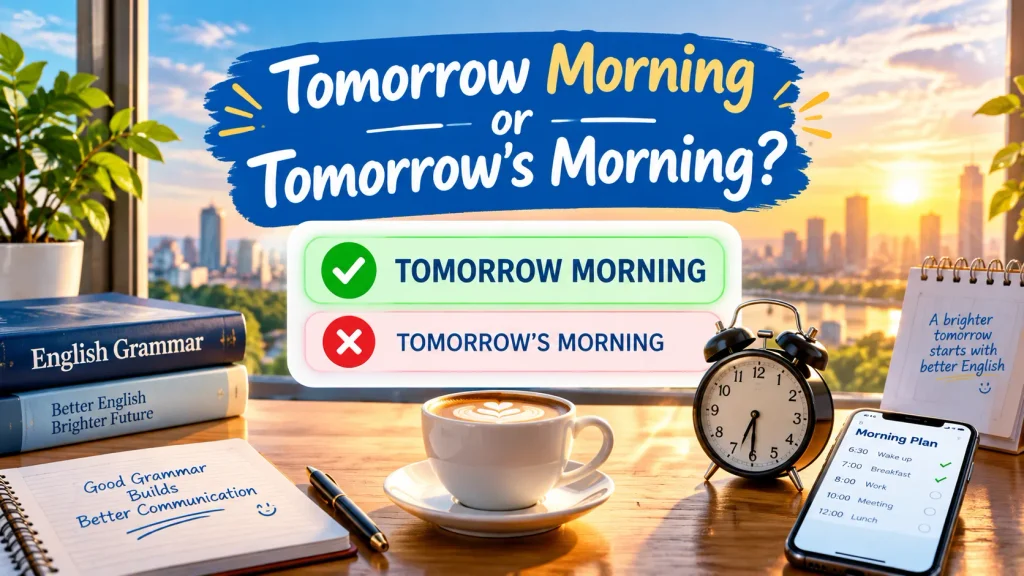
Tomorrow Morning or Tomorrow’s Morning?
“Tomorrow morning” is the standard and natural expression.
- ✅ I will call you tomorrow morning.
- ✅ We have a meeting tomorrow morning.
- ✅ She is leaving tomorrow morning.
- ❌ I will call you tomorrow’s morning.
- ❌ We have a meeting tomorrow’s morning.
English normally uses tomorrow directly before a part of the day:
- tomorrow morning
- tomorrow afternoon
- tomorrow evening
- tomorrow night
You do not normally add an apostrophe and ’s after tomorrow in these expressions.
What Does “Tomorrow Morning” Mean?
Tomorrow morning means the morning of the day after today.
For example, if today is Monday, tomorrow morning means Tuesday morning.
Examples
- I have an appointment tomorrow morning.
- Please send me the report tomorrow morning.
- We are traveling tomorrow morning.
- She will meet her teacher tomorrow morning.
- I need to wake up early tomorrow morning.
The phrase works naturally in both everyday speech and formal writing.
Explore More: https://wordminto.com/omg-meaning/
Why Is “Tomorrow’s Morning” Unnatural?
The confusion comes from the possessive form tomorrow’s.
The word tomorrow can sometimes take ’s when it functions as a possessive noun:
- Tomorrow’s meeting starts at 9 a.m.
- Tomorrow’s weather looks pleasant.
- Tomorrow’s schedule has changed.
- I am preparing for tomorrow’s exam.
Here, tomorrow’s means something like “of tomorrow” or “scheduled for tomorrow.”
However, English does not normally say “tomorrow’s morning.” Instead, it uses the simpler time expression “tomorrow morning.”
Compare:
| Less Natural | Natural |
| tomorrow’s morning | tomorrow morning |
| tomorrow’s afternoon | tomorrow afternoon |
| tomorrow’s evening | tomorrow evening |
| tomorrow’s night | tomorrow night |
Is “Tomorrow’s Morning” Grammatically Wrong?
In most ordinary contexts, “tomorrow’s morning” sounds unnatural rather than completely impossible.
Native English speakers overwhelmingly prefer “tomorrow morning” when they mean the morning of the next day.
For example:
❌ I will see you tomorrow’s morning.
✅ I will see you tomorrow morning.
The second sentence sounds natural and idiomatic.
If you need a possessive construction, English usually chooses a different structure:
- Tomorrow’s meeting
- Tomorrow’s appointment
- Tomorrow’s schedule
But for the time of day itself, use:
- tomorrow morning
- tomorrow afternoon
- tomorrow evening
Explore More: https://wordminto.com/rip-meaning/
Tomorrow Morning vs. Tomorrow
Tomorrow refers to the entire next day, while tomorrow morning refers specifically to its morning.
Compare:
I will call you tomorrow.
This means the call can happen at any time tomorrow.
I will call you tomorrow morning.
This specifies that the call will happen during tomorrow morning.
More examples:
- We are leaving tomorrow.
- We are leaving tomorrow morning.
- She will finish it tomorrow.
- She will finish it tomorrow morning.
Adding morning makes the time more specific.
Explore More: https://wordminto.com/yesterday-night-vs-last-night/
Tomorrow Morning vs. Tomorrow’s Meeting
These two expressions follow different grammatical patterns.
Tomorrow morning
Tomorrow morning functions as a time expression.
I will study tomorrow morning.
Here, tomorrow morning tells us when the studying will happen.
Tomorrow’s meeting
.
Tomorrow’s functions as a possessive determiner.
.
Tomorrow’s meeting starts at 10 a.m.
Here, tomorrow’s modifies meeting.
This distinction explains why “tomorrow morning” works naturally while “tomorrow’s morning” usually does not.
Explore More: https://wordminto.com/tysm-meaning/
Can You Say “Tomorrow Morning” Without “On”?
Yes. In fact, tomorrow morning normally appears without on.
✅ I will see you tomorrow morning.
❌ I will see you on tomorrow morning.
When tomorrow identifies the day, English normally does not use on before it.
Compare:
- I will see you tomorrow.
- I will see you tomorrow morning.
- I saw you yesterday morning.
- I will see you on Monday morning.
Notice the difference:
- tomorrow morning — no on
- Monday morning — on can appear
For example:
I will meet you on Monday morning.
But:
I will meet you tomorrow morning.
Tomorrow Morning vs. The Morning of Tomorrow
“The morning of tomorrow” is grammatically understandable but extremely unnatural in ordinary English.
Instead, say:
tomorrow morning
For example:
❌ I will visit you in the morning of tomorrow.
✅ I will visit you tomorrow morning.
The shorter expression sounds much more natural.
Tomorrow Morning in Questions
You can use tomorrow morning naturally in questions.
- What are you doing tomorrow morning?
- Are you free tomorrow morning?
- Can we meet tomorrow morning?
- What time will you leave tomorrow morning?
- Will you be working tomorrow morning?
These forms work well in both casual and professional conversations.
Tomorrow Morning in Negative Sentences
You can also use the expression in negative sentences.
- I cannot come tomorrow morning.
- She will not be available tomorrow morning.
- We do not have a meeting tomorrow morning.
- He does not work tomorrow morning.
Tomorrow Morning in Questions and Answers
Q: When will you call me?
A: I will call you tomorrow morning.
Q: Are you free tomorrow morning?
A: Yes, I am.
Q: When is the interview?
A: It is tomorrow morning.
Q: What time are you leaving?
A: I am leaving tomorrow morning at 7 a.m.
Common Mistakes
1. Using “tomorrow’s morning”
❌ I will call you tomorrow’s morning.
✅ I will call you tomorrow morning.
2. Adding “on” before tomorrow
❌ I will meet you on tomorrow morning.
✅ I will meet you tomorrow morning.
3. Using “in tomorrow morning”
❌ I will see you in tomorrow morning.
✅ I will see you tomorrow morning.
4. Saying “the tomorrow morning”
❌ I will go there the tomorrow morning.
✅ I will go there tomorrow morning.
“Tomorrow Morning” in American and British English
Tomorrow morning works naturally in both American and British English.
There is no major American-versus-British spelling difference here.
For example:
American English:
I have a meeting tomorrow morning.
British English:
I have a meeting tomorrow morning.
The expression remains the same.
Practice: Choose the Correct Expression
Choose tomorrow morning or tomorrow’s morning.
- I will call you ______.
- We have an important meeting ______.
- She plans to travel ______.
- Can you send the documents ______?
- I need to wake up early ______.
Answers
- tomorrow morning
- tomorrow morning
- tomorrow morning
- tomorrow morning
- tomorrow morning
Is “Tomorrow’s Morning” Ever Possible?
You may occasionally encounter “tomorrow’s morning” in non-native English, translated text, unusual literary writing, or contexts where a writer deliberately treats tomorrow as a possessive noun.
However, that does not make it the preferred expression for normal English.
If your goal is natural, clear, standard English, choose:
tomorrow morning
Quick Grammar Rule
Remember this simple rule:
Use “tomorrow + time of day.”
- tomorrow morning ✅
- tomorrow afternoon ✅
- tomorrow evening ✅
- tomorrow night ✅
Avoid adding ’s to tomorrow before these time-of-day expressions:
- tomorrow’s morning ❌ usually unnatural
- tomorrow’s afternoon ❌ usually unnatural
- tomorrow’s evening ❌ usually unnatural
- tomorrow’s night ❌ usually unnatural
But use tomorrow’s naturally before nouns such as:
- tomorrow’s meeting
- tomorrow’s exam
- tomorrow’s schedule
- tomorrow’s event
- tomorrow’s weather
People Also Ask
Yes. “Tomorrow morning” is the standard and natural expression for the morning of the next day.
Although people may understand it, “tomorrow’s morning” sounds unnatural in standard everyday English. Use “tomorrow morning” instead.
No. Say “tomorrow morning”, without on.
No. The natural expression is “tomorrow morning.”
No. Tomorrow and morning remain two separate words.
Final Verdict
“Tomorrow morning” is the correct and natural expression.
Use tomorrow morning when you mean the morning of the next day.
✅ I will see you tomorrow morning.
Avoid “tomorrow’s morning” in normal English because it sounds unnatural.
❌ I will see you tomorrow’s morning.
For possessive constructions, however, tomorrow’s works perfectly before nouns such as meeting, exam, schedule, appointment, and event.
Easy rule:
Tomorrow + morning = tomorrow morning.









1 thought on “Tomorrow Morning or Tomorrow’s Morning: Which Is Correct?”