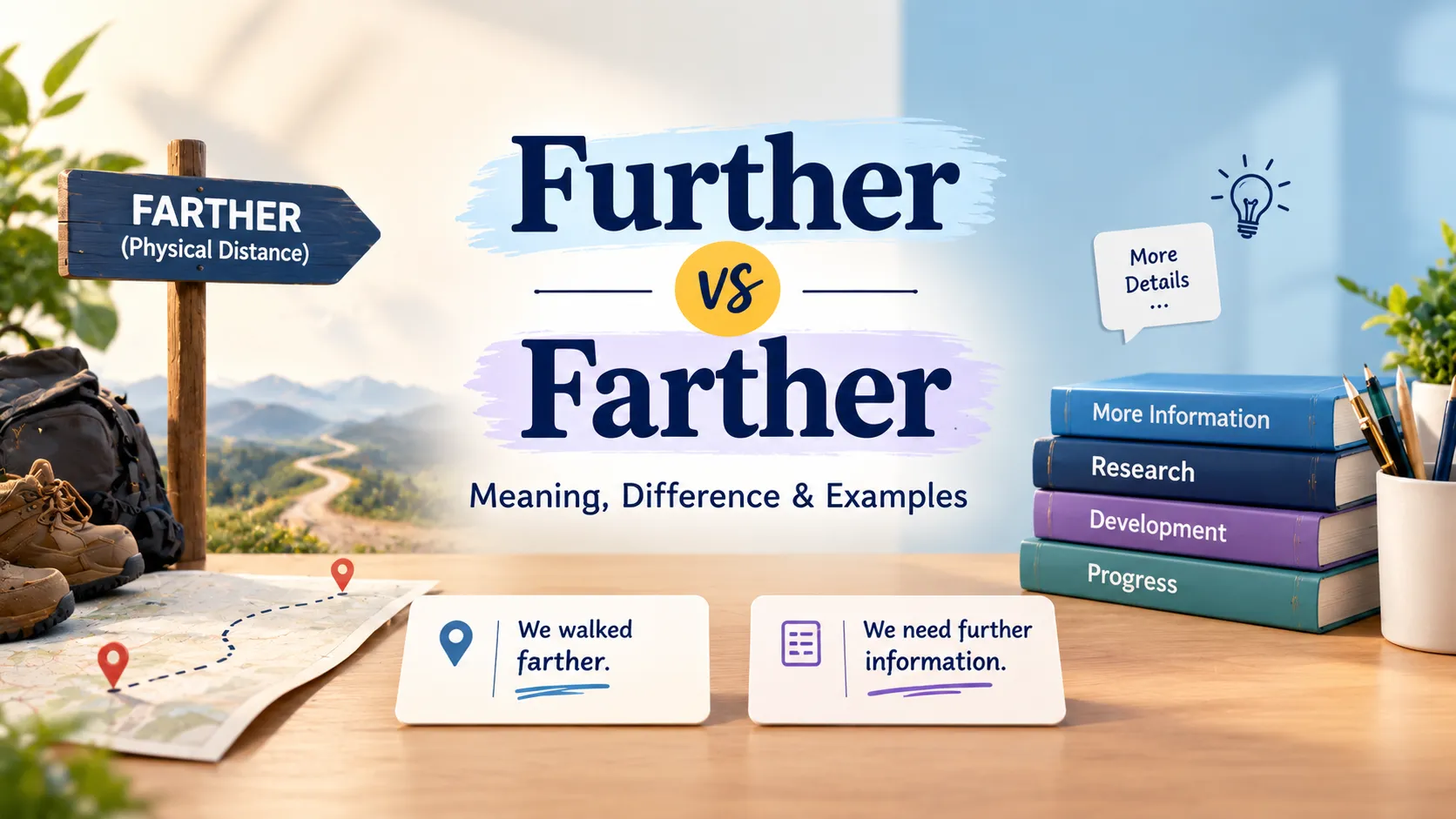
Further vs Farther can confuse even fluent English speakers because both words describe something that goes beyond a point or reaches a greater distance. However, traditional English usage gives them different roles.
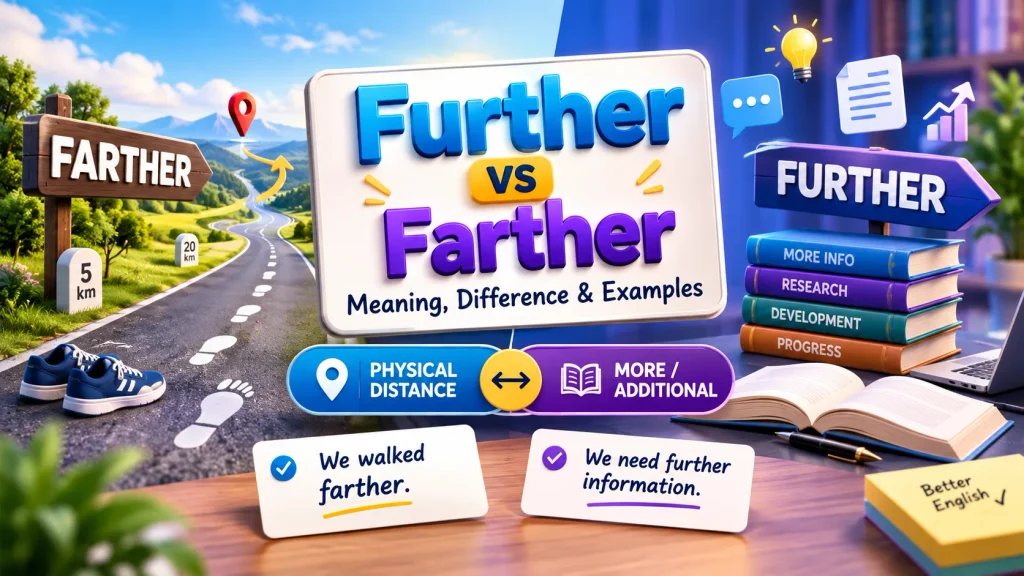
Farther usually refers to physical distance, while further commonly refers to figurative distance, additional information, degree, time, or progress.
For example:
- The school is farther from my house than the library.
- We need further information before making a decision.
In modern English, people sometimes use further for both physical and figurative distance. Still, learning the traditional distinction helps you write with greater precision.
Further vs Farther: Quick Difference
| Word | Main Use | Example |
| Farther | Physical distance | The station is farther than I expected. |
| Further | Additional or figurative meaning | We need further discussion. |
| Farther | Greater measurable distance | She ran farther than I did. |
| Further | More, additional, or continued | Please provide further details. |
Easy Rule
Farther = physical distance
Further = additional, figurative, or nonphysical meaning
A simple memory trick:
Farther has “far” in it, so think of physical distance.
What Does Further Mean?
Further can mean additional, more, to a greater degree, or beyond the current point.
It commonly describes ideas, information, discussion, progress, development, time, or other nonphysical concepts.
Examples of Further
- Please provide further information.
- We need further discussion.
- She wants to further her education.
- Nothing could be further from the truth.
- The company plans to further develop the product.
- We cannot continue without further evidence.
In these examples, further does not describe a measurable physical distance.
Explore More: https://wordminto.com/idc-meaning/
Further as an Adjective
As an adjective, further can mean additional or more.
Examples:
- Do you have any further questions?
- We need further evidence.
- The teacher gave us further instructions.
- No further action is necessary.
- The company announced further changes.
Further Questions
Further questions means additional questions.
Example:
If you have any further questions, please contact us.
What Does Farther Mean?
Farther traditionally refers to physical distance.
It describes something located at or moving to a greater measurable distance.
Examples of Farther
- The airport is farther from here than the train station.
- We walked farther than we planned.
- How much farther do we have to go?
- The blue house is farther down the road.
- She threw the ball farther than I did.
In each example, you can think about actual physical space or distance.
Farther as an Adjective
Farther can describe something that lies at a greater physical distance.
Example:
The farther end of the field was covered in snow.
Another example:
Their house is farther away from the city center.
Explore More: https://wordminto.com/idk-meaning/
Farther as an Adverb
Farther can also describe movement or action across a greater physical distance.
Examples:
- We walked farther than expected.
- The runner went farther than everyone else.
- Don’t go any farther.
- The bird flew farther away.
Further vs Farther: The Main Difference
The traditional distinction comes down to physical distance versus additional or figurative meaning.
Use Farther for Physical Distance
Use farther when you can measure the distance between physical locations or objects.
The mountain is farther than I thought.
We drove farther than planned.
How much farther is the hotel?
Use Further for Additional or Figurative Meaning
Use further when you mean additional, more, continued, or deeper.
We need further information.
Let’s discuss this further.
She wants to further her career.
Nothing could be further from the truth.
Explore More: https://wordminto.com/could-of-vs-could-have/
Further vs Farther Examples
Here are examples that show the traditional difference clearly.
Physical Distance
Correct:
The second store is farther from my house.
Why?
The sentence describes physical distance.
Additional Information
Correct:
Please send me further information.
Why?
The sentence means additional information, not physical distance.
Physical Movement
Correct:
We walked farther down the road.
Why?
The sentence describes movement over physical distance.
Additional Discussion
Correct:
We need to discuss the issue further.
Why?
The sentence means to discuss the issue in greater detail.
Further or Farther: Which One Should You Use?
Use this simple decision process.
Step 1: Are you talking about physical distance?
Use farther.
The beach is farther away than the park.
Step 2: Do you mean additional or more?
Use further.
We need further information.
Step 3: Are you talking about figurative progress or development?
Use further.
This course will further your understanding of grammar.
Step 4: Are you talking about physical movement or measurable distance?
Use farther.
The runner traveled farther than his competitors.
Further vs Farther in a Sentence
Compare these sentences:
1. Farther
The grocery store is farther from my house.
The sentence refers to physical location.
2. Further
We need further information about the project.
The sentence refers to additional information.
3. Farther
She ran farther than I did.
The sentence describes physical distance.
4. Further
We should investigate the matter further.
The sentence means investigate it more deeply.
5. Farther
Don’t walk any farther.
The sentence refers to physical movement.
6. Further
Don’t discuss the matter further.
The sentence means don’t continue the discussion.
Can Further Mean Physical Distance?
Yes.
In modern English, further can also refer to physical distance, and many dictionaries recognize this usage.
For example:
How much further do we need to drive?
This sentence is common and widely understood.
Traditionally, some style guides recommend farther for physical distance:
How much farther do we need to drive?
Both forms appear in modern English, but farther gives you the clearest traditional choice when you specifically mean measurable physical distance.
Can Farther Mean More or Additional?
Traditionally, farther focuses on physical distance, while further handles additional or figurative meanings.
Therefore, standard careful writing generally prefers:
We need further discussion.
rather than:
We need farther discussion.
Similarly:
Please provide further details.
Not:
Please provide farther details.
Further and Farther as Comparatives
Both words function as comparative forms connected with far, but English developed different uses for them.
Farther
Farther commonly expresses greater physical distance.
The next town is farther away.
Further
Further commonly expresses additional degree, extent, or amount.
We need to examine the issue further.
This distinction helps explain why English speakers commonly say:
- farther away
- further information
- farther down the road
- further discussion
- farther from home
- further development
Common Expressions with Further
Several common English expressions use further.
Further Information
Meaning: additional information.
For further information, contact the office.
Further Details
Meaning: additional details.
The report contains further details about the project.
Further Discussion
Meaning: additional or continued discussion.
The matter requires further discussion.
Further Notice
Often used in the expression:
Until further notice
This means until someone provides a new announcement or instruction.
Further Education
Meaning: additional education or education beyond a particular stage.
She returned to university for further education.
Further Research
Meaning: additional research.
Further research may help answer the question.
Further Action
Meaning: additional steps or measures.
No further action is required.
Further Ado
The phrase without further ado means without any additional delay or introduction.
Without further ado, let’s begin.
Common Expressions with Farther
Farther commonly appears in expressions involving physical distance.
Farther Away
The station is farther away than the museum.
Farther Down the Road
There is a gas station farther down the road.
Farther From
The hotel is farther from the airport.
Farther Than
We walked farther than we expected.
How Much Farther?
How much farther is the next town?
These expressions involve physical distance, so farther fits naturally.
Further vs Farther: Common Mistakes
Mistake 1: Using Farther for Additional Information
Incorrect in traditional usage:
Please give me farther information.
Better:
Please give me further information.
Why?
You mean additional information, not greater physical distance.
Mistake 2: Using Farther for Figurative Progress
Less appropriate in traditional usage:
We need to explore this issue farther.
Preferred:
We need to explore this issue further.
The sentence refers to deeper investigation rather than physical movement.
Mistake 3: Assuming Further Never Refers to Distance
It is too strict to say that further can never describe physical distance.
Modern English frequently uses further for distance:
We drove further than expected.
However, farther remains a useful choice when you want to make the physical-distance meaning especially clear.
Further vs Farther in American English
American English commonly maintains the traditional distinction:
- farther → physical distance
- further → additional or figurative meaning
However, everyday American English also uses further for physical distance.
For example:
How much further can we drive?
This sounds natural to many speakers.
In formal writing, choosing farther for measurable physical distance and further for additional or figurative meanings provides a clear and traditional distinction.
Further vs Farther in British English
British English also uses both forms, but actual usage can overlap.
For example:
We need to walk further.
British speakers commonly use further for physical distance.
The distinction between the two words therefore remains useful as a traditional writing guideline rather than an absolute rule that every English speaker follows in every context.
Is Further More Formal Than Farther?
Not necessarily.
The two words have different traditional functions.
Further often appears in formal expressions such as:
- further information
- further research
- further discussion
- further investigation
- further evidence
This frequent use in formal writing can make further seem more formal, but the word itself is not simply a more formal version of farther.
Further as a Verb
Further can also function as a verb meaning to advance, promote, or help something develop.
Examples:
Education can further your career.
The program aims to further scientific research.
She worked hard to further her professional goals.
In these sentences, further means to help something progress.
Farther does not normally function as a verb in this way.
Further as an Adverb
As an adverb, further can mean to a greater degree, additionally, or more deeply.
Examples:
We need to investigate the issue further.
I don’t want to discuss this further.
The company plans to expand further.
Let’s look into the matter further.
Further as an Adjective
As an adjective, further commonly means additional.
Examples:
Do you have any further questions?
The doctor requested further tests.
We need further evidence.
The company announced further changes.
Farther as an Adverb
Farther commonly functions as an adverb when it describes physical distance.
Examples:
We walked farther than expected.
The car traveled farther on a full tank.
The ball went farther than anyone expected.
A Simple Memory Trick
Remember:
Farther = Far + physical distance
The word farther contains far, which can remind you of physical distance.
For example:
The airport is farther away.
For everything involving additional information, deeper discussion, progress, or figurative meaning, think:
Further = more
Examples:
I need further information.
Let’s discuss it further.
She wants to further her education.
Further vs Farther: Comparison Chart
| Feature | Further | Farther |
| Physical distance | Can occur in modern usage | Traditional choice |
| Additional meaning | Yes | Usually no |
| Figurative meaning | Yes | Usually no |
| Additional information | Yes | No |
| Deeper discussion | Yes | No |
| Career advancement | Yes | No |
| Physical movement | Sometimes | Yes |
| “Further information” | Correct | Not standard |
| “Farther away” | Possible | Traditional choice |
| Verb | Yes | No |
Practice: Choose Further or Farther
Choose the correct word in each sentence.
- How much ______ do we need to walk?
- Please provide ______ information.
- We drove ______ than expected.
- We need to investigate the matter ______.
- The next town is ______ away.
- Do you have any ______ questions?
- She wants to ______ her education.
- The runner traveled ______ than his opponent.
- Let’s discuss this ______ tomorrow.
- The hotel is ______ from the airport.
Answers
- farther — physical distance
- further — additional information
- farther — physical distance
- further — deeper investigation
- farther — physical distance
- further — additional questions
- further — advance or develop
- farther — physical distance
- further — additional discussion
- farther — physical distance
Further vs Farther: Quick Test
Ask yourself:
Can I measure the distance physically?
- Yes → farther is the traditional choice.
- No → further is usually the choice.
For example:
The store is farther away.
We need further information.
Another useful test:
If you can replace the word with “additional” or “more,” choose further.
Further information = additional information.
Discuss it further = discuss it more.
Further vs Farther in Formal Writing
For formal and academic writing, maintaining the traditional distinction can make your meaning clearer.
Use farther for measurable physical distance:
The second sampling site lies farther from the main road.
Use further for additional or abstract concepts:
Further research is necessary to confirm the findings.
The researchers conducted further analysis.
The study requires further investigation.
This distinction works especially well in academic, professional, and technical writing.
People Also Ask
Both are correct words, but they traditionally serve different purposes. Farther usually refers to physical distance, while further usually means additional, more, or figuratively beyond a point.
Farther away is the traditional choice when referring to physical distance.
Example:
The airport is farther away than the station.
Further away also occurs frequently in modern English.
The standard expression is further information.
Example:
Please contact us for further information.
Use further discussion.
Example:
The proposal requires further discussion.
Both can occur, but farther down the road follows the traditional physical-distance distinction.
Example:
There is a restaurant farther down the road.
Yes. Further can mean to advance, promote, or help something develop.
Example:
The program aims to further scientific research.
Use this shortcut:
Farther = physical distance.
Further = additional, deeper, or figurative meaning.
Final Difference Between Further and Farther
The traditional distinction between further and farther is simple:
- Farther usually refers to physical distance.
- Further usually refers to an additional amount, deeper degree, progress, or figurative distance.
- Further can also refer to physical distance in modern English.
- Further can function as an adjective, adverb, and verb.
- Farther mainly focuses on comparative physical distance.
Compare:
We walked farther than we planned.
We need to discuss the issue further.
The first sentence describes physical distance. The second describes additional discussion.
The easiest rule to remember:
Farther = physical distance
Further = additional or figurative distance
Once you connect farther with physical distance and further with “more” or “additional,” choosing between the two becomes much easier.