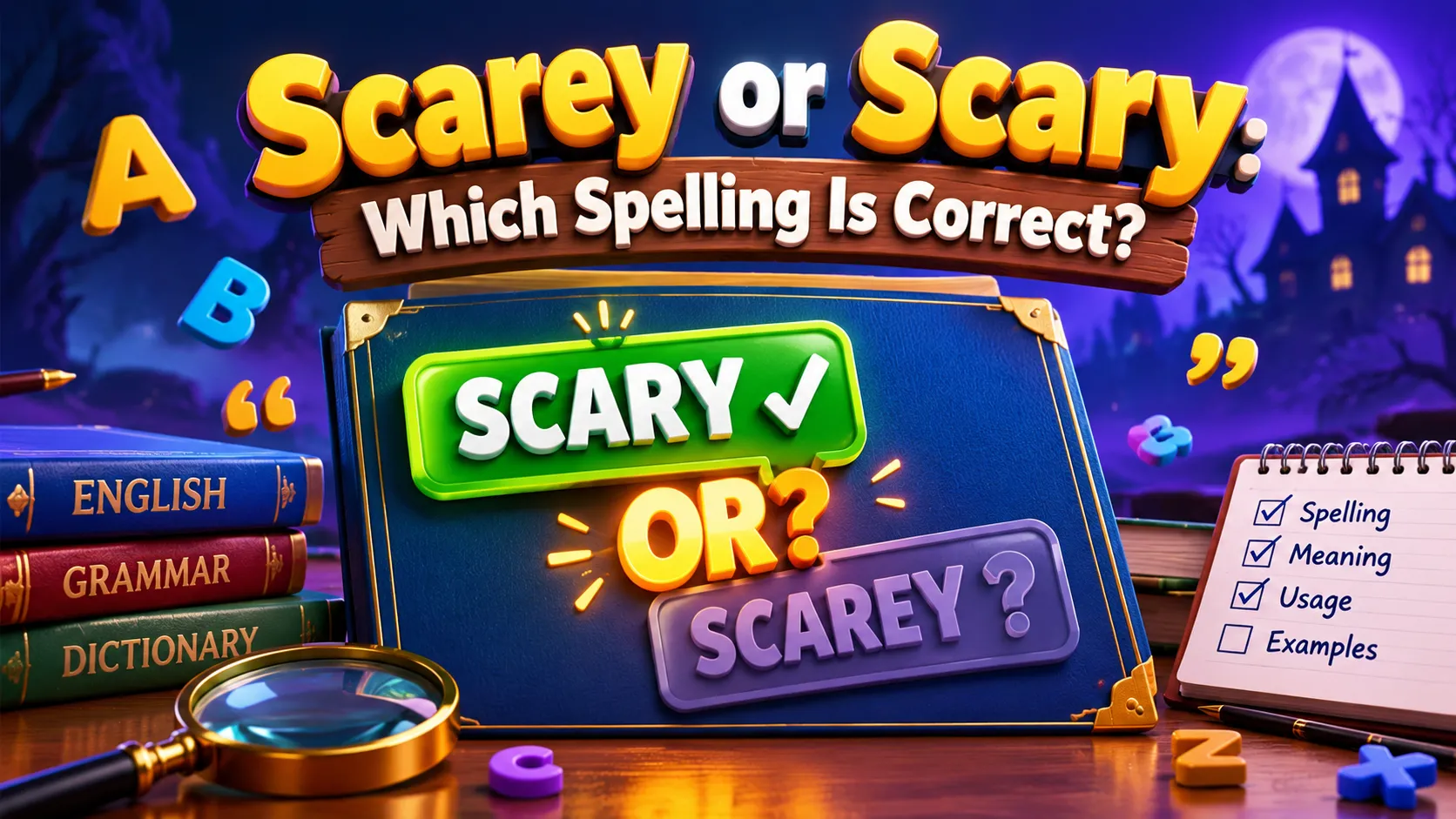
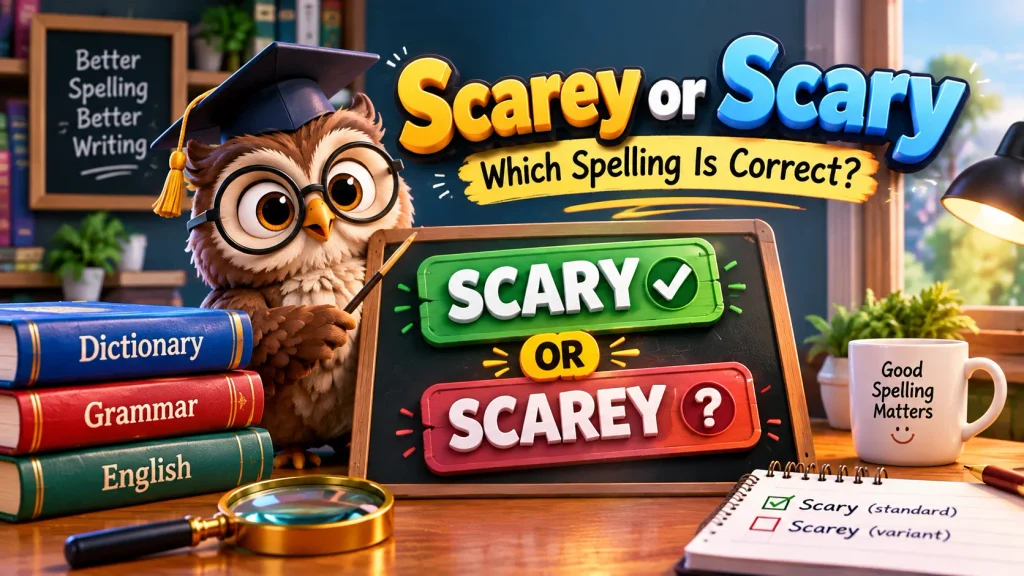
Scarey or scary? If you have ever wondered which spelling to use, you are not alone. The two forms look almost identical and are pronounced similarly, but they do not have the same status in modern English.
Scary is the standard and much more common spelling. It is an adjective meaning frightening or causing fear. Cambridge lists scarey as a UK variant, while Collins also records scarey as a variant spelling of scary.
So, the most useful rule is:
Use “scary” in normal modern writing. “Scarey” is a recognized but uncommon variant.
That distinction is more accurate than simply saying that scarey is always wrong.
Quick Answer: Scarey or Scary?
Scary is the standard spelling you should normally use.
Scarey is a documented variant, especially associated with British English, but it is much less common.
| Spelling | Status | Meaning | Recommended use |
| scary | Standard/common | Frightening; causing fear | Use normally |
| scarey | Recognized variant | Same basic meaning | Use only when the variant is specifically intended |
| scarry | Nonstandard spelling | — | Avoid |
| scareyer | Incorrect comparative spelling | — | Use scarier |
| scareiest | Incorrect superlative spelling | — | Use scariest |
For example:
- ✅ That was a scary movie.
- ✅ The storm looked scary.
- ⚠️ That was a scarey movie. — documented variant, but not the usual modern spelling
- ❌ That was a scarry movie.
Collins lists scary with the forms scarier and scariest, while its British-English entry also records scarey as a variant.
What Does “Scary” Mean?
Scary is an adjective that means frightening, alarming, or causing fear.
Cambridge defines scary as “frightening” and gives examples involving movies, stories, people, and frightening moments.
Examples
- The movie was scary.
- We heard a scary noise.
- That was a scary experience.
- The storm became scary very quickly.
- She told us a scary story.
- It was a scary moment for everyone.
The word is broader than horror. Something can be scary because it is dangerous, unexpected, uncertain, or threatening.
For example:
The car accident was scary.
The sudden noise was scary.
Losing my phone while traveling alone was scary.
Is “Scarey” a Real Word?
Yes, “scarey” is a documented English variant.
This is one of the most important points to understand about this spelling.
Cambridge gives scary as the main adjective and marks scarey as a UK variant. Collins explicitly defines scarey as “a variant spelling of scary.”
Therefore, it is too simplistic to say:
“Scarey is not a word.”
A more accurate explanation is:
Scarey is a recognized variant spelling, but scary is the normal modern form and the one most writers should choose.
This distinction matters because a word can be documented in dictionaries without being equally common or equally appropriate for every writing situation.
Quick rule
Dictionary-recognized does not necessarily mean preferred for ordinary contemporary writing.
For most readers, scary is the expected spelling.
Scary vs Scarey: What Is the Difference?
The primary difference is usage and spelling preference, not basic meaning.
Both forms refer to something that causes fear or alarm.
Scary
Scary is the standard modern form.
The haunted house looked scary.
That was a scary experience.
The movie was too scary for the children.
Scarey
Scarey is a less common variant.
The variant spelling scarey can be found in English sources.
For general contemporary writing, however, scary is the clearer choice.
The practical distinction
Think of it this way:
Scary = standard/common
Scarey = recognized variant/uncommon
That gives English learners a more precise answer than simply labeling one form “right” and the other “wrong.”
Is “Scarey” British English?
Scarey is particularly associated with British English, but scary is also standard British English.
Cambridge explicitly labels scarey as UK also scarey, while its main entry is scary.
Collins likewise gives a British English entry as:
scary or scarey
and identifies scarey as a variant spelling.
So it would be misleading to say:
American English = scary
British English = scarey
The reality is more nuanced:
| Variety | Common form | Variant |
| American English | scary | scarey is uncommon |
| British English | scary | scarey is recognized |
| International English | scary | scarey is less familiar |
If you are writing for an international audience, scary is the safest choice.
Why Do People Spell “Scary” as “Scarey”?
The confusion is understandable because scare is the base word.
A learner may naturally think:
scare + y = scarey
That looks logical at first glance.
But English spelling is not always created by simply attaching a suffix to the complete written form of a related word.
The established adjective is:
scary
not:
scarey
The pronunciation can make the confusion even easier because the two spellings do not provide a useful pronunciation distinction for most speakers.
Compare the word family
| Word | Part of speech | Example |
| scare | Verb/noun | The noise may scare me. |
| scared | Adjective | I was scared. |
| scary | Adjective | The noise was scary. |
| scarier | Comparative adjective | This movie is scarier. |
| scariest | Superlative adjective | That was the scariest scene. |
Learning the entire word family is more useful than trying to construct scary from scare every time.
Why Is “Scary” Spelled Without the E?
The standard spelling is simply scary.
A useful way to remember it is:
SCAR + Y = SCARY
Do not preserve the final e from scare when writing the standard adjective.
Remember:
❌ scarey
✅ scary
The spelling may seem unusual if you are thinking mechanically about scare + y, but scary is the established form.
Collins traces scary to scare + -y, while its current dictionary entry gives the standard spelling as scary.
Is “Scary” an Adjective?
Yes. Scary is an adjective.
It describes a person, object, event, place, situation, experience, or other noun.
Before a noun
Scary movie
A scary story
Scary experience
A scary situation
Scary noise
After a linking verb
The movie was scary.
The house looked scary.
The situation became scary.
The storm seemed scary.
In each sentence, scary tells us what something is like.
Scare vs Scary vs Scared
One of the most important related distinctions is:
Scary = causes fear
Scared = experiences fear
Scare
Scare can be a verb or a noun.
As a verb:
The loud noise scared me.
As a noun:
The unexpected noise gave me a scare.
Scary
Scary describes something that causes fear.
The loud noise was scary.
Scared
Scared describes someone who feels frightened.
I was scared by the loud noise.
Compare these sentences
The dog is scary.
The dog appears frightening.
The child is scared.
The child feels fear.
This distinction is extremely useful for English learners.
Scary vs Frightening
Scary and frightening are close synonyms.
Both can describe something that causes fear.
The movie was scary.
The movie was frightening.
The main difference is style and frequency. Scary is very common in everyday English, while frightening can sound somewhat more formal.
Cambridge lists frightening as the core meaning of scary.
Use “scary” for everyday conversation
That was a scary experience.
Use “frightening” when a more formal tone fits
The report described a frightening situation.
Both are grammatically correct.
Scary vs Terrifying
Both words describe fear, but terrifying generally expresses a stronger degree.
The movie was scary.
The experience was terrifying.
The second sentence normally communicates a more intense level of fear.
Other related words include:
- frightening
- alarming
- terrifying
- horrifying
- chilling
- eerie
- unsettling
The exact choice depends on the context and intensity you want to express.
Scary vs Creepy
Creepy and scary overlap, but they are not identical.
Creepy often describes something strange, disturbing, or unsettling that makes someone uncomfortable or frightened. Collins defines creepy in terms of causing nervousness or fear, while Cambridge includes the idea of something strange or unnatural that makes you feel frightened.
Compare:
The abandoned house was creepy.
This emphasizes an unsettling atmosphere.
The abandoned house was scary.
This directly emphasizes fear.
Something can be creepy without being immediately terrifying.
Scary vs Spooky
Spooky often has an eerie, ghostly, or supernatural association.
For example:
We visited a spooky old house.
The Halloween decorations looked spooky.
Collins describes spooky in terms of a frightening atmosphere and associations with ghosts.
Scary, however, is broader.
The car accident was scary.
The thunderstorm was scary.
The exam results were scary.
You would not normally use spooky for every situation that causes fear.
Scary vs Scared
This is one of the most common learner mistakes.
Scary
Something is scary when it causes fear.
The horror film was scary.
Scared
Someone is scared when they experience fear.
I was scared during the horror film.
Easy memory rule
The movie is scary.
I am scared.
Collins defines scared as frightened or nervous, which reinforces this distinction.
Explore More: https://wordminto.com/babies-or-babys/
Scary, Scarier, and Scariest
The standard forms are:
scary → scarier → scariest
1. Scary
Use the basic adjective when no comparison is being made.
The movie is scary.
2. Scarier
Use scarier when comparing two things.
The second movie is scarier than the first.
This storm is scarier than yesterday’s.
3. Scariest
Use scariest when describing the highest degree within a group.
That was the scariest scene.
It was the scariest night of my life.
Collins explicitly gives scarier and scariest as the comparative and superlative forms of scary.
Do not write:
- ❌ scareyer
- ❌ scariyer
- ❌ scareiest
- ❌ scarryer
- ❌ scarryest
Write:
- ✅ scary
- ✅ scarier
- ✅ scariest
Examples of “Scary” in Sentences
Very easy examples
- The movie was scary.
- That dog looks scary.
- The noise was scary.
- It was a scary story.
- The dark room looked scary.
Everyday English
- That was a really scary moment.
- The storm became scary at night.
- I heard a scary sound outside.
- Driving in that weather was scary.
- The abandoned building looked scary.
Academic English
- The experiment produced a scary result.
- The students described the experience as scary.
- The documentary presented a scary picture of the situation.
Business English
- The sudden decline in sales was scary for the company.
- The financial figures looked scary at first.
- The unexpected costs created a scary situation for the business.
Comparative examples
- This movie is scarier than the first one.
- The second storm was scarier than the first.
- That route is scarier at night.
Superlative examples
- That was the scariest movie I have ever seen.
- It was the scariest moment of the trip.
- That was the scariest part of the story.
Common Scary Spelling Mistakes
The following forms are commonly confused with the standard spelling.
| Nonstandard form | Standard form |
| scarey | scary |
| scarry | scary |
| scareyer | scarier |
| scariyer | scarier |
| scareiest | scariest |
| scarryest | scariest |
Remember that scarey requires a special qualification: it is documented as a variant spelling, so it should not be treated in exactly the same way as an invented misspelling such as scarryest.
Common Sentence Corrections
Example 1
❌ The movie was scarey.
✅ The movie was scary.
Why? Scary is the standard modern spelling.
Example 2
❌ It was a scarry experience.
✅ It was a scary experience.
Why? The standard spelling has one r before y.
Example 3
❌ This movie is scareyer than the first.
✅ This movie is scarier than the first.
Why? The comparative form is scarier.
Example 4
❌ That was the scareiest scene.
✅ That was the scariest scene.
Why? The superlative form is scariest.
Example 5
❌ I was scary during the storm.
✅ I was scared during the storm.
Why? A person who experiences fear is scared; something that causes fear is scary.
Is “Scarey” Acceptable in Formal Writing?
Although scarey is a documented variant, scary is normally the better choice for contemporary formal and general writing.
Use scary in:
- school assignments
- academic writing
- professional emails
- business documents
- websites
- blog articles
- educational materials
- applications
- general publications
A variant spelling can still be legitimate without being the most appropriate choice for every context.
Practical rule
If you are unsure, write “scary.”
That will be immediately familiar to readers across English varieties.
When Might “Scarey” Appear?
Because dictionaries recognize scarey as a variant, you may encounter it in:
- British English sources
- older texts
- quotations
- regional writing
- informal writing
- material that deliberately preserves a particular spelling
If you are reproducing an original quotation, for example, changing the spelling may alter the original wording.
But if you are creating your own contemporary sentence, scary is generally the natural choice.
How to Remember the Correct Spelling
Use this simple memory trick:
SCAR + Y = SCARY
Think of the standard spelling as:
SCARY
not:
SCAREY
Then remember the comparison pattern:
scary → scarier → scariest
And remember the meaning distinction:
Scary causes fear.
Scared feels fear.
These three patterns cover most common mistakes.
Quick Revision Box
Scarey or Scary?
Scary is the standard and much more common modern spelling.
Scarey is a documented variant, particularly associated with British English.
Scary = frightening or causing fear.
Scared = experiencing fear.
Comparative: scarier
Superlative: scariest
Scarey vs Scary: Comparison Table
| Feature | Scary | Scarey |
| Meaning | Frightening | Same basic meaning |
| Part of speech | Adjective | Variant adjective spelling |
| Standard modern form | Yes | No |
| Dictionary recognition | Yes | Yes |
| British English | Common | Recognized variant |
| American English | Standard | Uncommon |
| General writing | Recommended | Usually avoid |
| Comparative | scarier | Standard comparison is scarier |
| Superlative | scariest | Standard comparison is scariest |
Cambridge and Collins both support the important distinction between the standard form and the recognized variant.
Practice Exercise: Choose the Correct Word
Fill in each blank with scary, scared, scarier, or scariest.
- The horror movie was very ________.
- I was ________ when I heard the noise.
- This movie is ________ than the first one.
- That was the ________ moment of my life.
- The abandoned house looks ________ at night.
- She felt ________ during the storm.
- The second story was ________ than the first.
- That was the ________ scene in the film.
Answers
- scary
- scared
- scarier
- scariest
- scary
- scared
- scarier
- scariest
Multiple-Choice Questions
1. Which is the standard modern spelling?
A. Scarey
B. Scarry
C. Scary
D. Scarie
Answer: C. Scary
2. What does “scary” mean?
A. Funny
B. Frightening
C. Beautiful
D. Confusing
Answer: B. Frightening
3. Which sentence is correct?
A. I was scary during the storm.
B. The storm was scared.
C. The storm was scary.
D. The storm was scareyer.
Answer: C. The storm was scary.
4. What is the comparative form of “scary”?
A. Scareyer
B. Scariyer
C. Scarier
D. More scarey
Answer: C. Scarier
5. What is the superlative form?
A. Scareiest
B. Scariest
C. Scaryest
D. Most scarey
Answer: B. Scariest
6. Which word describes someone experiencing fear?
A. Scary
B. Scared
C. Scarier
D. Scare
Answer: B. Scared
Sentence Correction Practice
Correct the following sentences.
- The movie was scarey.
- That was the scareiest part.
- I was scary when the lights went out.
- This film is scareyer than the first.
- It was a scarry experience.
Correct Answers
- The movie was scary.
- That was the scariest part.
- I was scared when the lights went out.
- This film is scarier than the first.
- It was a scary experience.
People Also Ask
Scary is the standard and much more common spelling. Scarey is also documented as a variant, particularly in British English.
Yes. Scarey is a documented variant spelling of scary. Collins explicitly lists it as a variant, and Cambridge marks it as a UK variant.
It is recognized as a British English variant, but scary is also standard British English. British speakers do not need to use scarey.
Scary is used in both American and British English. It is not exclusively an American spelling. Collins provides entries for both varieties.
The spelling is easy to construct from the related word scare, leading people to assume that scare + y should be scarey. The established modern spelling, however, is scary.
The standard spelling is:
S-C-A-R-Y
No. The standard spelling is scary, with one r before the final y.
Conclusion
So, scarey or scary—which spelling should you use?
The practical answer is scary.
Scary is the standard, familiar modern spelling of the adjective meaning frightening or causing fear. Cambridge identifies scarey as a UK variant, and Collins likewise records it as a variant spelling, so calling scarey completely nonexistent would be inaccurate.
For everyday communication, schoolwork, professional writing, websites, and international audiences, choose:
SCARY
Remember the related forms:
scary → scarier → scariest
And keep this essential distinction in mind:
Scary = causes fear
Scared = feels fear
Once you understand that difference, the scarey vs scary confusion becomes much easier to avoid.









3 thoughts on “Scarey or Scary: Which Spelling Is Correct?”