PassedorPast—Which word should you use?
If you have ever hesitated over “walked past” vs. “walked passed,” “time has passed” vs. “time has past,” or “past due” vs. “passed due,” you are not alone. These two words sound alike in many varieties of English, but they have different meanings and grammatical functions.
The easiest rule is:
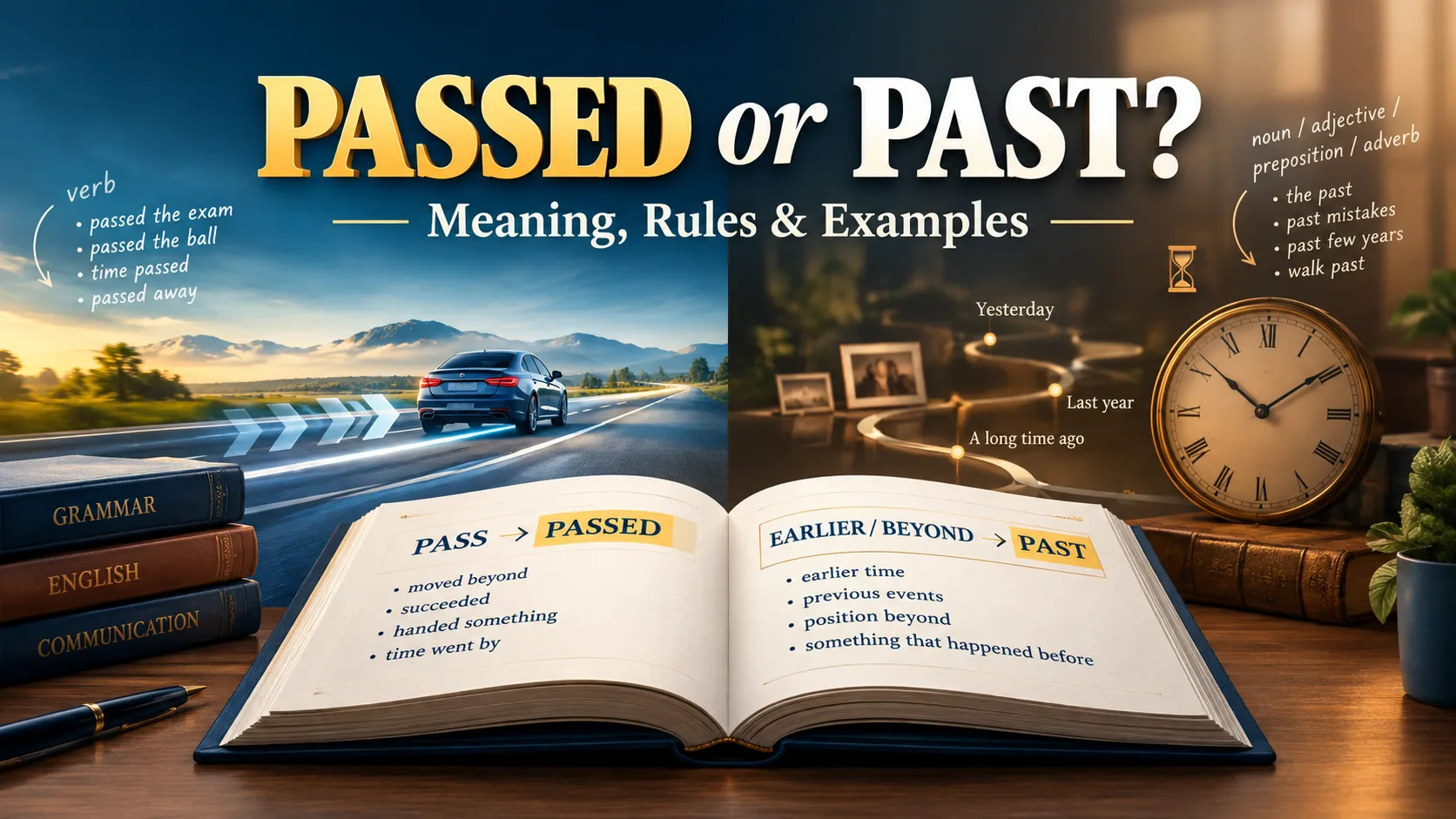
Passed is a form of the verb pass. Past usually refers to earlier time, something previous, or a position beyond a person or place.
Compare:
- She passed the exam. ✅
- We walked past the school. ✅
- Time has passed quickly. ✅
- The past few years have been challenging. ✅
The difference becomes much easier once you understand what grammatical job each word is doing.
PassedorPast: Quick Answer
PassedorPast
Passed is the simple past and past participle of the verb pass.
It can mean:
- moved beyond something
- succeeded in a test or exam
- handed something to someone
- went through or beyond a point
- allowed time to go by
- went away or ended in certain expressions
Examples:
- I passed my driving test.
- The car passed the truck.
- She passed me the phone.
- Several hours passed before he arrived.
Past is a separate word that can function as a noun, adjective, preposition, or adverb. It commonly refers to earlier time, previous events, or a position beyond something.
Examples:
- We learned from the past.
- He made several past mistakes.
- Walk past the bank.
- It is half past six.
The one-line rule
Use “passed” when you mean the past form of “pass.” Use “past” for earlier time, previous things, or position/direction beyond something.
PassedorPast: Main Difference
PassedorPast
| Passed | Past |
| Form of the verb pass | A separate word |
| Usually functions as a verb | Can be a noun, adjective, preposition, or adverb |
| Describes an action or event | Often describes time, position, or something previous |
| Can mean succeeded | Can mean earlier or previous |
| Can mean moved beyond something | Can mean beyond a place |
| Can mean handed something over | Can indicate time beyond an hour |
| She passed the exam. | We walked past the school. |
| Time has passed. | The past few years were difficult. |
A useful way to think about the difference is:
PASSED = PASS + ED
PAST = earlier time, previous, or beyond
However, this shortcut does not cover every grammatical use, so it is worth understanding the words more carefully.
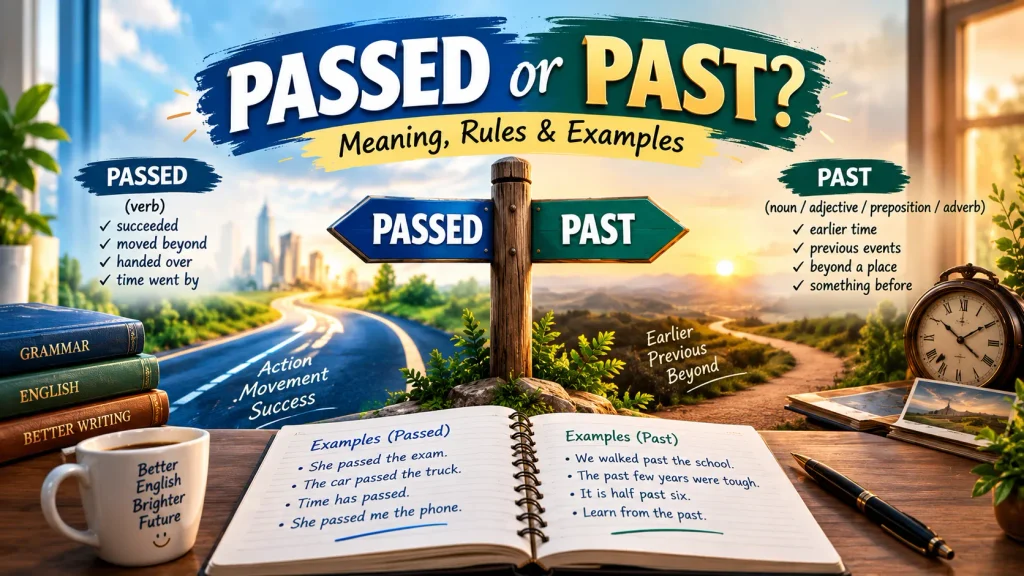
What Does “Passed” Mean?
Passed is the past form of pass.
The verb pass has several meanings, which means passed can appear in many different types of sentences.
Passed Means Moved Beyond Something
Use passed when pass describes movement beyond a person, object, place, or point.
Examples:
- The car passed the bus.
- We passed the old church.
- She passed me on the stairs.
- The train passed the station.
- The runner passed his opponent.
Here, passed is the main verb describing the action.
Compare
The car passed the house.
Here, passed itself expresses the movement.
But:
The car drove past the house.
Here, drove is the verb, while past describes the car’s position or direction.
That distinction explains one of the most common mistakes: “walked passed.”
Passed Means Succeeded
PassedorPast
Use passed when someone successfully completes a test, examination, driving test, or similar requirement.
Correct:
- I passed my English exam.
- She passed her driving test.
- He passed the final Examination.
- They passed the entrance test.
Incorrect:
- I past my English exam. ❌
- She past her driving test. ❌
Why?
Because the underlying verb is pass:
pass → passed
So:
I passed the exam.
I will pass the exam.
Passed Means Handed Something to Someone
PassedorPast
Pass can also mean to give or hand something to another person.
Examples:
- She passed me the salt.
- He passed the documents to his manager.
- Maria passed the phone to John.
- He passed the message to his colleague.
The present form is:
Please pass me the book.
The past form is:
She passed me the book.
Passed Can Describe Time Going By
We also use passed when time moves forward or elapses.
Examples:
- Two hours passed quickly.
- Several years passed before they met again.
- Time passed, but nothing changed.
- A month passed before we received an answer.
This creates a particularly common spelling mistake:
Time has passed. ✅
Not:
Time has past. ❌
Why?
Because passed is the past participle of the verb pass.
You can see the verb pattern clearly:
- Time passes quickly.
- Time passed quickly.
- Time has passed quickly.
- Time will pass quickly.
Passed in “Passed Away”
The standard expression is:
passed away ✅
Not:
past away ❌
Passed away is a verb phrase commonly used as a euphemistic way to say that someone died.
Examples:
- Her grandfather passed away last year.
- His father passed away peacefully.
- We were saddened to hear that she had passed away.
The underlying expression is:
pass away → passed away
What Does “Past” Mean?
Unlike Passed, past has several grammatical functions.
It can be a noun, adjective, preposition, or adverb.
Understanding these roles makes the difference between passed and past much clearer.
Past as a Noun
As a noun, past refers to a time or events that have already happened.
Examples:
- We cannot change the past.
- She does not like talking about her past.
- Learn from the past.
- He wants to leave his past behind.
- Our past can teach us valuable lessons.
Here, past is the thing being discussed.
Quick test
If you can think of past as “earlier time” or “things that happened before now,” it is likely functioning as a noun.
Past as an Adjective
Past can describe something that happened or existed before the present.
Examples:
- past experiences
- past mistakes
- past presidents
- past events
- the past year
- the past few months
- past generations
Example:
We can learn from our past mistakes.
Here, past describes the mistakes.
Past as a Preposition
Past can indicate movement or position beyond something.
Examples:
- Walk past the bank.
- Drive past the school.
- We ran past the stadium.
- The house is past the church.
- The store is just past the bridge.
It can also refer to a time beyond a particular point:
- It is past midnight.
- We arrived past noon.
- She stayed awake past her usual bedtime.
Past as an Adverb
Past can also function as an adverb, particularly when it indicates movement beyond a point.
Examples:
- The car drove past.
- She walked past without saying anything.
- He ran past quickly.
- The train went past.
PassedorPast for Movement?
PassedorPast
Movement is one of the most confusing areas because both words can appear in sentences about movement.
Compare:
She passed the school.
and:
She walked past the school.
Both describe movement, but their grammatical structures are different.
In “She passed the school”
Passed is the verb.
The sentence can be changed to:
She passes the school every morning.
or:
She will pass the school tomorrow.
In “She walked past the school”
Walked is already the verb.
Past tells us where she moved.
So:
walked + past + the school
Compare these sentences
| Sentence | Correct? | Why? |
| The car passed the house. | ✅ | Passed is the verb. |
| The car drove past the house. | ✅ | Drove is the verb; past shows direction. |
| We walked past the museum. | ✅ | Walked is the verb. |
| We walked passed the museum. | ❌ | Passed is incorrectly used as a preposition. |
| She passed me on the road. | ✅ | Passed is the verb. |
| She ran past me. | ✅ | Ran is the verb; past indicates movement beyond. |
Walked Past or Walked Passed?
PassedorPast
The correct expression is:
walked past ✅
Not:
walked passed ❌
For example:
I walked past the restaurant.
The structure is:
walked + past + the restaurant
Because walked is already the verb, you do not need passed.
You can also say:
I passed the restaurant.
This is also correct.
So:
- I walked past the restaurant. ✅
- I passed the restaurant. ✅
- I walked past the restaurant. ❌
The same pattern works with other movement verbs:
- drove past
- ran past
- rode past
- flew past
- cycled past
- moved past
Examples:
We drove past the museum.
She ran past me.
The cyclist rode past the entrance.
The plane flew past the mountain.
Time Has Passed or Time Has Past?
The correct expression is:
Time has passed. ✅
Not:
Time has past. ❌
Here, passed is the past participle of pass.
Examples:
- Time has passed quickly.
- Several months have passed.
- A long time has passed since we met.
- As time passed, things became easier.
Look at the verb forms:
| Tense/Form | Example |
| Present | Time passes quickly. |
| Past | Time passed quickly. |
| Present perfect | Time has passed quickly. |
| Future | Time will pass quickly. |
The word remains part of the verb pass.
Therefore:
Time has passed. ✅
Past Due or Passed Due?
The standard expression is:
past due ✅
Examples:
- Your payment is past due.
- The invoice is past due.
- The account is now past due.
- This bill is past due.
Here, past means that the expected or required time has already been exceeded.
Compare
The payment is past due. ✅
versus:
The deadline has passed. ✅
These sentences are related, but their grammatical structures differ.
Past due describes something that is overdue.
Passed is the verb in the deadline has passed.
Passed Away or Past Away?
The correct expression is:
passed away ✅
Not:
past away ❌
Examples:
- Her grandfather passed away last year.
- His father passed away peacefully.
- We were sorry to hear that she had passed away.
Think of the expression as:
pass away → passed away
Because pass is the verb, its past form is passed.
Passed the Deadline or Past the Deadline?
PassedorPast
Both passed and past can be correct, but they do different jobs.
Passed
Passed is the verb form of pass.
For example:
The deadline has passed.
Here, passed means that the deadline has gone by.
Past
Past can indicate that something is beyond a particular time.
For example:
We are already past the deadline.
Or:
The application is past the deadline.
A particularly useful comparison is:
The deadline has passed.
versus:
We are past the deadline.
The first uses passed as a verb.
The second uses past to describe a position in relation to the deadline.
The Past Few Years or the Passed Few Years?
The correct phrase is:
the past few years ✅
Not:
the passed few years ❌
Examples:
- The past few years have been difficult.
- Technology has changed rapidly over the past few years.
- I have learned a lot over the past few months.
- Sales have increased during the past year.
Here, past means the period immediately before now.
Passed vs. Past: Common Mistakes
Mistake 1: “I past the exam.”
❌ Incorrect:
I past the exam.
✅ Correct:
I passed the exam.
Why?
Because passed is the past tense form of the verb pass.
Mistake 2: “We walked passed the house.”
❌ Incorrect:
We walked passed the house.
✅ Correct:
We walked past the house.
Why?
Walked is already the verb. Past indicates movement beyond the house.
Mistake 3: “Time has past.”
❌ Incorrect:
Time has past.
✅ Correct:
Time has passed.
Why?
The sentence needs the past participle of pass.
Mistake 4: “Past away”
❌ Incorrect:
He past away last year.
✅ Correct:
He passed away last year.
Why?
The expression is based on the verb phrase pass away.
Mistake 5: “Passed few years”
❌ Incorrect:
The passed few years have been difficult.
✅ Correct:
The past few years have been difficult.
Why?
Here, past refers to the previous period of time.
Mistake 6: “Drove passed the store”
❌ Incorrect:
We drove passed the store.
✅ Correct:
We drove past the store.
Why?
Drove is the verb. Past indicates direction.
The Future-Tense Trick for PassedorPast
One of the most useful ways to distinguish these words is to change the sentence into the future.
Consider:
I passed the store.
Change it to:
I will pass the store.
The word changes from passed to pass because it is a verb.
Now consider:
I walked past the store.
Change it to:
I will walk past the store.
Past stays the same.
That gives you a useful test:
If “passed” can become “pass” when you change the sentence to the present or future, you are dealing with the verb pass.
Example
She passed the test.
Future:
She will pass the test.
Therefore:
passed is the verb.
Compare:
She walked past the test center.
Future:
She will walk past the test center.
Past does not change.
A Simple Memory Trick
Remember:
PASSED = PASS + ED
If you can replace the word with pass, passes, or passing, you probably need passed in the past-tense sentence.
For example:
I passed the test.
Present:
I pass the test.
Future:
I will pass the test.
But:
I walked past the school.
You would not say:
I walked pass the school. ❌
So past is correct.
Quick memory rule
PASSED = an action related to PASS
PAST = earlier time, previous, or beyond
This is a practical shortcut rather than a complete description of every possible grammatical use.
PassedorPast: 30 Example Sentences
Examples with “Passed”
- She passed her driving test.
- He passed the final exam.
- The car passed the truck.
- We passed the old church.
- Time passed quickly.
- Several weeks passed before he replied.
- She passed me the phone.
- He passed the message to his colleague.
- The bill passed yesterday.
- The storm eventually passed.
- The train passed through the tunnel.
- She passed away peacefully.
- The runner passed his competitor.
- A year passed before they met again.
- The feeling soon passed.
Examples with “Past”
- We walked past the school.
- He drove past my house.
- She ran past me.
- The store is past the bank.
- We arrived past midnight.
- It is half past seven.
- Learn from the past.
- He regrets his past mistakes.
- The past few months were difficult.
- She has changed over the past year.
- The worst is past.
- Don’t dwell on the past.
- We talked about his past.
- The car drove past without stopping.
- He walked past the entrance.
PassedorPast: Comparison Table
| Sentence | Correct Word | Reason |
| She ___ the exam. | passed | Verb: succeeded |
| We walked ___ the house. | past | Direction/location |
| Time has ___. | passed | Verb: time went by |
| The ___ few years were difficult. | past | Previous time |
| He ___ away last year. | passed | Verb phrase |
| It is ___ midnight. | past | Beyond a time |
| She ___ me the book. | passed | Verb: handed |
| Don’t dwell on the ___. | past | Noun: earlier time |
| The car ___ us. | passed | Verb: moved beyond |
| The car drove ___ us. | past | Direction/location |
| The deadline has ___. | passed | Verb: gone by |
| We are ___ the deadline. | past | Beyond the deadline |
| He ___ the ball. | passed | Verb: transferred |
| The ball rolled ___ me. | past | Movement beyond |
| Your bill is ___ due. | past | Beyond the due date |
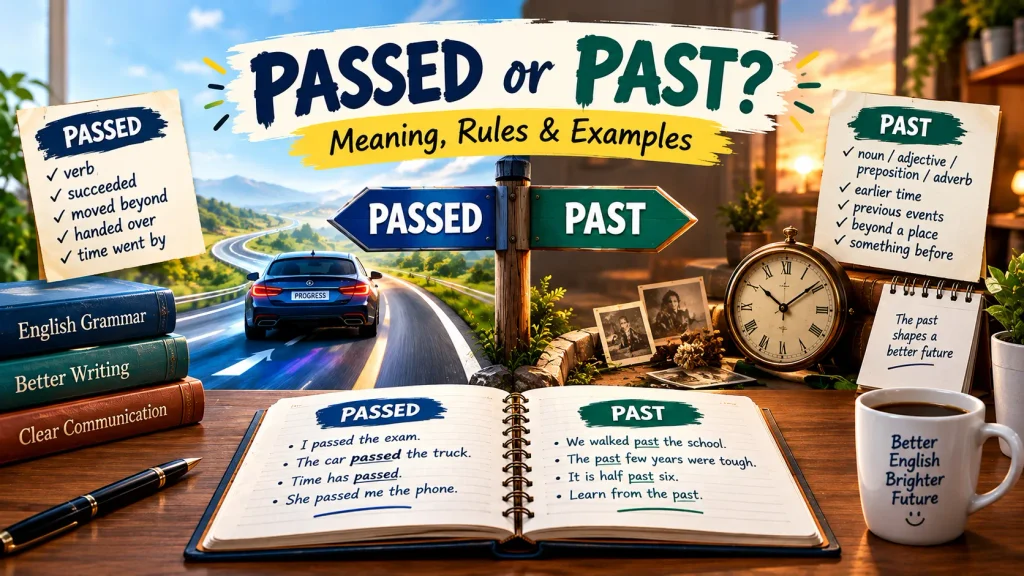
Is “Past” Ever a Verb?
This is an important point because quick explanations sometimes oversimplify the distinction.
When you are choosing between passed and past as the past form of pass, the standard verb form is:
pass → passed → passing
For example:
Pass the store every morning.
I passed the store yesterday.
I am passing the store now.
Therefore, if your sentence needs the past-tense form of pass, use passed, not past.
PassedorPast Pronunciation
Another reason these words cause spelling mistakes is pronunciation.
In wide standard varieties of English, passed and past are pronounced alike. They are commonly treated as homophones—words that sound the same but have different spellings and meanings.
That means listening alone may not help you decide which spelling to use.
For example:
I passed the house.
and:
I walked past the house.
Because the words sound alike, you need to examine the meaning and grammatical role of the word.
Ask yourself:
Is this the verb “pass”?
If yes, the spelling is usually passed.
PassedorPast: A 10-Second Decision Test
When you’re unsure, use these five steps.
Step 1: Look for the verb “pass”
Ask:
Is this word the past form of pass?
If yes, use:
Passed
Example:
She passed the exam.
Step 2: Look for earlier time
Does the word refer to something that happened before now?
Use:
Past
Example:
We learned from the past.
Step 3: Look for position or direction
Does it mean beyond a person, place, or point?
Use:
Past
Example:
Walk past the library.
Step 4: Try the future test
Change the sentence to the future.
She passed the test.
becomes:
She will pass the test.
That confirms that “passed ” is a form of the verb.
Compare:
I walked past the store.
becomes:
I will walk past the store.
Past remains unchanged.
Step 5: Check familiar expressions
Some combinations are especially useful to memorize:
- past due
- past few years
- past midnight
- passed away
- time has passed
- passed the exam
- walked past
- drove past
- deadline has passed
PassedorPast in Everyday English
Understanding these words is particularly useful in everyday conversations.
Talking about exams
I passed my exam.
Talking about previous experience
My past experience helped me.
Talking about movement
We walked past the store.
Talking about an action
The bus passed us.
Talking about time
Three hours passed quickly.
Talking about a previous period
The past few weeks have been busy.
Talking about a deadline
The deadline has passed.
Talking about being beyond a deadline
We are past the deadline.
PassedorPast in Academic and Business English
The distinction also matters in professional and academic writing.
Academic English
The researchers passed the required assessment.
The study examines changes over the past decade.
The deadline has passed.
Business English
The payment is past due.
The invoice deadline has passed.
Please walk past reception and turn left.
Using the wrong spelling can make otherwise polished writing look careless, particularly when writing emails, reports, applications, or academic assignments.
PassedorPast: Tricky Sentence Pairs
Pair 1
The car passed the school.
The car drove past the school.
Why?
In the first sentence, passed is the verb.
In the second, drove is the verb, and past indicates direction.
Pair 2
Time has passed.
The past few days have been busy.
Why?
Passed is the verb in the first sentence.
Past describes the previous period in the second.
Pair 3
The deadline has passed.
The application is past the deadline.
Why?
The first sentence describes the deadline as having gone by.
The second describes something as being beyond the deadline.
Pair 4
She passed the exam.
She walked past the exam room.
Why?
She passed the exam = she succeeded.
She walked past the exam room = she moved beyond the room.
Pair 5
He passed me on the road.
He drove past me on the road.
Both can be correct.
In the first sentence, passed is the verb.
In the second, drove is the verb, and past indicates movement beyond the speaker.
Explore More: https://wordminto.com/licence-or-license/
Practice Quiz: PassedorPast?
Choose passed or past to complete each sentence.
1. She ___ her driving test.
2. We walked ___ the library.
3. Time has ___ quickly.
4. He learned from his ___ mistakes.
5. The train ___ the station.
6. It is ___ midnight.
7. Her grandfather ___ away last year.
8. The ___ few weeks have been busy.
9. The car drove ___ our house.
10. She ___ the message to me.
Answers
- passed
- past
- passed
- past
- passed
- past
- passed
- past
- past
- passed
Score yourself
- 10/10: Excellent—you have mastered the basic distinction.
- 8–9/10: Very good; review the movement examples.
- 6–7/10: You understand the basics but need more practice.
- Below 6: Review the verb-versus-direction rule and try the quiz again.
More Practice: Correct the Mistakes
Correct the incorrect word in each sentence.
1. I past my English test.
Correct: I passed my English test.
2. We walked past the supermarket.
Correct: We walked past the supermarket.
3. Time has past so quickly.
Correct: Time has passed so quickly.
4. He past away last year.
Correct: He passed away last year.
5. The passed few months have been difficult.
Correct: The past few months have been difficult.
6. We drove passed the hotel.
Correct: We drove past the hotel.
7. The deadline has past.
Correct: The deadline has passed.
8. The payment is passed due.
Correct: The payment is past due.
People Also Ask
Both passed and past are correct English words, but they have different grammatical functions. Passed is a form of the verb pass, while past commonly refers to earlier time, something previous, or a position beyond something.
The correct expression is walked past.
We walked past the store.
Walked is already the verb, so past indicates the direction or position.
The correct expression is time passed when passed is being used as the verb.
Time has passed.
Both can be correct depending on the sentence.
We walked past the house.
We passed the house.
In the first sentence, walked is the verb, and past indicates direction. In the second, passed is the verb.
The correct expression is:
passed away ✅
Example:
Her uncle passed away last year.
The standard expression meaning overdue is:
past due ✅
Example:
The payment is past due.
Quick Revision Box
PASSED
Passed is a form of the verb pass.
- passed the exam
- passed the car
- passed the ball
- time passed
- passed away
PAST
Past commonly refers to earlier time, something previous, or a position beyond something.
- the past
- past mistakes
- past few years
- walk past the house
- past midnight
- past due
The fastest question to ask
“Is this the verb PASS?”
Yes → PASSED
If not, check whether the word refers to an earlier time, something previous, or a position beyond something.
Then → PAST is often correct.
Final Rule: Passed or Past?
The easiest rule to remember is:
Use “passed” when you need the past form of the verb “pass.” Use “past” when you’re talking about earlier time, something previous, or a position beyond something.
Compare these examples:
- She passed the exam.
- We walked past the school.
- Time has passed.
- The past few years were difficult.
- He passed the ball.
- The ball rolled past me.
- She passed away.
- It is past midnight.
- The deadline has passed.
- The payment is past due.
The words may sound identical, but their meanings and grammatical roles are different.
When you’re uncertain, ask:
“Is this the verb pass?”
If it is, use passed.
If you’re describing an earlier time, a previous period, or a position beyond something, use past.
Once you recognize the role each word plays in a sentence, choosing between passed or past becomes much easier.