
Slew vs Slough can be confusing because these words have different meanings and pronunciations, and slough has more than one meaning and pronunciation. Slew usually means a large number of people or things, or it can describe a sudden turning movement. Slough can mean to shed dead skin, peel away, abandon something, or refer to a muddy or marshy area.
Understanding the difference helps you choose the correct word in writing, reading, and everyday communication.
Slew vs Slough: Quick Difference
| Feature | Slew | Slough |
| Part of speech | Noun; also a verb | Noun; also a verb |
| Main meaning | A large number; a sudden turn | To shed or peel off; a muddy area |
| Common usage | A slew of ideas, problems, or opportunities | Slough off dead skin; a slough of mud |
| Pronunciation | Usually “sloo” | “sluff” or “sloo,” depending on meaning and dialect |
| Example | We received a slew of applications. | Snakes slough off their skin. |
| Common context | Informal writing, news, and conversation | Biology, medicine, nature, and figurative language |
Quick rule: Use slew when you mean “a large number” or a sudden movement. Use slough when you mean shedding, peeling away, discarding something, or a muddy or marshy place.
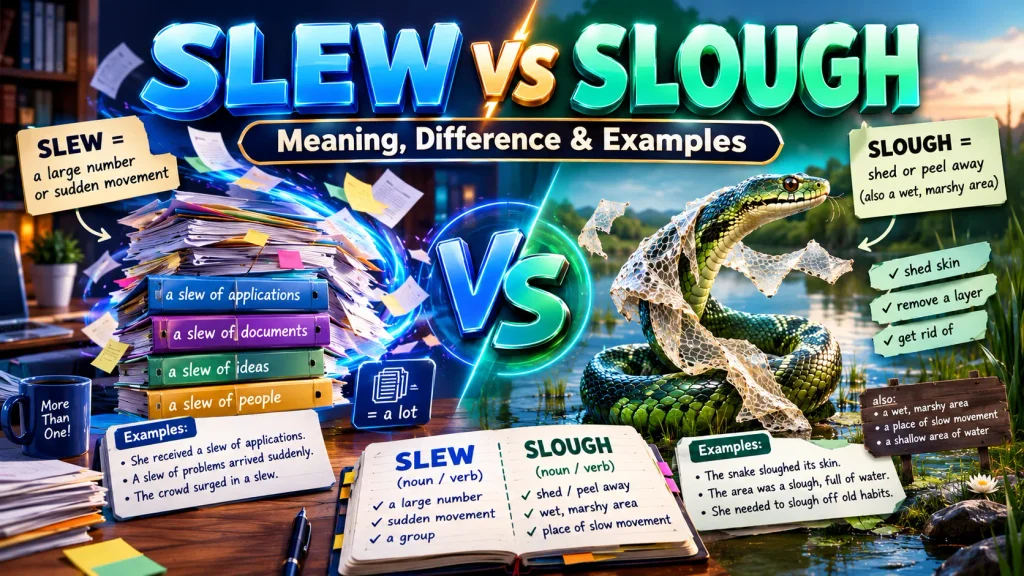
What Does Slew Mean?
Slew is a noun or verb with several meanings. In everyday English, people most often use it to describe a large number of things. It can also mean to turn or slide suddenly, and it serves as the past tense of slay.
1. Slew as a noun: A large number
When slew acts as a noun, it means a large number or quantity of people or things. It often appears in the expression a slew of.
Examples:
- The company received a slew of job applications.
- She has a slew of ideas for the new project.
- The storm caused a slew of problems across the region.
- We watched a slew of documentaries over the weekend.
- The website published a slew of new grammar articles.
In these sentences, slew means “many,” “a lot of,” or “a large number of.”
2. Slew as a verb: To turn or move suddenly
As a verb, slew can describe a sudden or awkward turn, particularly when a vehicle slides or changes direction.
English meaning – Cambridge Dictionary+1
Examples:
- The car slewed across the icy road.
- The driver slewed the vehicle to avoid an obstacle.
- The truck slewed sideways on the wet pavement.
- The aircraft slewed around before landing.
Here, slew describes movement rather than quantity.
3. Slew as the past tense of slay
Slew is also the simple past tense of slay, which means to kill, especially in literary, historical, or fictional contexts.
Examples:
- The knight slew the dragon.
- According to the legend, the hero slew the monster.
- The warrior slew his enemy in battle.
The verb forms are:
| Verb form | Word |
| Base form | Slay |
| Simple past | Slew |
| Past participle | Slain |
Example: The hero slew the dragon and had slain another creature earlier in the story.
Remember that this meaning differs from slew in “a slew of books.”
Explore More: https://wordminto.com/may-vs-can-in-formal-requests/
What Does Slough Mean?
Slough can function as a noun or a verb. Its meaning depends on the context and, in some cases, its pronunciation. As a verb, it commonly means to shed or peel away dead skin or unwanted material. As a noun, it can refer to a muddy or marshy place. It can also appear in figurative expressions.
1. Slough as a verb: To shed or peel off
The verb slough commonly means to shed dead skin, tissue, or an outer layer. People also use it figuratively to mean getting rid of something unwanted.
Examples:
- Snakes slough off their old skin.
- The damaged tissue began to slough away.
- The tree sloughed off its loose bark.
- She tried to slough off her old habits.
- The organization needs to slough off unnecessary procedures.
In these examples, slough means “shed,” “peel away,” or “get rid of.”
2. Slough as a noun: A muddy or marshy area
As a noun, slough can describe a wet, muddy, or marshy area, often with stagnant water.
Examples:
- The hikers carefully crossed the slough.
- Birds gathered near the marshy slough.
- The path became difficult to cross after the rain.
- The wetland supports many species of wildlife.
In this sense, slough refers to a type of landscape, not a large number of things.
3. Slough in figurative expressions
Writers sometimes use slough to describe a difficult state, burden, or condition that someone struggles to escape.
Examples:
- The team struggled to escape a slough of despair.
- He worked hard to climb out of a slough of debt.
- The company finally emerged from a slough of uncertainty.
These expressions use slough figuratively to suggest a difficult or unpleasant situation.
4. Slough off: A common phrasal verb
Slough off means to shed, discard, or get rid of something, either literally or figuratively.
Examples:
- Some reptiles slough off their skin as they grow.
- She tried to slough off the stress of the workday.
- The company decided to slough off its unprofitable operations.
- He could not easily slough off the criticism.
The particle off emphasizes the idea of removing or getting rid of something.
Explore More: https://wordminto.com/shall-vs-will-in-legal-english/
Slew vs Slough: Pronunciation Differences
These words can cause confusion because slew and some forms of slough may sound alike.
| Word and meaning | Pronunciation | Sound guide |
| Slew (a large number) | /sluː/ | SLOO |
| Slew (past tense of slay) | /sluː/ | SLOO |
| Slough (to shed or peel) | /slʌf/ | SLUFF |
| Slough (a marshy area) | /slaʊ/ or /sluː/ in some US usage | SLOW, rhyming with “cow,” or SLOO |
Cambridge lists slough as /slʌf/ for the verb and /slaʊ/ for the noun, while American usage also includes /sluː/ for the noun.
Pronunciation in English+1
Pronunciation tip: If you hear “sluff,” the speaker probably means shedding or peeling. If you hear “sloo,” the speaker may mean slew or a marsh-related meaning of slough. Context determines the intended word.
Explore More: https://wordminto.com/sleight-vs-slight/
Slew vs Slough: Main Differences in Grammar
Although these words sometimes sound alike, their meanings and grammatical uses differ.
| Feature | Slew | Slough |
| Meaning: quantity | A large number or amount | Not the usual meaning |
| Meaning: shedding | No | To shed or peel away |
| Meaning: landscape | Rarely, a variant spelling for a marsh in some usage | A muddy or marshy area |
| Meaning: movement | To turn or slide suddenly | Not the usual meaning |
| Past tense of slay | Yes | No |
| Common expression | A slew of problems | Slough off old habits |
| Example | We faced a slew of challenges. | The snake sloughed off its skin. |
Explore More: https://wordminto.com/incite-vs-insight/
When Should You Use Slew or Slough?
Choose the word according to the meaning you want to communicate.
Use slew when:
- You describe a large number of people, objects, or events.
- You describe a vehicle or object turning or sliding suddenly.
- You use the past tense of slay.
Examples:
- The school received a slew of applications.
- The car slewed across the road.
- The knight slew the dragon.
Use slough when:
- You describe shedding or peeling dead skin or tissue.
- You mean getting rid of an unwanted habit or burden.
- You refer to a muddy or marshy area.
- You use expressions such as slough off or a slough of despair.
Examples:
- Snakes slough their skin.
- She wanted to slough off her bad habits.
- The birds nested near the slough.
Explore More: https://wordminto.com/climactic-vs-climatic/
Common Mistakes with Slew and Slough
Writers sometimes confuse these words because their spelling and pronunciation overlap in certain dialects. The following examples show how to avoid common errors.
| Incorrect or less suitable | Correct or clearer alternative | Explanation |
| We received a slough of complaints. | We received a slew of complaints. | Use slew for a large number. |
| The snake slew its skin. | The snake sloughed off its skin. | Use slough for shedding skin. |
| The knight sloughed the dragon. | The knight slew the dragon. | Slew is the past tense of slay. |
| She wanted to slew off her bad habits. | She wanted to slough off her bad habits. | Slough off means to discard something unwanted. |
| The car sloughed across the road. | The car slewed across the road. | Slew describes a sudden sideways movement. |
Important exception: Slough can appear in expressions such as “a slough of despair,” where it suggests a difficult or unpleasant state. However, for the ordinary meaning “a large number,” use slew of.
Explore More: https://wordminto.com/regimen-vs-regime/
Slew vs Slough in Sentences
Compare these sentence pairs to understand how context changes the word choice.
1. Quantity vs shedding
Slew: The editor received a slew of article submissions.
Slough: The snake began to slough off its old skin.
2. Sudden movement vs a wetland
Slew: The vehicle slewed sideways on the slippery road.
Slough: Several birds rested in the nearby slough.
3. Past tense vs figurative removal
Slew: The hero slew the creature in the final battle.
Slough: She worked to slough off her fear of public speaking.
Tips to Remember the Difference
- Slew = a lot: Think of the phrase “a slew of ideas.”
- Slough = shed: Think of a snake shedding its skin.
- Slew = slay: Remember that slew is the past tense of slay.
- Slough off = get rid of: Use this phrase for unwanted habits, feelings, or material.
- Slough = wetland: Remember that the noun can describe a muddy or marshy place.
These memory tricks work best when you connect each word with a familiar example.
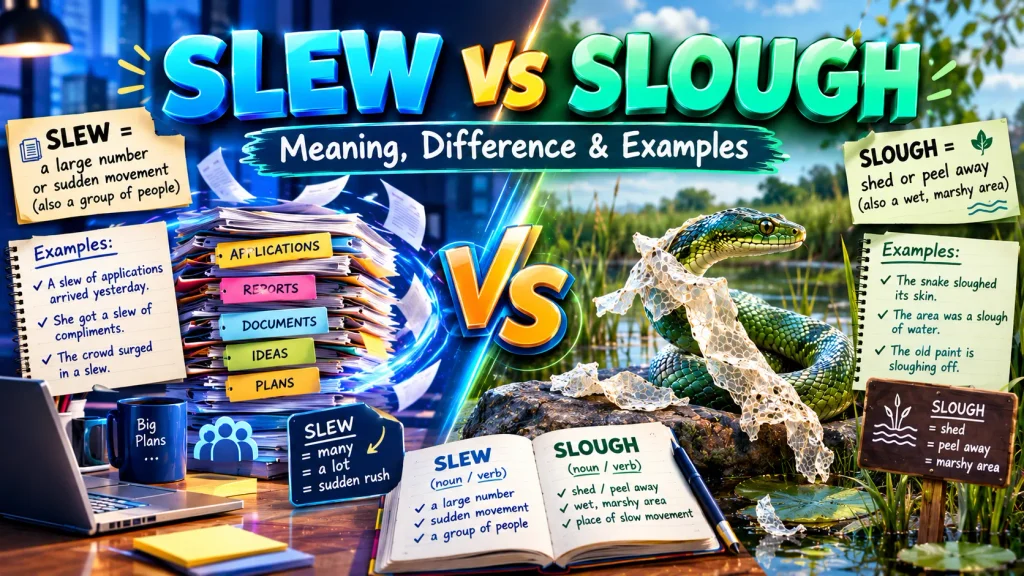
Quick Revision: Slew vs Slough
| Word | Remember this meaning | Example |
| Slew | A large number | A slew of ideas |
| Slew | Turned suddenly | The car slewed sideways |
| Slew | Past tense of slay | The hero slew the dragon |
| Slough | Shed or peel away | Snakes slough off skin |
| Slough | Muddy or marshy area | Birds crossed the slough |
| Slough off | Discard or get rid of | Slough off old habits |
Practice Exercises: Slew vs Slough
Choose the correct word or word form to complete each sentence.
- The company received a _____ of applications after announcing the job. (slew / slough)
- Snakes periodically _____ off their old skin. (slew / slough)
- The car _____ sideways when the driver applied the brakes. (slewed / sloughed)
- The knight _____ the dragon in the ancient legend. (slew / slough)
- She tried to _____ off her negative thoughts. (slew / slough)
- Many birds gathered around the marshy _____. (slew / slough)
- The new policy created a _____ of questions. (slew / slough)
- The damaged outer layer began to _____ away. (slew / slough)
- The vehicle _____ around on the icy road. (slewed / sloughed)
- The hero had _____ the monster before sunrise. (slain / sloughed)
Answers with explanations
- Slew — It means a large number of applications.
- Slough — The verb means to shed old skin.
- Slewed — It describes a sudden sideways movement.
- Slew — It is the simple past tense of slay.
- Slough — The phrase slough off means to get rid of something.
- Slough — The noun refers to a marshy area.
- Slew — It means a large number of questions.
- Slough — It means to peel or shed a layer.
- Slewed — It describes the vehicle’s sudden movement.
- Slain — It is the past participle of slay, used with had.
People Also Ask
Slew commonly means a large number, a sudden turn, or the past tense of slay. Slough commonly means to shed or peel away something, or a muddy or marshy area.
Use a slew of when you mean a large number or amount.
Example: The report identified a slew of problems.
Slough of has separate uses, particularly in figurative expressions such as “a slough of despair,” but it is not the standard spelling for the ordinary expression meaning “a lot of.”
Sometimes. Slew is pronounced /sluː/. Slough, when used as a verb meaning “shed,” is pronounced /slʌf/. The noun meaning a marsh can have different pronunciations depending on the dialect.
Yes. The principal forms are slay, slew, and slain.
Example: The warrior slew the enemy.
Slough off means to shed, discard, or get rid of something.
Example: He tried to slough off his old habits.
Conclusion
The difference between Slew vs Slough comes down to meaning and context. Use Slew for a large number of things, a sudden turning movement, or the past tense of slay. Use Slough when referring to shedding skin or tissue, discarding something unwanted, or describing a muddy or marshy place.
Remember the simple distinction: a Slew of problems, but Slough off old habits. This rule will help you choose the right word in most everyday writing situations.











3 thoughts on “Slew vs Slough: Meaning, Difference, Rules, and Examples”