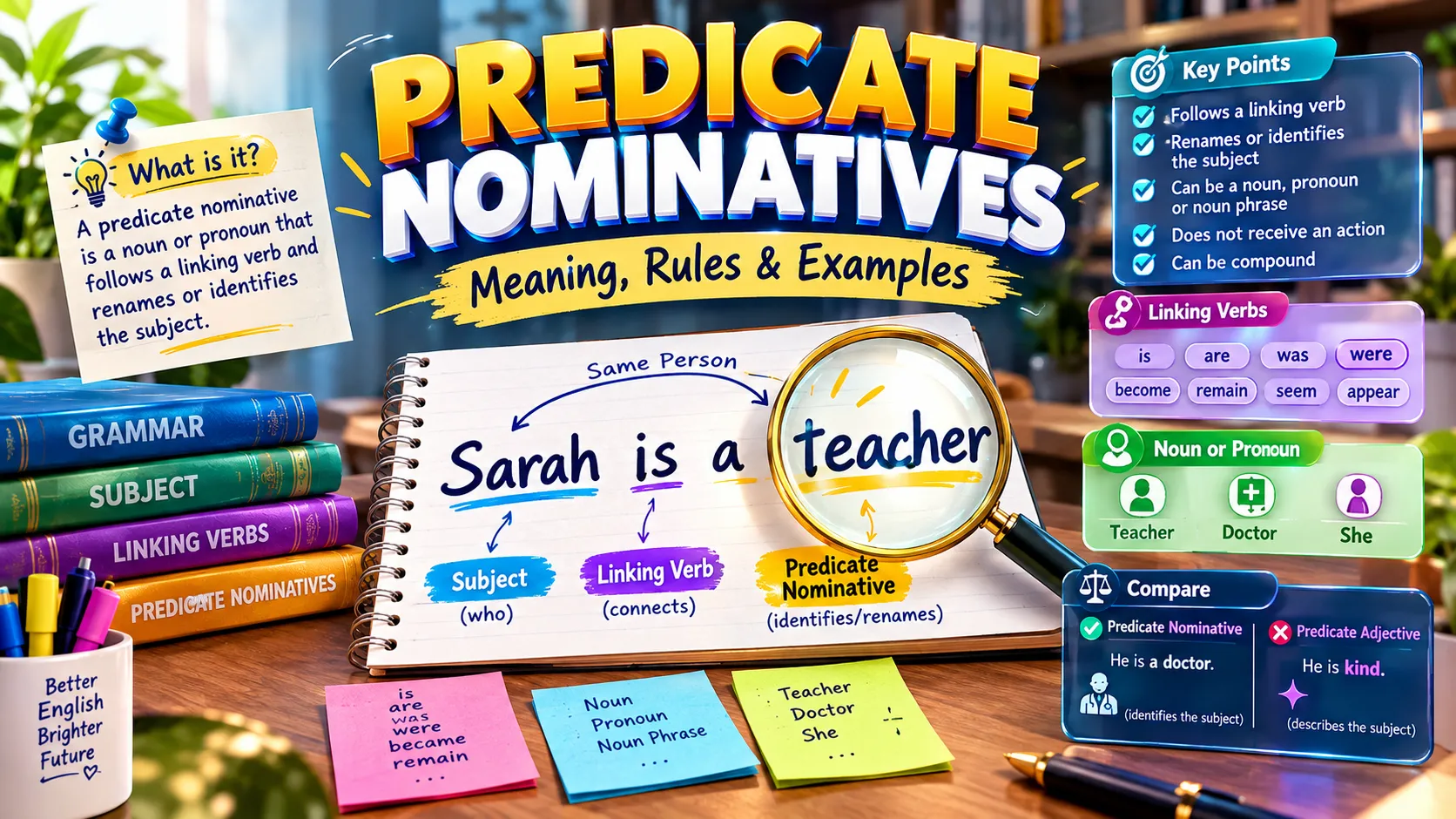
Predicate Nominatives: A Predicate Nominative is a noun or pronoun that follows a linking verb and renames or identifies the subject of a sentence. It appears in the predicate and gives another name to the subject.
For example:
- Sarah is a teacher.
- My brother became a doctor.
- The winner was she.
In these sentences, teacher, doctor, and she identify or rename the subjects. They are predicate nominatives.
A Predicate Nominative is also called a predicate noun. Learning this grammar concept helps students understand sentence structure, linking verbs, and the difference between subjects, direct objects, and subject complements.
What Is a Predicate Nominative?
A predicate nominative is a noun, pronoun, or noun phrase that follows a linking verb and identifies or renames the subject. It completes the meaning of the sentence by telling us who or what the subject is.
Consider this example:
Example: My mother is a nurse.
- Subject: My mother
- Linking verb: is
- Predicate nominative: nurse
The word nurse identifies the subject, my mother. It does not receive an action; instead, it renames the subject after the linking verb.
Another example:
Example: The winner became our captain.
- Subject: The winner
- Linking verb: became
- Predicate nominative: our captain
The phrase our captain identifies the winner, so it functions as a predicate nominative.
Explore More: https://wordminto.com/council-vs-counsel/
Predicate Nominative Definition in Simple Words
In simple terms, a predicate nominative is a noun or pronoun that comes after a linking verb and gives the subject another name.
For example:
- Ali is a student.
- My favorite animal is a dolphin.
- The speaker was Mr. Ahmed.
- The person at the door is she.
The bold words identify the subjects rather than describe their qualities or receive actions.
Predicate Nominative Examples
The following examples show how predicate nominatives work in different sentences.
| Sentence | Linking verb | Predicate nominative |
| Emma is a doctor. | is | doctor |
| My father became an engineer. | became | engineer |
| The winners are students. | are | students |
| Our neighbor is Mr. Khan. | is | Mr. Khan |
| The animals were lions. | were | lions |
| My best friends are Sara and Ayesha. | are | Sara and Ayesha |
| The team captain is he. | is | he |
| Her dream was a successful career. | was | a successful career |
| The problem remains a mystery. | remains | mystery |
| My favorite subjects are English and science. | are | English and science |
A predicate nominative may consist of one noun, a pronoun, or a longer noun phrase. It may also contain two or more nouns or noun phrases, which form a compound predicate nominative.
Explore More: https://wordminto.com/lmk-meaning/
Rules for Predicate Nominatives
Follow these rules to identify and use predicate nominatives correctly.
Rule 1: A Predicate Nominative Follows a Linking Verb
A predicate nominative follows a linking verb that connects it to the subject.
Common linking verbs include:
- Forms of be: am, is, are, was, were, be, being, been
- Other linking verbs: become, seem, remain, appear, and stay
Examples:
- He is a pilot.
- She became a lawyer.
- My uncle remains the manager.
- The winner will be John.
Remember that some verbs, such as look, feel, smell, and taste, can act as linking verbs or action verbs depending on their meaning.
- Linking: The soup smells delicious.
- Action: The chef smells the soup.
The first sentence contains a predicate adjective, not a predicate nominative. The second contains a direct object, soup.
Rule 2: It Renames or Identifies the Subject
A predicate nominative refers to the same person, place, thing, or idea as the subject.
Examples:
- London is the capital of England.
- My sister is a dentist.
- The winner was Daniel.
- That building became a museum.
In the first example, the capital of England identifies London. In the second, a dentist identifies the speaker’s sister.
Rule 3: It Can Be a Noun or Pronoun
Predicate nominatives commonly appear as nouns, noun phrases, and pronouns.
Examples:
- My brother is a teacher. (Noun)
- This is the best solution. (Noun phrase)
- The person responsible was she. (Pronoun, in formal grammar)
- The winners were they. (Pronoun, in formal grammar)
In traditional formal grammar, subject pronouns such as I, he, she, we, and they take the nominative case in this role. In everyday English, people commonly say “It’s me” rather than the more formal “It is I.”
Rule 4: It Does Not Receive an Action
A predicate nominative follows a linking verb rather than functioning as the receiver of an action.
Compare these sentences:
- Maria is a writer.
- Maria reads a book.
In the first sentence, writer identifies Maria. In the second, book receives the action of reading, so it is a direct object.
Rule 5: A Predicate Nominative Can Be Compound
A sentence can have more than one predicate nominative.
Examples:
- My parents are teachers and writers.
- The winners were Ali, Sara, and John.
- Her favorite fruits are apples, oranges, and bananas.
Each bolded group identifies the subject.
Explore More: https://wordminto.com/bff-meaning/
Predicate Nominative vs Predicate Adjective
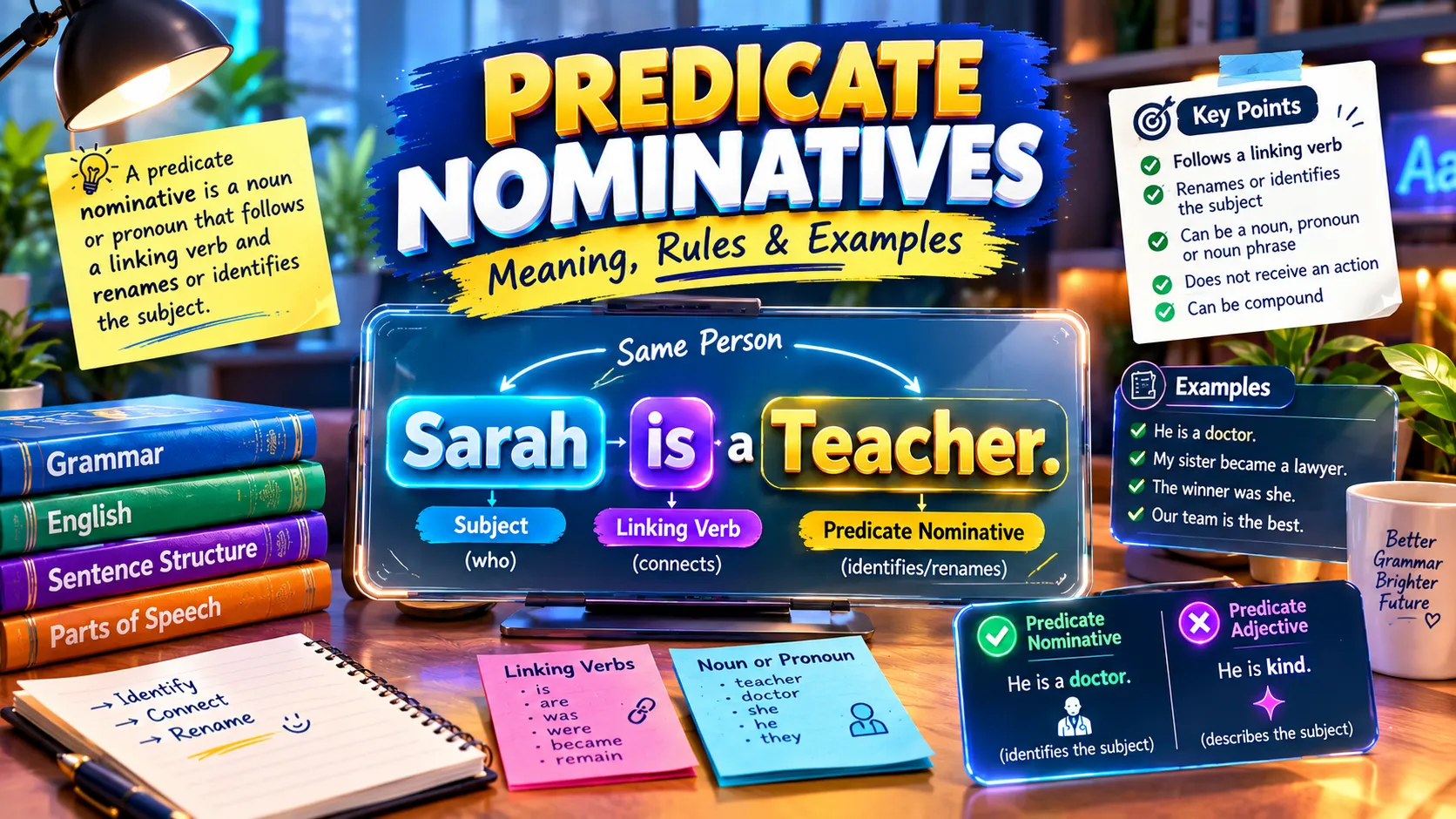
A predicate nominative identifies or renames the subject, whereas a predicate adjective describes the subject. Both can follow linking verbs and function as subject complements.
| Predicate Nominative | Predicate Adjective |
| My father is a doctor. | My father is kind. |
| The sky became a canvas. | The sky became dark. |
| She seems a professional. | She seems confident. |
| The food smells like a disaster. | The food smells delicious. |
The last example in the predicate nominative column is intentionally unnatural English. A more natural sentence would be “The food is a disaster.” Use natural examples when practicing this distinction.
Quick tip: If the word identifies what the subject is, it may be a predicate nominative. If it describes what the subject is like, it is a predicate adjective.
Predicate Nominative vs Direct Object
A direct object receives the action of a transitive verb. A predicate nominative identifies or renames the subject after a linking verb.
| Predicate Nominative | Direct Object |
| She became a doctor. | She treated a patient. |
| He is the captain. | He kicked the ball. |
| They are students. | They completed the assignment. |
| My uncle became a chef. | My uncle prepared dinner. |
Notice the difference in the verbs. Became and is connect the subject to its identity. Treated, kicked, completed, and prepared express actions.
Explore More: https://wordminto.com/privilege-vs-priviledge/
How to Identify a Predicate Nominative
Use these steps to find a predicate nominative in a sentence.
1
Find the subject.
Identify the person, place, thing, or idea the sentence discusses.
Example: My sister is a scientist.
2
Find the verb.
Determine whether the verb links the subject to another word.
Example: is
3
Find the word that identifies the subject.
Look for a noun or pronoun connected to the subject by the linking verb.
Example: scientist
4
Check the meaning.
Ask whether the word identifies the subject rather than receiving an action or describing a quality.
My sister = a scientist. Therefore, scientist is the predicate nominative.
Explore More: https://wordminto.com/subject-verb-agreement/
More Predicate Nominative Sentences
Here are 20 additional examples for students and English learners.
- My cousin is a photographer.
- The principal is Mrs. Ahmed.
- His ambition became a reality.
- The tallest student is my brother.
- Their destination was the airport.
- The main ingredient is flour.
- Our classroom representative is Hassan.
- The winners became champions.
- Her favorite color is purple.
- This animal is a cheetah.
- The main problem remains a lack of time.
- My uncle was a football coach.
- The inventors were two young students.
- His greatest achievement was the award.
- Our next lesson will be grammar.
- The new team leader is my friend.
- Their final choice was the blue car.
- The building became a library.
- The two speakers were teachers.
- The most important question is the cost.
Common Mistakes With Predicate Nominatives
Avoid these common errors when analyzing sentence structure.
Mistake 1: Confusing a Predicate Nominative With a Predicate Adjective
Incorrect identification: In “The girl is happy,” happy is a predicate nominative.
Correct identification: Happy is a predicate adjective because it describes the girl.
Mistake 2: Confusing a Predicate Nominative With a Direct Object
Incorrect identification: In “Ahmed kicked the ball,” ball is a predicate nominative.
Correct identification: Ball is a direct object because it receives the action of the verb kicked.
Mistake 3: Assuming Every Word After a Linking Verb Is a Predicate Nominative
Incorrect identification: In “The children are happy,” happy is a predicate nominative.
Correct identification: Happy is an adjective, so it functions as a predicate adjective.
Mistake 4: Ignoring the Verb’s Meaning
Some verbs can function as linking verbs or action verbs.
- Linking: The flowers smell wonderful.
- Action: She smelled the flowers.
The first sentence contains a predicate adjective. The second contains a direct object.
Explore More: https://wordminto.com/tense-consistency-rules/
Predicate Nominative Worksheet With Answers
Identify the predicate nominative in each sentence.
| Sentence | Answer |
| My mother is a nurse. | nurse |
| The winner was Daniel. | Daniel |
| Her favorite subject is mathematics. | mathematics |
| My cousins became doctors. | doctors |
| The building is a hospital. | hospital |
| His main goal was success. | success |
| Our new coach is Mr. Ali. | Mr. Ali |
| The best solution remains a mystery. | mystery |
| The flowers look beautiful. | None — predicate adjective |
| She opened the door. | None — direct object |
People Also Ask
A predicate nominative is a noun or pronoun that follows a linking verb and renames or identifies the subject. For example, in “James is a student,” student is the predicate nominative.
A predicate nominative is also called a predicate noun. It belongs to a broader grammatical category known as the subject complement.
Here are five examples:
She is a teacher.
He became a doctor.
My favorite fruit is mango.
The winner was Ali.
Their house is a museum.
Yes. A predicate nominative can be a pronoun. Traditional formal grammar favors “It is she,” while everyday English commonly uses “It is her.”
No. It can follow other linking verbs, including am, are, was, were, become, and remain, when those verbs connect the subject to its identity.
A predicate is the part of a sentence that says something about the subject and typically contains the verb. A predicate nominative is a specific noun or pronoun within that predicate that identifies or renames the subject.
Conclusion
A Predicate Nominative is an important part of English grammar because it identifies or renames the subject after a linking verb. It usually appears as a noun, pronoun, or noun phrase and functions as a subject complement.
To recognize it, find the subject and linking verb, then check whether the following noun or pronoun identifies the subject. Remember the key distinction: a predicate nominative renames the subject, a predicate adjective describes it, and a direct object receives an action.
Practice these examples and exercises regularly to improve your understanding of predicate nominatives and sentence structure.











3 thoughts on “Predicate Nominatives: Meaning, Rules, Examples, and Exercises”