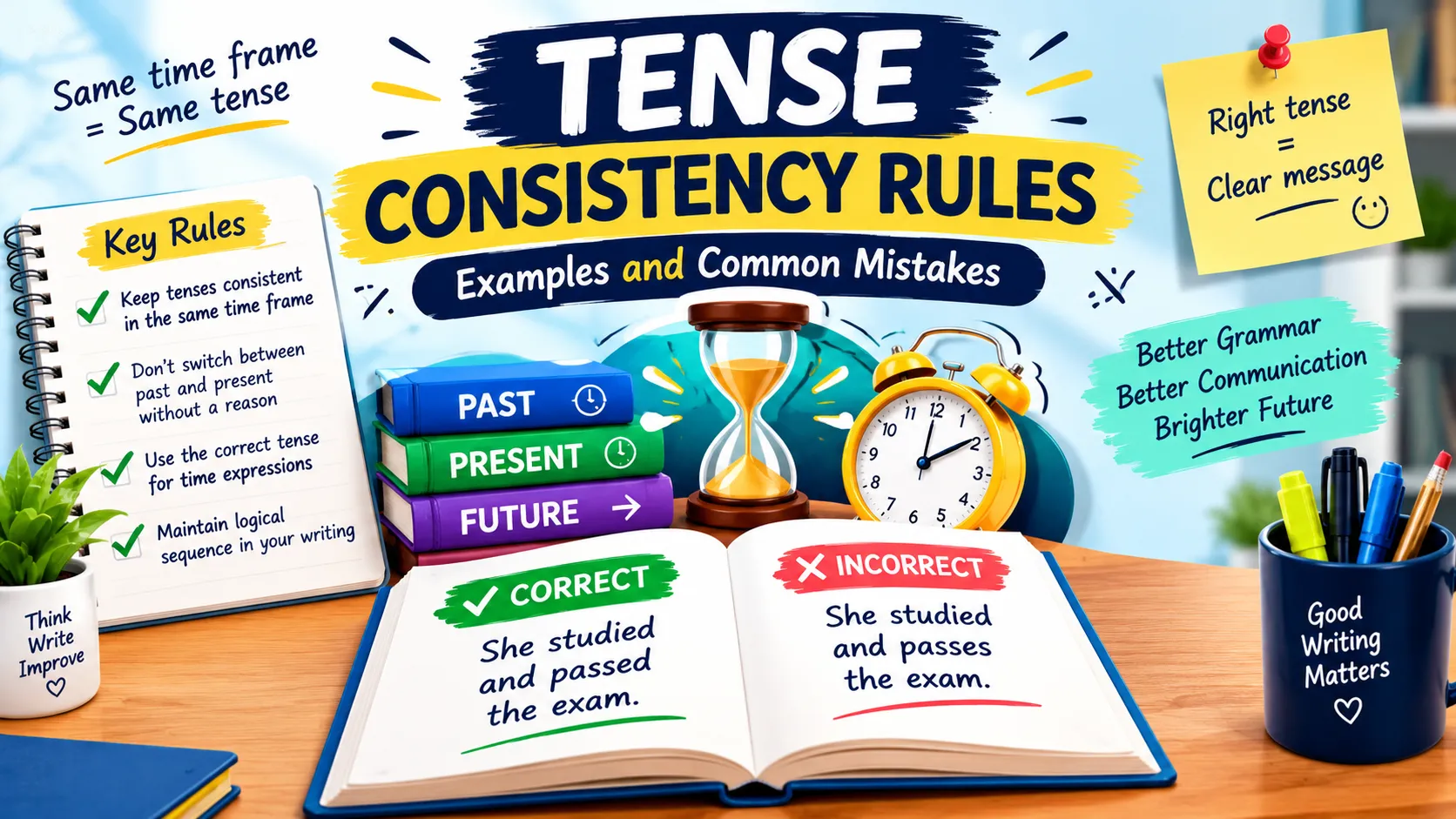
Tense Consistency Rules: Tense consistency is an important part of English grammar that helps make sentences clear, logical, and easy to understand. Whether you are writing an essay, telling a story, sending an email, or speaking in everyday conversations, using the correct verb tense helps your readers understand when an action happens.
The main rule of tense consistency is simple: keep verb Tenses Consistent when describing actions that happen in the same time frame. However, changing tenses is sometimes necessary when you describe events that happen at different times or express a general truth.
For example:
- Incorrect: Sarah walked into the room and sees her friend.
- Correct: Sarah walked into the room and saw her friend.
In the first sentence, the verb walked is in the past tense, but sees is in the present tense. The second sentence maintains the past tense, making the sequence of events easier to follow.
In this guide, you will learn the definition of tense consistency, its main rules, examples, common mistakes, and ways to use verb tenses correctly in your writing.

What Is Tense Consistency?
Tense consistency means using verb tenses logically throughout a sentence or passage. The verb tense should match the time of the action and the surrounding context.
English has three main time categories: past, present, and future. Each category has different forms that communicate whether an action is ongoing, completed, repeated, or connected to another event.
Consider these examples:
- Past tense: Maria studied for her exam and passed it.
- Present tense: Maria studies every evening and practices grammar.
- Future tense: Maria will study tonight and complete her assignment.
Each example maintains a logical relationship between the verbs.
Tense consistency does not mean using only one tense in every paragraph. Instead, it means changing tenses only when the meaning or time frame requires a change.
For example:
I finished my homework yesterday, but I will review it again tomorrow.
This sentence is correct because finished refers to the past, while will review refers to the future.
Tense Consistency Rules
Explore More: https://wordminto.com/quiet-vs-quite/
Why Is Tense Consistency Important?
Using consistent verb tenses improves the quality of your writing and helps prevent confusion.
Here are the main reasons tense consistency matters.
Tense Consistency Rules
1. It Makes Writing Clear
Consistent tenses help readers understand when actions take place.
Incorrect: James opened the window and looks outside.
Correct: James opened the window and looked outside.
The correct sentence keeps both actions in the past.
2. It Improves Grammar and Readability
Unnecessary tense changes can make even a simple sentence sound awkward.
Incorrect: The teacher explains the lesson and gave us homework.
Correct: The teacher explains the lesson and gives us homework.
Both verbs now describe actions in the present.
3. It Makes Stories Easier to Follow
When telling a story, writers generally establish a main tense and maintain it unless the timeline changes.
Example:
Lily entered the garden, noticed a beautiful flower, and took a photograph.
The past-tense verbs establish a clear sequence of events.
4. It Strengthens Academic and Professional Writing
Essays, reports, business documents, and research papers often require careful control of verb tenses. Maintaining a logical timeline makes arguments and explanations easier to understand.
5. It Helps Communicate the Correct Meaning
A tense change can alter the meaning of a sentence.
Compare:
- He said that he was tired.
- He said that he is tired.
The first sentence reports his tiredness from a past perspective. The second can suggest that he is still tired now. Both can be correct, depending on the intended meaning.
Explore More: https://wordminto.com/good-vs-well/
The Main Tense Consistency Rules
Understanding the following rules will help you use verb tenses accurately in everyday writing.
Tense Consistency Rules
Rule 1: Keep the Same Tense for Actions in the Same Time Frame
When two or more actions occur within the same time frame, use compatible verb tenses.
Incorrect: Emma cooked dinner and washes the dishes.
Correct: Emma cooked dinner and washed the dishes.
Both actions happened in the past.
More examples:
| Incorrect | Correct |
| He runs to school and arrived late. | He ran to school and arrived late. |
| She opens the book and started reading. | She opened the book and started reading. |
| They play football and won the match. | They played football and won the match. |
| I completed the task and submit the report. | I completed the task and submitted the report. |
Remember: Do not change tenses without a reason. If the actions belong to the same time frame, keep their tense relationship logical.
Rule 2: Do Not Switch Between Past and Present Without a Reason
A common tense consistency mistake occurs when writers begin describing something in the past and suddenly switch to the present.
Incorrect: I walked to the store and buy some milk.
Correct: I walked to the store and bought some milk.
However, a tense change is appropriate when the second action occurs in the present.
Correct: I walked to the store yesterday, but I usually buy my milk online.
The first action happened yesterday, while the second describes a present habit.
Rule 3: Maintain the Established Tense in a Paragraph
Once you establish the main tense of a paragraph, continue using it unless the timeline or meaning changes.
Incorrect:
Last weekend, we visited the beach. We swim in the ocean, build a sandcastle, and ate lunch together.
Correct:
Last weekend, we visited the beach. We swam in the ocean, built a sandcastle, and ate lunch together.
The corrected paragraph uses the past tense consistently because all the actions occurred during the same past event.
Rule 4: Use Present Tense for General Truths
General truths, scientific facts, and established principles are normally expressed in the present tense, even when the main sentence refers to the past.
Incorrect: The teacher explained that water boiled at 100°C at standard atmospheric pressure.
Correct: The teacher explained that water boils at 100°C at standard atmospheric pressure.
The present tense boils expresses a general scientific fact.
More examples:
- The instructor explained that the Earth revolves around the Sun.
- We learned that plants need sunlight to grow.
- The scientist discovered that sound travels through different materials.
The past-tense reporting verb does not require every following verb to be in the past tense.
Rule 5: Use Past Tense for Completed Past Actions
When an action was completed at a specific time in the past, the simple past tense is usually appropriate.
Incorrect: Yesterday, I go to the library and borrowed two books.
Correct: Yesterday, I went to the library and borrowed two books.
Common past-time expressions include:
- Yesterday
- Last night
- Last week
- Two days ago
- In 2020
- When I was a child
Examples:
- She visited her grandmother last Sunday.
- We watched a movie last night.
- They moved to Chicago in 2020.
Using the correct past-tense forms keeps the timeline clear.
Rule 6: Use Present Tense for Habits and Routines
Use the simple present tense to describe repeated actions, habits, routines, and general situations that are currently true.
Incorrect: He wakes up at six every morning and drank coffee.
Correct: He wakes up at six every morning and drinks coffee.
Both verbs describe a regular routine.
More examples:
- My sister works in an office and travels by bus.
- He exercises every morning and eats a healthy breakfast.
- They study English and practice speaking every day.
If the routine belongs to the past, use the past tense instead.
Example: When I lived in London, I woke up early and walked to work every day.
Rule 7: Use Future Tense for Future Actions
When describing actions that will happen in the future, use an appropriate future form.
Incorrect: Tomorrow, we will visit the museum and explored the art gallery.
Correct: Tomorrow, we will visit the museum and explore the art gallery.
More examples:
- I will finish my work and send you the report.
- She will attend the meeting and discuss the project.
- They are going to travel abroad and visit several cities.
Future meaning can also be expressed with present-tense forms, such as in timetables or planned arrangements.
Example: The train leaves at 8 a.m. tomorrow.
The simple present is correct because it describes a scheduled event.
Rule 8: Use Perfect Tenses to Show Relationships Between Actions
Perfect tenses help show how one action relates to another in time.
Present perfect
Use the present perfect to describe past actions connected to the present.
Example: She has completed her homework, so she can relax now.
Past perfect
Use the past perfect to show that one past action occurred before another past action.
Example: When we arrived at the station, the train had already left.
The train left before we arrived.
Future perfect
Use the future perfect to describe an action that will be completed before a specified future time.
Example: By Friday, I will have finished the project.
Avoid changing perfect tenses randomly because each form communicates a different time relationship.
Rule 9: Use the Correct Tense in Conditional Sentences
Conditional sentences often follow specific tense patterns. Using the wrong combination can change the meaning or make the sentence grammatically incorrect.
Zero conditional: General truths or facts.
If you heat ice, it melts.
First conditional: A realistic future possibility.
If it rains tomorrow, we will stay home.
Second conditional: An imaginary or unlikely situation.
If I had more free time, I would learn another language.
Third conditional: An imaginary alternative to a past event.
If she had studied harder, she would have passed the exam.
These patterns help maintain a logical relationship between the condition and its result.
Rule 10: Maintain Logical Tenses in Reported Speech
Reported speech often requires a tense change when the reporting verb is in the past. This process is commonly called backshifting.
Direct speech:
Anna said, “I am busy.”
Reported speech:
Anna said that she was busy.
Other common changes include:
| Direct speech | Reported speech |
| Present simple: “I work.” | Past simple: He said he worked. |
| Present continuous: “I am working.” | Past continuous: He said he was working. |
| Present perfect: “I have finished.” | Past perfect: He said he had finished. |
| Will: “I will call.” | Would: He said he would call. |
However, backshifting is not always required. If a statement is still true or its present relevance is important, the present tense may remain appropriate.
Example: She said that she lives in New York.
This can be correct if she still lives there.
Rule 11: Use Consistent Tenses When Describing Literature or Art
When analyzing a novel, short story, play, or film, writers often use the literary present tense to discuss events and characters.
Incorrect: In the novel, the main character discovers a secret and decided to leave town.
Correct: In the novel, the main character discovers a secret and decides to leave town.
The present tense is conventional in literary analysis because the work is being discussed as a text that readers can examine now.
A past-tense summary may also be appropriate in certain contexts. The key is to maintain a consistent perspective within the analysis.
Rule 12: Keep Tenses Consistent in Lists and Parallel Structures
When a sentence contains a series of related actions, keep the verb forms grammatically parallel.
Incorrect: She enjoys reading, writing, and painted.
Correct: She enjoys reading, writing, and painting.
This example concerns parallel structure rather than tense alone, but it is an important related rule.
For a series of past actions:
Incorrect: He entered the room, greets everyone, and sat down.
Correct: He entered the room, greeted everyone, and sat down.
The verbs now follow the same past-tense pattern.
Explore More: https://wordminto.com/hyphen-rules/
When Is It Correct to Change Verb Tenses?
Changing tenses is not always a grammatical mistake. In fact, appropriate tense changes are necessary to communicate different times, ongoing situations, and relationships between events.
Here are common situations in which changing tenses is correct.
Tense Consistency Rules
1. When the Time Changes
Example: I lived in Boston for five years, but I live in Dallas now.
Lived refers to the past, while live describes the present.
2. When Describing Past and Future Events
Example: She finished her assignment yesterday and will submit it tomorrow.
The verbs refer to two different times.
3. When Expressing General Facts
Example: The professor explained that the Moon orbits Earth.
Explained is in the past tense, while orbits expresses a continuing scientific fact.
4. When Describing an Ongoing Action Interrupted by Another
Example: I was cooking dinner when the phone rang.
The past continuous describes the ongoing action, while the simple past describes the interruption.
5. When Using Different Time Relationships in a Story
Example: I was nervous because I had never spoken in front of such a large audience before.
Was establishes the past perspective, while had never spoken describes an experience before that past moment.
Key takeaway: A tense change is correct when it reflects a real difference in time, meaning, or grammatical structure. Unnecessary tense changes are the problem.
Explore More: https://wordminto.com/a-or-an-usage/
Tense Consistency Examples: Incorrect vs Correct
The following examples demonstrate common mistakes and their corrections.
| Incorrect sentence | Correct sentence |
| She walked home and sees a dog. | She walked home and saw a dog. |
| He studies every day and played football. | He studies every day and plays football. |
| We will travel to Paris and visited Rome. | We will travel to Paris and visit Rome. |
| I was sleeping when the alarm rings. | I was sleeping when the alarm rang. |
| They finished dinner and go outside. | They finished dinner and went outside. |
| She opens the door and walked inside. | She opened the door and walked inside. |
| He said that he is sick yesterday. | He said that he was sick yesterday. |
| By the time I arrived, she leaves. | By the time I arrived, she had left. |
| If I will see him, I will tell him. | If I see him, I will tell him. |
| The sun rose in the east and sets in the west. | The sun rises in the east and sets in the west. |
Note that the best correction can depend on the intended meaning. For example, He said that he is sick can be correct if the illness is still current. Always consider the context before changing a tense.
Explore More: https://wordminto.com/modal-verb-rules/
Common Tense Consistency Mistakes to Avoid
Even experienced English learners sometimes make tense errors. Understanding these common problems can help you identify and correct them.
Tense Consistency Rules
1. Changing Tenses in the Middle of a Sentence
Incorrect: The baby cried and falls asleep.
Correct: The baby cried and fell asleep.
Keep related actions in the same time frame unless there is a reason to change.
2. Mixing Past and Present in a Narrative
Incorrect: I entered the classroom, greeted my teacher, and sit down.
Correct: I entered the classroom, greeted my teacher, and sat down.
A narrative written in the past tense should normally maintain that tense for actions in the same timeline.
3. Using the Wrong Tense After a Time Expression
Incorrect: Last year, she travels to Japan.
Correct: Last year, she traveled to Japan.
The phrase last year identifies a completed past period, so the simple past is appropriate.
4. Confusing Simple Past and Past Perfect
Incorrect: When I reached the cinema, the movie already started.
Correct: When I reached the cinema, the movie had already started.
The past perfect clarifies that the movie started before I reached the cinema.
5. Changing Tenses When Reporting Facts
Incorrect: The teacher explained that plants needed sunlight, but the lesson is about a general scientific fact.
Better: The teacher explained that plants need sunlight.
The present tense communicates a general truth. The past tense needed is not always grammatically wrong, but it may suggest a past-specific situation or viewpoint.
6. Ignoring the Main Tense of a Paragraph
Before writing a paragraph, decide whether you are mainly describing the past, present, or future. This simple step can help you avoid accidental tense changes.
7. Overcorrecting Every Tense Change
Do not assume that every sentence must use a single tense. A paragraph can correctly contain past, present, and future forms when the timeline calls for them.
Example: I started learning English last year, I practice every day, and I hope to become fluent soon.
The tense changes are logical because the sentence refers to past experience, a present habit, and a future goal.
How to Maintain Tense Consistency in Writing
You can improve your grammar by following a few practical steps.
Tense Consistency Rules
Step 1: Identify the Main Time Frame
Ask yourself whether you are describing something that happened in the past, is happening now, or will happen in the future.
For example:
Last Saturday, we visited a museum.
The main time frame is the past.
Step 2: Underline the Verbs
Look for every verb in the sentence or paragraph. Check whether each verb fits the intended timeline.
Example:
She walked to the store, bought groceries, and returned home.
The main verbs are walked, bought, and returned. All three describe completed past actions.
Step 3: Check Time Expressions
Words and phrases such as yesterday, now, every day, since Monday, and tomorrow can help determine which tense is appropriate.
For example:
- Yesterday, I visited my friend.
- Every day, I visit my friend.
- Tomorrow, I will visit my friend.
Step 4: Look for Unnecessary Tense Changes
Read your paragraph carefully and identify places where you change from past to present or future.
Ask yourself: Does this change reflect a real difference in time or meaning?
If not, you may need to revise the verb.
Step 5: Check the Sequence of Events
When describing multiple events, make sure their order is clear.
Example: After she had finished her homework, she watched television.
The past perfect indicates that the homework was completed before the television viewing.
Step 6: Read Your Writing Aloud
Reading aloud can help you notice sentences that sound awkward or confusing. Pay attention to changes in verb forms and whether the timeline remains logical.
Step 7: Revise for Meaning, Not Just Grammar
A grammatically correct sentence must also communicate what you intend.
Compare:
- He said that he was ready.
- He said that he is ready.
Both can be correct, but they may communicate different relationships between the reported statement and the present.
Tense Consistency in Different Types of Writing
Tense consistency is important in many forms of writing, but the most appropriate tense depends on the purpose.
Academic Writing
Academic writing commonly uses the present tense for established facts and interpretations, the past tense for completed research or historical events, and other tenses when required by the context.
Example: The study found that regular exercise improves cardiovascular health.
Found describes a completed study, while improves expresses a general claim.
Narrative Writing
Stories often use the past tense to describe completed events or the present tense to create an immediate storytelling effect.
Past-tense example: The detective entered the house and discovered a hidden letter.
Present-tense example: The detective enters the house and discovers a hidden letter.
Either approach can work if the tense is maintained appropriately.
Business Writing
Professional emails and reports should use tenses that make deadlines, current situations, and completed tasks clear.
Example: We completed the report yesterday and will send it to the client tomorrow.
Everyday Communication
Tense consistency helps people communicate their experiences and plans clearly.
Example: I went shopping yesterday, bought a new jacket, and returned home before dinner.
Descriptive Writing
When describing a current scene, use the present tense for details that exist now. When describing a past scene, use the past tense for events that occurred then.
Present: The garden looks beautiful, and the flowers smell wonderful.
Past: The garden looked beautiful, and the flowers smelled wonderful.
Tense Consistency Practice: Test Your Knowledge
Choose the grammatically correct option in each sentence.
Question 1
She walked into the kitchen and _____ a glass of water.
A. drinks
B. drank
C. drink
Question 2
Every morning, Daniel wakes up early and _____ breakfast.
A. ate
B. eats
C. will eat
Question 3
Tomorrow, we will visit the zoo and _____ photographs.
A. took
B. taking
C. take
Question 4
I was reading a book when the doorbell _____.
A. rings
B. rang
C. will ring
Question 5
The teacher explained that the Earth _____ around the Sun.
A. revolves
B. revolved
C. revolve
Question 6
By the time we arrived, the concert _____.
A. begins
B. has begun
C. had begun
Question 7
If she studies hard, she _____ the exam.
A. will pass
B. would passed
C. passed
Question 8
Last weekend, we visited our cousins and _____ a movie together.
A. watch
B. watched
C. watches
Question 9
He said that he _____ tired, but he feels better now.
A. was
B. were
C. be
Question 10
I finished my assignment yesterday, and I _____ it tomorrow.
A. submitted
B. submit
C. will submit
Answer Key and Explanations
- B. drank — Both actions occurred in the past.
- B. eats — The sentence describes a daily routine.
- C. take — After will, use the base form of the verb.
- B. rang — The past continuous describes the ongoing action, while the simple past describes the interruption.
- A. revolves — The present tense expresses a general scientific fact.
- C. had begun — The concert started before the arrival.
- A. will pass — This is a first conditional sentence describing a realistic future possibility.
- B. watched — Both actions happened last weekend.
- A. was — The past-tense reporting context makes was appropriate. The following clause explains the current situation.
- C. will submit — Yesterday refers to the completed action, while tomorrow refers to the future action.
Quick Summary of Tense Consistency Rules
Use this table as a quick reference when checking your writing.
| Rule | Example |
| Keep related past actions in the past. | She called and left a message. |
| Keep present habits in the present. | He walks and exercises daily. |
| Use appropriate future forms for future actions. | I will call and explain everything. |
| Use present tense for general truths. | Water freezes at 0°C under standard pressure. |
| Use past perfect for an earlier past action when needed. | The bus had left before we arrived. |
| Use logical tense changes when the time changes. | I lived there before, but I live here now. |
| Follow conditional sentence patterns. | If it rains, we will stay inside. |
| Use appropriate tense forms in reported speech. | She said she was busy. |
People Also Ask
Tense consistency means using verb tenses that logically match the time and meaning of the actions being described. Maintain the same tense for actions in the same time frame, and change tenses when the timeline or context requires it.
She opened the door, walked inside, and greeted everyone.
All three verbs are in the simple past tense, making the sequence of actions clear.
Yes. You can use multiple tenses in a sentence when the actions occur at different times or have different meanings.
Example: I finished my work yesterday, but I will start a new project tomorrow.
He went to the store and buys some bread.
The sentence switches from the past tense to the present without a clear reason.
Correct: He went to the store and bought some bread.
No. A paragraph can contain different tenses when necessary. However, the tense changes should be logical and easy to understand.
For example, you may describe a past event, explain a present fact, and discuss a future plan in the same paragraph.
Conclusion
Tense Consistency is a fundamental English grammar rule that helps you communicate clearly and accurately. By maintaining logical verb tenses, you can make your sentences easier to understand and your writing more professional.
Remember that Tense Consistency does not require using the same tense everywhere. Instead, it requires choosing verb forms that correctly represent the time and meaning of each action.
To improve your writing, practice identifying verb tenses, correcting inconsistent sentences, and checking the timeline of your paragraphs. With regular practice, you will find it easier to recognize tense errors and write clear, natural English.
For more straightforward English grammar explanations, examples, and practical writing tips, explore Wordminto and continue building your grammar skills one rule at a time.











2 thoughts on “Tense Consistency Rules: Definition, Examples, and Common Mistakes”