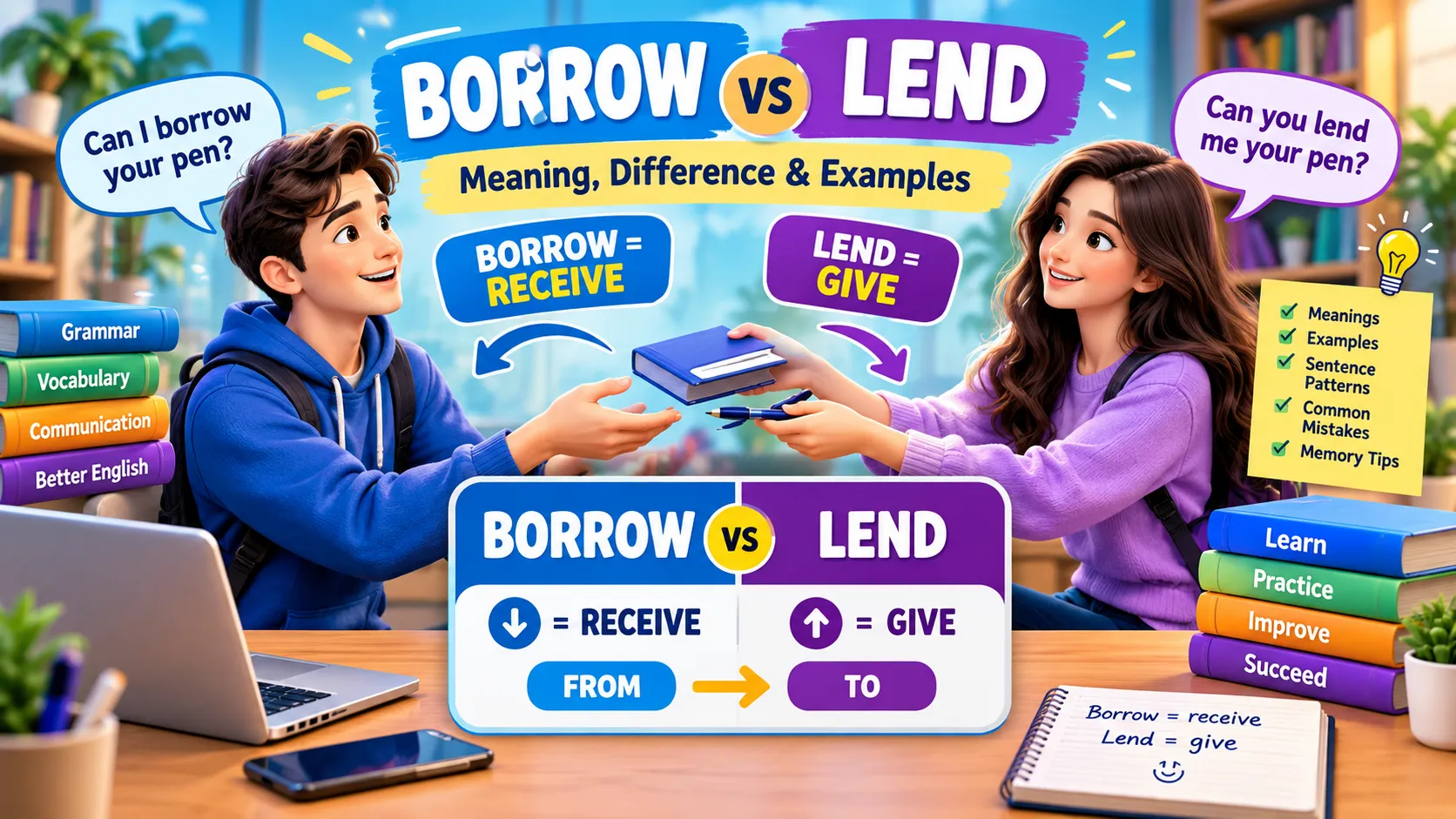
Borrow vs Lend often confuses English learners because both words describe the same exchange of something between two people—but they describe it from opposite sides.
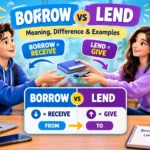
- Borrow means to take or receive something temporarily from someone and plan to return it.
- Lend means to give something temporarily to someone and expect its return.
Simple rule
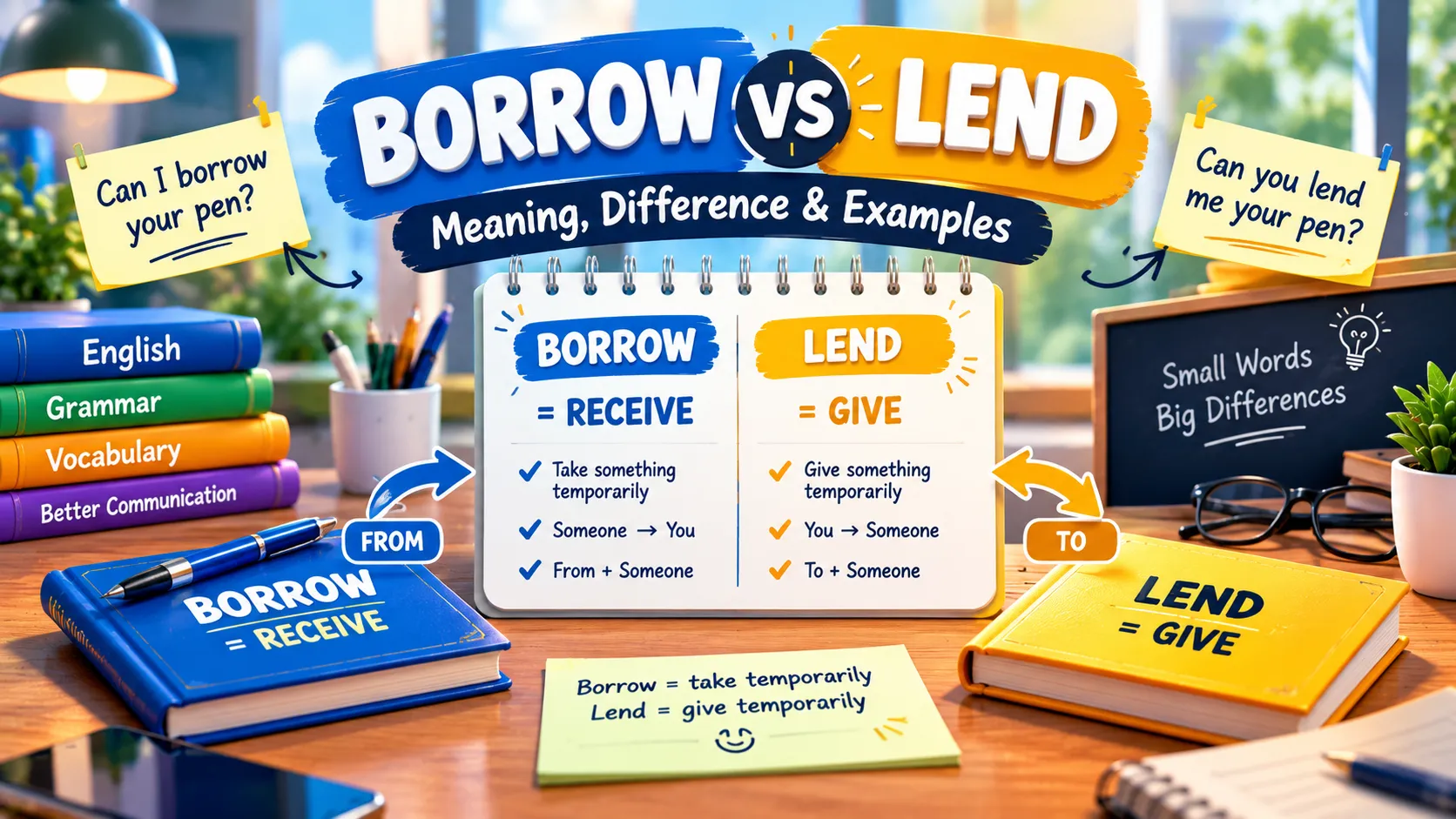
You borrow something from someone.
You lend something to someone.
Example:
- Can I borrow your pen?
- Can you lend me your pen?
Both sentences describe the same situation from different perspectives.
Borrow vs Lend: Quick Difference
| Word | Meaning | Direction | Example |
| Borrow | Receive something temporarily | Someone → You | I borrowed a book from Sara. |
| Lend | Give something temporarily | You → Someone | Sara lent me a book. |
Think of it this way:
Borrow = take temporarily
Lend = give temporarily
What Does Borrow Mean?
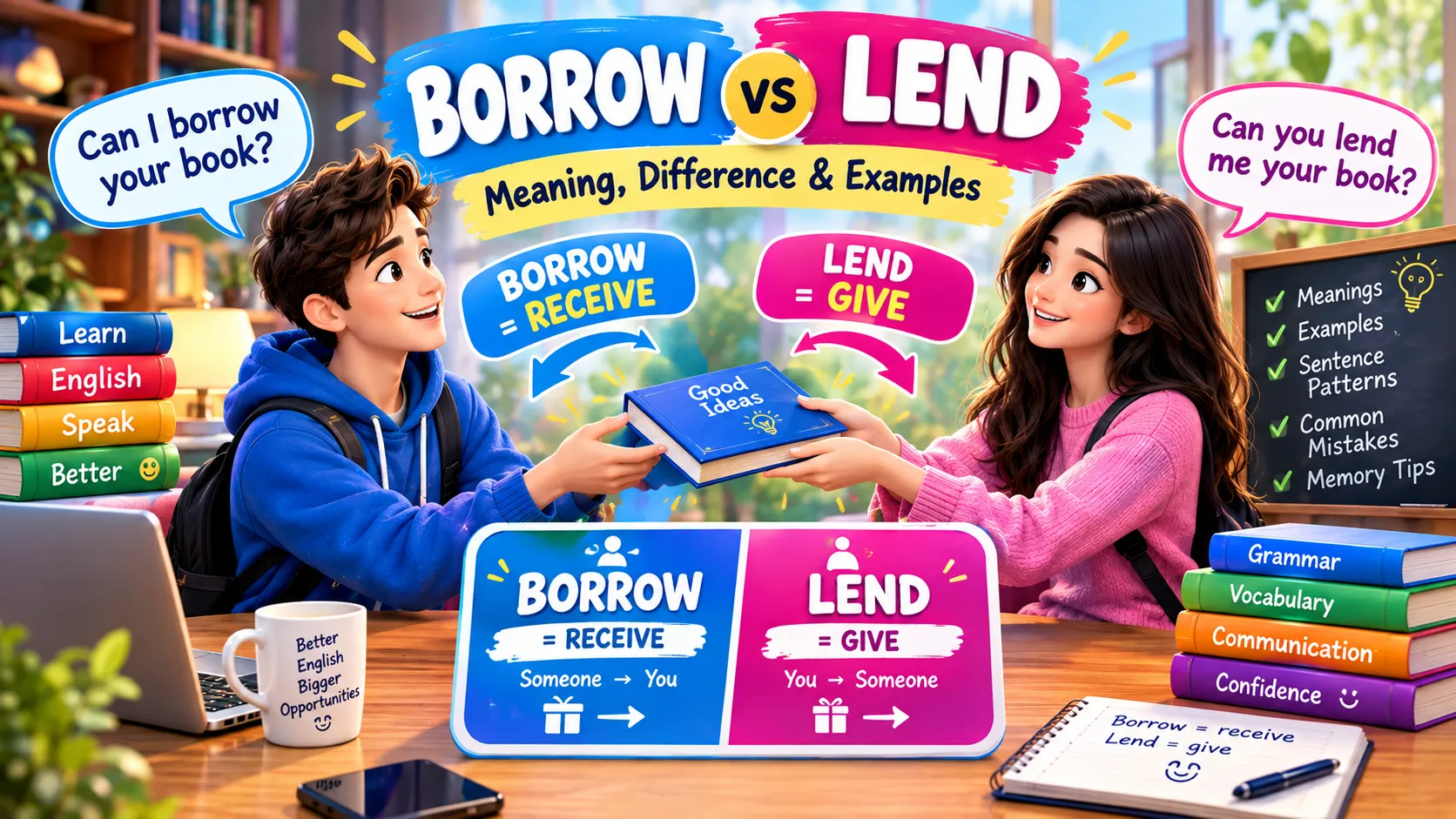
Borrow means to receive or take something from another person temporarily with the intention of returning it.
You usually use borrow when you focus on the person who receives something.
Examples
- Can I borrow your pen?
- I borrowed some money from my brother.
- She borrowed my laptop for the weekend.
- May I borrow your car?
- He borrowed a book from the library.
- We borrowed some chairs from our neighbors.
In each example, the subject receives or takes something temporarily.
Borrow + from
We commonly use borrow + something + from + someone.
Examples:
- I borrowed a book from Ali.
- She borrowed money from her friend.
- Can I borrow your notes from you?
- He borrowed a jacket from his brother.
Explore More: https://wordminto.com/btw-meaning/
What Does Lend Mean?
Lend means to give something to another person temporarily, expecting that person to return it.
You use lend when you focus on the person who gives something.
Examples
- Can you lend me your pen?
- I lent him some money.
- She lent her car to her sister.
- Could you lend me your notes?
- My friend lent me his laptop.
- They lent us some chairs.
In each example, the subject gives something temporarily.
Lend + to
You can commonly use:
lend + something + to + someone
Examples:
- I lent my book to Ahmed.
- She lent her car to her sister.
- He lent some money to his friend.
You can also use:
lend + someone + something
Examples:
- I lent Ahmed my book.
- She lent her sister her car.
- He lent his friend some money.
Explore More: https://wordminto.com/asap-meaning/
Borrow vs Lend: The Main Difference
The easiest way to understand the difference involves looking at the direction of the action.
Borrow
You receive something.
I borrowed a book from John.
John → book → me
Lend
You give something.
John lent me a book.
John → book → me
The event remains the same, but the verb changes depending on whose action you describe.
Borrow vs Lend Examples
Example 1: A Pen
Borrow:
Can I borrow your pen?
You want to receive the pen temporarily.
Lend:
Can you lend me your pen?
You ask another person to give you the pen temporarily.
Example 2: Money
Borrow:
I borrowed $20 from Tom.
You received the money.
Lend:
Tom lent me $20.
Tom gave you the money.
Example 3: A Car
Borrow:
I borrowed my father’s car.
You received permission to use the car temporarily.
Lend:
My father lent me his car.
Your father gave you temporary use of the car.
Example 4: A Book
Borrow:
I borrowed a book from the library.
You received the book temporarily.
Lend:
The library lent me a book.
The library provided the book temporarily.
Explore More: https://wordminto.com/sos-meaning/
Borrow From vs Lend To
This pattern helps many learners remember the difference.
Borrow + from
I borrowed a laptop from Sarah.
Borrow = receive
Lend + to
Sarah lent a laptop to me.
Lend = give
Compare:
I borrowed money from my brother.
My brother lent money to me.
Both sentences describe the same transaction.
Borrow Me or Lend Me?
This causes a common mistake.
❌ Can you borrow me your pen?
Standard English does not use borrow this way.
✅ Can you lend me your pen?
Use lend when you ask another person to give you something temporarily.
You can say:
Can I borrow your pen?
Or:
Can you lend me your pen?
Both sentences work.
Can I Borrow You…?
This sentence can create a different meaning.
❌ Can I borrow you your car?
Incorrect if you mean:
Can I use your car temporarily?
Say:
Can I borrow your car?
Or:
Can you lend me your car?
However, English sometimes uses borrow with a person informally to mean getting someone’s temporary help or attention:
Can I borrow you for a minute?
Here, borrow does not mean physically taking the person. It means asking for their time or attention.
Explore More: https://wordminto.com/fwb-meaning/
Borrow vs Lend in Questions
The choice depends on what you want to emphasize.
If you want to receive something:
Can I borrow your charger?
If you want someone to give you something:
Can you lend me your charger?
If you want to ask about giving:
Can you lend your car to me?
If you want to ask about receiving:
Can I borrow your car from you?
The first pair sounds more natural in everyday conversation.
Borrow vs Lend in the Past Tense
The past forms sometimes create additional confusion.
Borrow
The past tense of borrow is:
borrowed
Examples:
- I borrowed her book.
- He borrowed my phone.
- We borrowed some money.
Lend
The past tense of lend is:
lent
Not lended.
Examples:
- I lent him my book.
- She lent me $50.
- They lent us their car.
Common mistake
❌ I lended him my book.
✅ I lent him my book.
Borrow vs Lend in the Future
You can use borrow and lend with future forms.
Borrow
I will borrow some money from my brother.
Lend
My brother will lend me some money.
Both sentences describe a future exchange.
Borrow vs Lend in the Present Perfect
Borrow
I have borrowed her laptop several times.
Lend
She has lent me her laptop several times.
Remember:
borrow → borrowed → borrowed
lend → lent → lent
Loan vs Borrow
Borrow and loan can also cause confusion.
Borrow describes receiving something temporarily.
I borrowed $500 from the bank.
Loan can function as a noun and, especially in American English, as a verb.
As a noun
I took out a loan from the bank.
As a verb
The bank loaned me $500.
In everyday English, lend often sounds more natural when you talk about a person temporarily giving something:
My friend lent me $50.
For formal financial contexts, loan commonly appears as a noun:
She applied for a bank loan.
Borrow vs Rent
These words have related but different meanings.
Borrow
You receive something temporarily, usually without paying for its use.
I borrowed my friend’s bicycle.
Rent
You pay to use something temporarily.
I rented a bicycle for the day.
So:
Borrow = temporary use without a rental charge
Rent = temporary use in exchange for payment
Borrow vs Take
Borrow means you take something temporarily and intend to return it.
Take has a much broader meaning and does not automatically imply that you will return the item.
Compare:
I borrowed her book.
This means you took the book temporarily with the intention of returning it.
I took her book.
This sentence does not clearly tell us whether you plan to return it.
Borrow vs Steal
These words have completely different meanings.
Borrow
You take something temporarily with permission and intend to return it.
I borrowed his bicycle.
Steal
You take something without permission and intend to keep it or deprive the owner of it.
Someone stole his bicycle.
The key distinction involves permission and intention.
Common Mistakes With Borrow and Lend
1. Using Borrow Instead of Lend
❌ Can you borrow me your phone?
✅ Can you lend me your phone?
Or:
✅ Can I borrow your phone?
2. Saying “Lended”
❌ She lended me some money.
✅ She lent me some money.
Lend has an irregular past tense: lent.
3. Confusing “From” and “To”
❌ I lent a book from John.
✅ I borrowed a book from John.
Or:
✅ John lent a book to me.
Remember:
borrow from
lend to
4. Saying “Borrow From Me” When You Mean “Lend”
Suppose your friend asks you for money.
You might say:
❌ I will borrow you $20.
✅ I will lend you $20.
Or:
✅ You can borrow $20 from me.
Easy Memory Trick for Borrow vs Lend
Use this simple rule:
B = Borrow = Bring something to yourself
When you borrow, something comes to you.
I borrowed a book from her.
L = Lend = Let someone use something
When you lend, you give something to another person temporarily.
I lent her my book.
Another useful shortcut:
Borrow = receive
Lend = give
If you remember only one rule, remember this one.
Borrow vs Lend Sentence Pattern
Borrow
Subject + borrow + object + from + person
I borrowed a laptop from my friend.
Lend
Subject + lend + person + object
My friend lent me a laptop.
Or:
Subject + lend + object + to + person
My friend lent a laptop to me.
These structures make the difference much easier to recognize.
Can You Borrow Money?
Yes.
You can borrow money when you receive money temporarily and expect to repay it.
Examples:
- Can I borrow some money?
- I borrowed $100 from my brother.
- She borrowed money from the bank.
- He needs to borrow money to pay the bill.
The person who gives the money lends it.
My brother lent me $100.
Can You Lend Money?
Yes.
Lend commonly describes giving money temporarily.
Examples:
- Can you lend me $20?
- I lent him some money.
- She lent her friend $500.
- Would you lend me enough money for the ticket?
Remember:
I borrow money.
You lend money.
Borrow and Lend in Everyday Conversation
Here are natural examples you might hear in daily English:
Can I borrow your charger?
Sure. I’ll lend it to you.
Did you borrow my headphones?
Yes, I’ll return them later.
Can you lend me some cash?
I can lend you $20.
I borrowed this book from my sister.
She lent it to me last week.
Borrow vs Lend: Examples With Answers
1. Can I ___ your pen?
Answer: borrow
Can I borrow your pen?
You receive the pen.
2. Can you ___ me your pen?
Answer: lend
Can you lend me your pen?
The other person gives you the pen.
3. I ___ some money from my brother.
Answer: borrowed
I borrowed some money from my brother.
You received the money.
4. My brother ___ me some money.
Answer: lent
My brother lent me some money.
Your brother gave you the money.
5. She ___ her car to her friend.
Answer: lent
She lent her car to her friend.
She gave her friend temporary use of the car.
6. He ___ a car from his friend.
Answer: borrowed
He borrowed a car from his friend.
He received temporary use of the car.
Borrow vs Lend: Practice Exercise
Choose borrow or lend to complete each sentence.
- Can I ___ your umbrella?
- Could you ___ me your notes?
- I ___ a book from the library.
- She ___ me her bicycle yesterday.
- He wants to ___ some money from his parents.
- Would you ___ me your charger?
- They ___ some chairs from their neighbors.
- I can ___ you my laptop for the weekend.
- She ___ $50 from her sister.
- My friend ___ me his camera.
Answers
- borrow
- lend
- borrowed
- lent
- borrow
- lend
- borrowed
- lend
- borrowed
- lent
Borrow vs Lend: Quick Comparison
| Feature | Borrow | Lend |
| Basic meaning | Receive temporarily | Give temporarily |
| Focus | Receiver | Giver |
| Common preposition | from | to |
| Present | borrow | lend |
| Past | borrowed | lent |
| Past participle | borrowed | lent |
| Example | I borrowed his book. | He lent me his book. |
| Money | borrow money | lend money |
| Object | borrow a phone | lend a phone |
People Also Ask
Both words are correct, but they describe opposite sides of a temporary exchange.
Borrow means to receive something temporarily.
Lend means to give something temporarily.
Borrow focuses on the person who receives something, while lend focuses on the person who gives it.
I borrowed a book from Maria.
Maria lent me a book.
The correct forms are:
Can I borrow your pen?
or
Can you lend me your pen?
No. The standard past tense and past participle of lend are lent.
She lent me her book.
Not:
❌ She lended me her book.
Use borrow from.
I borrowed money from my friend.
Use lend to when you mention the recipient.
I lent my book to my friend.
You can also say:
I lent my friend my book.
Final Difference: Borrow vs Lend
The difference becomes simple when you focus on who receives and who gives.
Borrow = receive something temporarily
I borrowed a book from my friend.
Lend = give something temporarily
My friend lent me a book.
Remember the easiest formula:
BORROW = receive
LEND = give
And remember the common patterns:
borrow something from someone
lend something to someone
lend someone something
Once you connect borrow with receiving and lend with giving, the two words become much easier to use correctly.









2 thoughts on “Borrow vs Lend: Meaning, Difference & Examples”