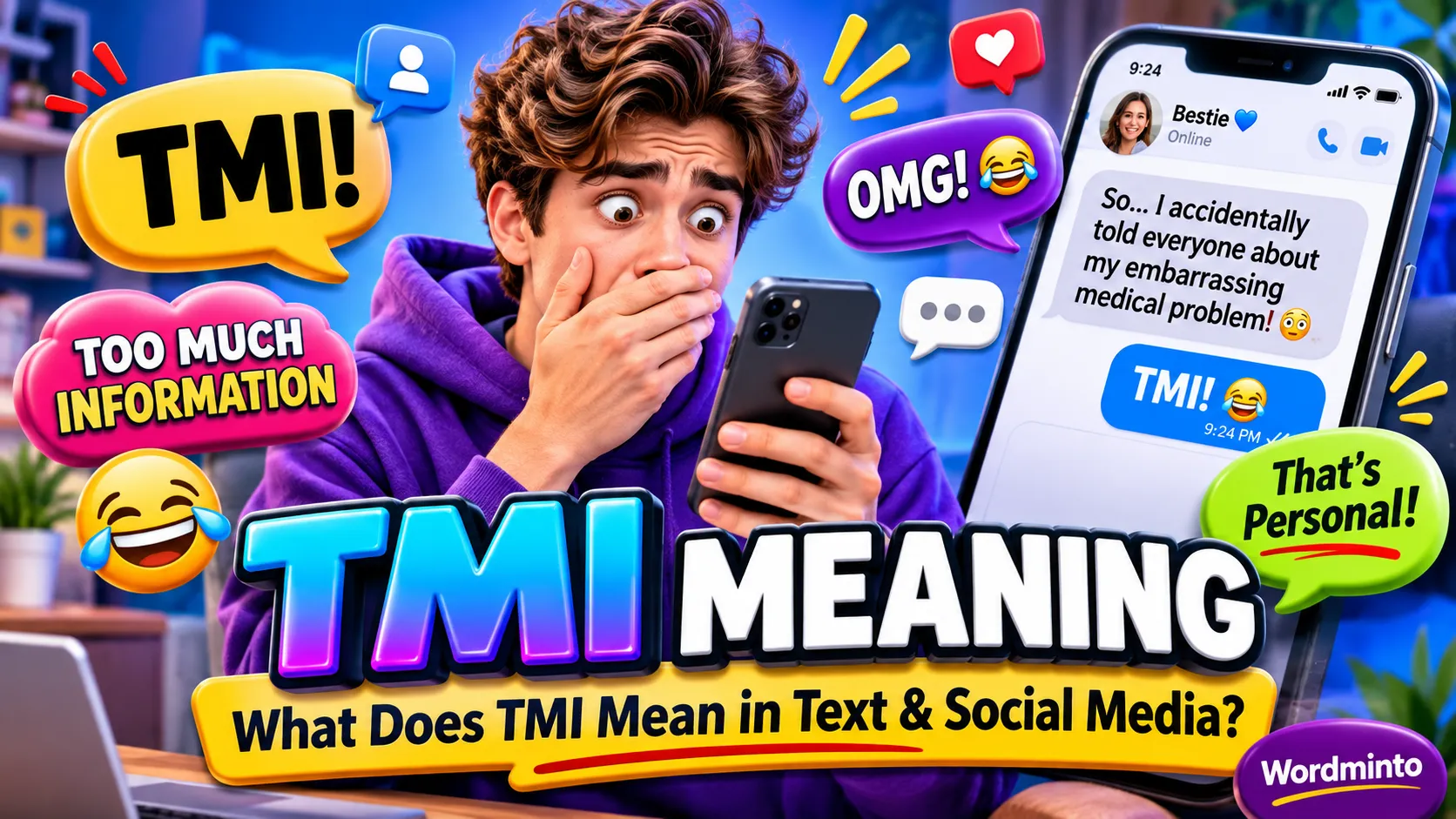
TMI Meaning: TMI is a popular internet abbreviation that stands for “Too Much Information.” People use it in text messages, social media, and everyday conversations when someone shares more personal, private, embarrassing, or unnecessary details than others want to hear.
For example:
- Person 1: I accidentally told everyone about my embarrassing medical problem.
- Person 2: TMI! 😂
In this example, the second person uses TMI to say that the information was too personal or detailed.
But does TMI always sound rude? Can you use it jokingly with friends? And what does it mean on platforms like Snapchat, Instagram, and TikTok?
Let’s explore its meaning, examples, common uses, and related abbreviations.
What Does TMI Stand For?
TMI stands for Too Much Information.
It describes a situation in which someone shares more details than the listener wants or needs to know. These details often involve private matters, personal experiences, health issues, relationships, or embarrassing situations.
Here is a quick breakdown:
| Abbreviation | Full Form | Meaning |
| T | Too | An excessive amount |
| M | Much | A large quantity |
| I | Information | Facts or details |
Simple definition: TMI is an informal expression people use when someone shares unnecessary, overly personal, or uncomfortable details.
TMI Meaning
Explore More: https://wordminto.com/prepositions-after-adjectives/
TMI Meaning in Text Messages
In text messages, TMI means “Too Much Information.” People usually send it as a short reaction when a conversation becomes too personal, graphic, or detailed.
It can communicate several feelings:
- Discomfort: Someone shares something you do not want to hear.
- Surprise: A person reveals an unexpected personal detail.
- Humor: You jokingly react to an embarrassing story.
- Awkwardness: Someone gives unnecessary information during a conversation.
Example conversations:
1:
- Alex: I haven’t showered in three days.
- Sam: TMI! 😂
2:
- Emma: My stomach made the weirdest noise during the meeting.
- Mia: Haha, TMI!
3:
- John: Let me tell you every detail about my breakup.
- Mike: TMI, bro!
In these conversations, TMI keeps the response short while showing that the information feels too personal or unnecessary.
TMI Meaning
Explore More: https://wordminto.com/sentence-variety/
What Does TMI Mean on Social Media?
On social media, TMI has the same meaning: “Too Much Information.” Users commonly write it in comments, captions, replies, and direct messages.
You might see TMI on platforms such as:
- Snapchat: When friends share embarrassing or overly personal stories.
- Instagram: In comments and replies to personal posts.
- TikTok: When creators discuss awkward, private, or uncomfortable experiences.
- Facebook: During conversations involving unnecessary personal details.
- WhatsApp: In group chats when someone overshares.
For example:
“That story was funny, but definitely TMI! 😂”
Here, the commenter jokingly suggests that the story contains too many personal details.
Is TMI Rude?
TMI is not necessarily rude. Its tone depends on the conversation, your relationship with the other person, and the way you express it.
It can sound funny, playful, uncomfortable, or slightly dismissive.
Here are three common situations:
- Friendly and funny: You use TMI to tease a close friend who shares an embarrassing story.
- Polite but uncomfortable: You use TMI to indicate that someone has shared more personal information than necessary.
- Rude or dismissive: You use TMI abruptly when someone discusses a sensitive experience.
Example:
- Friend: I spent 20 minutes explaining my entire medical history to the new dentist.
- You: TMI! 😂
This sounds playful because the conversation involves friends.
However, if someone shares a serious personal problem, responding with TMI might hurt their feelings. Consider the situation before using it.
TMI Meaning
Explore More: https://wordminto.com/hyphen-vs-dash/
How to Use TMI in a Conversation
You can use TMI as a standalone reaction or include it in a complete sentence.
Here are some natural ways to use it:
| Expression | Meaning |
| TMI! | That’s more information than I need. |
| That’s TMI. | You’re sharing too many details. |
| TMI, bro! | You’re giving me too much personal information. |
| Sorry, TMI. | I realize I’ve shared too much. |
| Is that TMI? | Am I sharing more information than necessary? |
| Not to give you TMI, but… | I’m about to share something personal or detailed. |
| Okay, that’s enough TMI. | I don’t need any more details. |
Example sentences:
- “Your bathroom story is definitely TMI.”
- “I don’t want to give you TMI, but my weekend was pretty embarrassing.”
- “She shared so many details about her relationship. It was TMI.”
- “Sorry for the TMI, but I had a terrible experience at the hospital.”
- “That conversation went from normal to TMI very quickly.”
TMI Meaning
Explore More: https://wordminto.com/ai-writing-grammar-rules/
Examples of TMI in Text Conversations
These examples show how people naturally use TMI in everyday digital conversations.
1. Talking about personal matters
- Alex: I told my entire family about my relationship problems.
- Sam: TMI, dude!
2. Sharing embarrassing details
- Emma: I slipped in the bathroom this morning and landed in the bathtub.
- Mia: Haha, TMI!
3. Discussing health problems
- John: My stomach has been hurting all morning.
- Mike: Okay, that’s TMI.
4. Talking about relationships
- Lily: Let me tell you everything that happened on my date last night.
- Sarah: TMI! 😂
5. Sharing too many details
- Ryan: First, I woke up at 6 AM, brushed my teeth, took a shower, and then…
- Tom: TMI, bro. Get to the point!
6. During a group chat
- Jake: I haven’t washed my hair in five days.
- Chris: TMI! Nobody asked. 😂
7. Discussing food
- Anna: I ate so much that I couldn’t button my jeans.
- Lisa: That’s TMI!
8. Sharing an awkward experience
- Mark: I accidentally waved at someone who wasn’t waving at me.
- David: That’s not TMI. That’s just embarrassing! 😂
9. Talking about sleep
- Emma: I was snoring so loudly that my roommate recorded me.
- Olivia: TMI, but that’s hilarious!
10. Discussing a private experience
- Peter: I want to share every detail about my doctor’s appointment.
- James: Maybe skip the TMI parts!
11. Sending a funny message
- Alex: I just sneezed while drinking water.
- Sam: TMI! 😂
12. Talking about a breakup
- Mia: He told me exactly why he ended the relationship.
- Emma: I hope he didn’t give you too much TMI.
13. Sharing unnecessary information
- Ryan: My neighbor’s cousin’s friend has the same problem.
- Jack: Bro, TMI!
14. Apologizing for oversharing
- Sarah: Sorry, I didn’t mean to share so many details.
- Emily: It’s okay! No worries.
15. Asking before sharing
- Daniel: Can I tell you something personal?
- Alex: Sure, as long as it’s not TMI! 😂
TMI Meaning
Explore More: https://wordminto.com/how-to-introduce-yourself-in-english/
What Does “Sorry for the TMI” Mean?
“Sorry for the TMI” means that you apologize for sharing information that might be too personal, embarrassing, or unnecessary for someone else.
People usually say this when they realize they have provided more details than the listener needs.
Examples:
- “Sorry for the TMI, but I had a really uncomfortable experience yesterday.”
- “My stomach was hurting all night. Sorry for the TMI!”
- “I probably shared too many details about my breakup. Sorry for the TMI.”
This expression makes your message sound more considerate because you acknowledge that the information might make someone uncomfortable.
What Is the Difference Between TMI and Oversharing?
Both expressions relate to sharing too much personal information, but they have slightly different uses.
| TMI | Oversharing |
| Abbreviation for Too Much Information | A word describing excessive sharing |
| Often used as a quick reaction | Describes the behavior itself |
| Common in texting and online chats | Common in everyday conversations |
| Can be humorous or dismissive | Can suggest poor boundaries |
| Example: “That’s TMI!” | Example: “You’re oversharing.” |
Example:
- “That’s TMI!” — A quick reaction to someone’s personal details.
- “He keeps oversharing about his private life.” — A description of someone’s behavior.
Both expressions communicate that someone has shared more information than necessary.
Explore More: https://wordminto.com/how-to-speak-english-fluently/
TMI vs FYI: What’s the Difference?
TMI and FYI are common texting abbreviations, but they have different meanings.
- TMI: Too Much Information.
- FYI: For Your Information.
People use TMI when someone shares excessive or uncomfortable details. They use FYI when they want to provide useful information or notify someone about something.
| Feature | TMI | FYI |
| Full form | Too Much Information | For Your Information |
| Purpose | React to excessive details | Share useful information |
| Tone | Humorous, awkward, or dismissive | Informative or neutral |
| Example | “That’s TMI!” | “FYI, the meeting starts at 10.” |
The main difference is simple: TMI reacts to too many details, while FYI introduces information that someone may find useful.
When Should You Use TMI?
You can use TMI in casual situations when someone shares more information than necessary.
Here are some appropriate situations:
- With friends: When someone tells an embarrassing or overly personal story.
- In group chats: When a conversation becomes unnecessarily detailed.
- On social media: When someone posts or comments about private matters.
- During casual conversations: When someone shares details that make others uncomfortable.
- As a joke: When a friend reveals something funny but personal.
When Should You Avoid Using TMI?
Although TMI works well in informal conversations, it is not appropriate for every situation.
Avoid using it:
- During serious conversations about someone’s health or emotional struggles.
- When someone shares a personal problem and needs support.
- In formal emails or professional meetings.
- When your response might embarrass or disrespect someone.
- When you do not have a friendly relationship with the person.
In professional settings, you can use more polite alternatives such as “That’s more detail than we need” or “Let’s focus on the main point.”
What Are Some Alternatives to TMI?
If you want to communicate the same idea without using TMI, several alternatives can help.
| Alternative | Meaning |
| Oversharing | Sharing too many personal details |
| Too much detail | More information than necessary |
| That’s enough | No additional information is needed |
| I didn’t need to know that | The information was unnecessary |
| Let’s change the subject | Move to another topic |
| Spare me the details | Don’t share unnecessary details |
| Keep it brief | Explain something in fewer words |
Example sentences:
- “That’s a little too much detail for me.”
- “You don’t need to share every personal detail.”
- “Let’s change the subject.”
- “I think I know more than I needed to know!”
These alternatives help you respond naturally without sounding unnecessarily harsh.
Is TMI an Acronym or an Abbreviation?
TMI is an abbreviation formed from the initial letters of the words “Too Much Information.”
More specifically, it is an initialism because people pronounce each letter separately: “T-M-I,” rather than pronouncing the letters as one word.
It is also commonly described as an internet slang abbreviation because people frequently use it in text messages, online conversations, and social media comments.
Is TMI Still Used Today?
Yes. TMI remains a recognizable expression in modern English. People use it in texting, social media discussions, online comments, and everyday spoken conversations.
Although newer internet slang appears regularly, TMI continues to serve a useful purpose: expressing that someone has shared more information than necessary.
You can encounter it in both uppercase and lowercase forms:
- TMI
- tmi
Both forms communicate the same meaning. Uppercase letters are common when someone wants to emphasize their reaction.
People Also Ask
TMI means “Too Much Information” in texting. People use it when someone shares excessive, personal, embarrassing, or unnecessary details. It can express humor, surprise, or discomfort.
When a girl texts TMI, she usually means that you have shared more personal information than she wants to hear. Depending on the conversation, she might be joking, expressing discomfort, or politely asking you to stop sharing details.
When a guy texts TMI, he generally means that someone has shared too many personal or unnecessary details. He might use it humorously with friends or seriously when a conversation becomes uncomfortable.
On Snapchat, TMI means “Too Much Information.” People use it in chats and story replies when someone shares embarrassing, private, or overly personal details.
You can respond to TMI humorously or politely, depending on the conversation. Common responses include:
“Haha, sorry!”
“My bad! 😂”
“I know, I got carried away.”
“Okay, I’ll stop sharing!”
“Sorry, I didn’t realize that was too much.”
Conclusion
TMI stands for “Too Much Information.” It is a widely recognized informal abbreviation used in texting, social media, and everyday conversations when someone shares excessive, personal, or unnecessary details.
People commonly use TMI to express surprise, discomfort, or humor when a conversation becomes too personal.
For example, if your friend shares every embarrassing detail about a recent experience, you can simply reply, “TMI! 😂”
Remember that TMI works best in casual conversations. Consider the other person’s feelings before using it, especially when discussing sensitive topics.











2 thoughts on “TMI Meaning: What Does TMI Mean in Text and Social Media?”